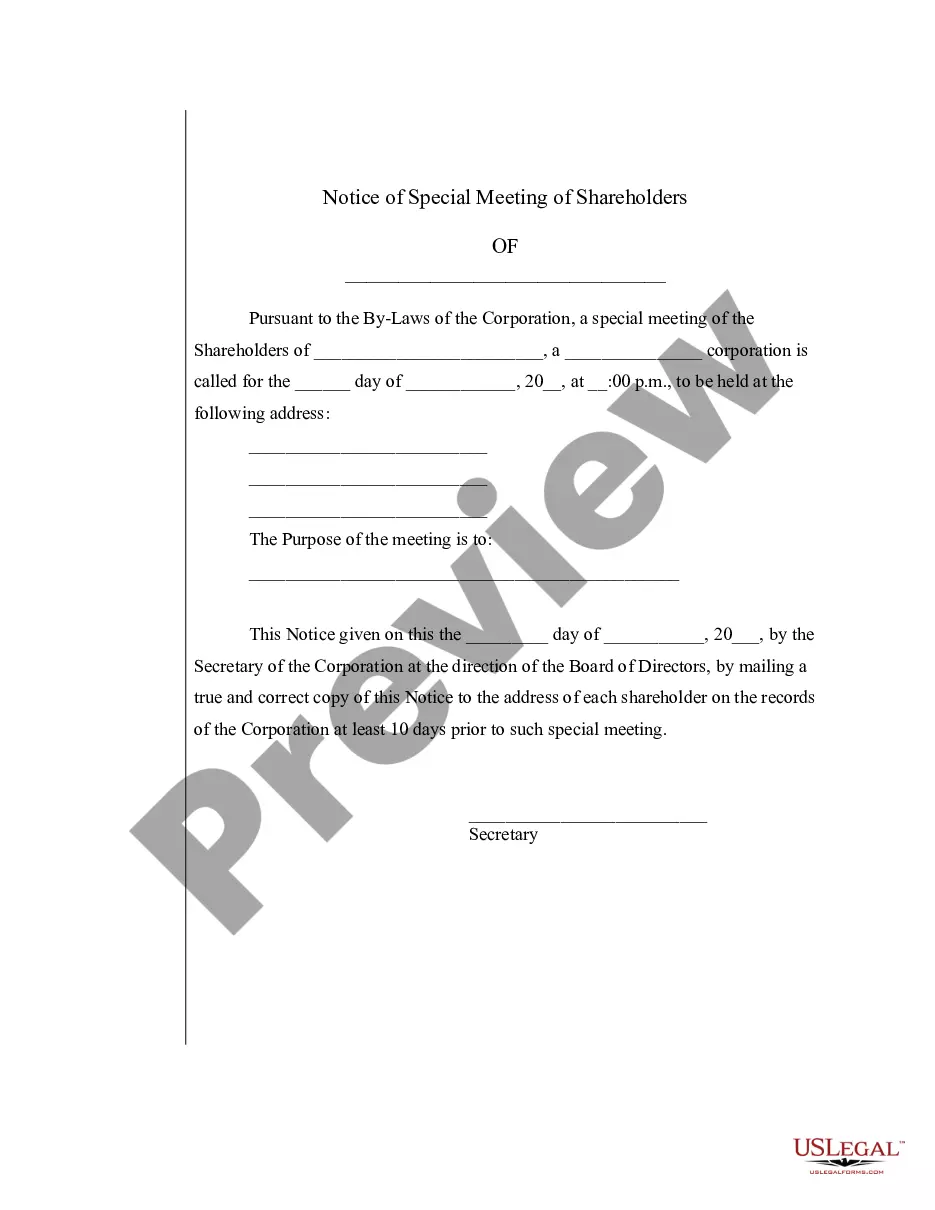
Special Meeting Sample Format In Middlesex
Description



Get your form ready online
Our built-in tools help you complete, sign, share, and store your documents in one place.
Make edits, fill in missing information, and update formatting in US Legal Forms—just like you would in MS Word.
Download a copy, print it, send it by email, or mail it via USPS—whatever works best for your next step.
Sign and collect signatures with our SignNow integration. Send to multiple recipients, set reminders, and more. Go Premium to unlock E-Sign.
If this form requires notarization, complete it online through a secure video call—no need to meet a notary in person or wait for an appointment.
We protect your documents and personal data by following strict security and privacy standards.

Make edits, fill in missing information, and update formatting in US Legal Forms—just like you would in MS Word.

Download a copy, print it, send it by email, or mail it via USPS—whatever works best for your next step.

Sign and collect signatures with our SignNow integration. Send to multiple recipients, set reminders, and more. Go Premium to unlock E-Sign.

If this form requires notarization, complete it online through a secure video call—no need to meet a notary in person or wait for an appointment.

We protect your documents and personal data by following strict security and privacy standards.
Looking for another form?








Form popularity
FAQ
A quick definition of special meeting: A special meeting is a gathering of people that is called for a specific purpose or reason. It is different from a regular meeting because it is not scheduled in advance and is only held when necessary.
Special Committee Meetings – Urgent meetings of the committee are called Special Committee Meetings and are usually called to deal with a dispute or grievance or other matters of urgency. Minutes from the committee meeting are not available to the members. General Meetings - General meetings are for all members.
For example, a company may call a special meeting to discuss a major decision, such as a merger or acquisition. A school board may call a special meeting to address a specific issue, such as a budget shortfall.
Content of Notice A proper meeting notice should include: Date, Time, and Venue: Clear details on when and where the meeting will take place. Purpose of the Meeting: A brief description of the meeting's objectives. Agenda: An outline of topics to be discussed; this helps attendees prepare for the meeting.
The EGM is convened at an irregular time to address a crisis. All matters transacted at an EGM are deemed special. For example, the removal of a top executive might constitute the agenda of an extraordinary general meeting.
Any key decisions or votes taken should be noted, along with the final resolutions. The report should also list action items, making it clear who is responsible for each task, their due dates, and any other relevant details. Providing this information ensures follow-up after the meeting.
Report Structure Cover Page: Include the report title, date, meeting name, location, attendees, and other basic info. Agenda: List the agenda items/topics covered in the same order as the meeting. Meeting Notes: Provide a summary of the discussions, decisions, and action items for each agenda item.
Essentially, they are documents that gather important aspects of a business meeting: from the agenda to the follow-up actions. For example, if you're going to conduct a meeting to discuss a new business plan with your board members, you'll need a specific meeting report to get things covered.
How to create an incident report Have all basic facts prepared. In order for an incident report to be useful, it is helpful for all facts listed in the report to be specific and accurate. Explain the sequence of events step-by-step. Analyze the incident. Describe any injuries. Proofread your work. Submit your report.
How to Write a Formal Report Check for a required format for the report. Create a title page. Write the table of contents. Write the summary or abstract. Write the introduction. Outline the methodology. Present findings. Write the conclusion and recommendations.
