Special Meeting Sample For School In Cook
Description



Get your form ready online
Our built-in tools help you complete, sign, share, and store your documents in one place.
Make edits, fill in missing information, and update formatting in US Legal Forms—just like you would in MS Word.
Download a copy, print it, send it by email, or mail it via USPS—whatever works best for your next step.
Sign and collect signatures with our SignNow integration. Send to multiple recipients, set reminders, and more. Go Premium to unlock E-Sign.
If this form requires notarization, complete it online through a secure video call—no need to meet a notary in person or wait for an appointment.
We protect your documents and personal data by following strict security and privacy standards.

Make edits, fill in missing information, and update formatting in US Legal Forms—just like you would in MS Word.

Download a copy, print it, send it by email, or mail it via USPS—whatever works best for your next step.

Sign and collect signatures with our SignNow integration. Send to multiple recipients, set reminders, and more. Go Premium to unlock E-Sign.

If this form requires notarization, complete it online through a secure video call—no need to meet a notary in person or wait for an appointment.

We protect your documents and personal data by following strict security and privacy standards.
Looking for another form?







Form popularity
FAQ
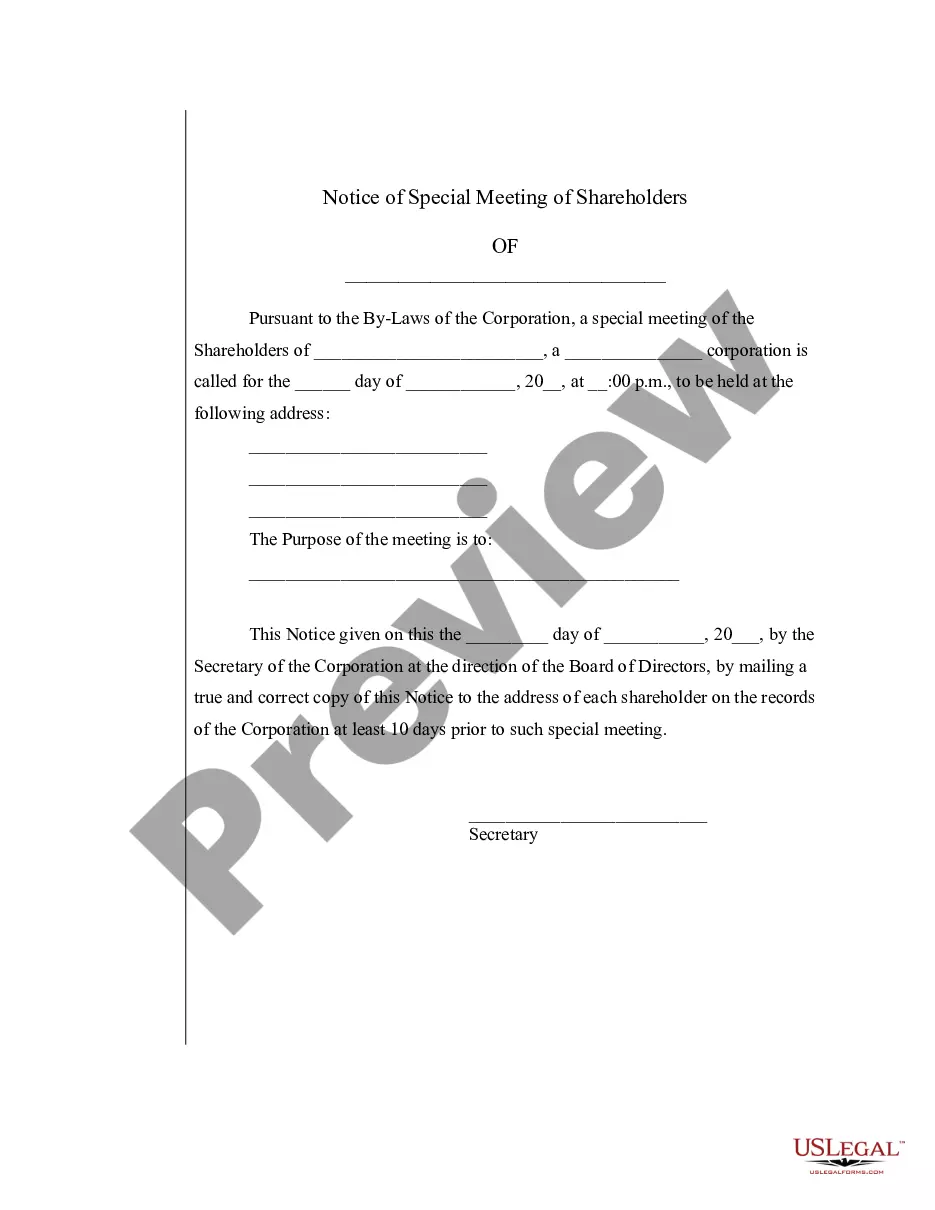
In addition to specifying the date, time and location of the meeting, special meeting notices should make note of all agenda items. Unless the bylaws indicate something different, board members should only be discussing the business that was stated in the notice for the special meeting.
Ing to Robert's Rules of Order, special meetings always require previous notice. Here are a few valid reasons for calling a special meeting: An urgent matter needs to be dealt with before the next regular meeting. There is a proposal to amend bylaws.
A quick definition of special meeting: A special meeting is a gathering of people that is called for a specific purpose or reason. It is different from a regular meeting because it is not scheduled in advance and is only held when necessary.
Unless the governing documents require a longer notice period, members must be notified of the time and place of board meetings at least four (4) days before the meeting. (Civ. Code § 4920(a).)
At their core, meeting minutes should include several key elements: Details of the Meeting: Start with the basics - the date, time, and location of the meeting, as well as the type of meeting (regular, special, annual, etc.). This sets the stage for what follows. Attendees: List everyone present and note any absences.
2.3. 1 Under the Act, the minimum period of notice for any General Meeting is 14 clear days.
How To Write Effective Meeting Minutes (with Templates and Samples) Create an outline. Check-off attendees as they join the meeting. Record decisions or notes on action items. Ask for clarification if necessary. Don't try to capture it all. Record the meeting.
Minutes should start with the attendance and continue through the motion to close the meeting (opening and closing of the meeting should have times attached.) Each topic that is discussed should have a brief paragraph summarizing what was discussed.
Include the key elements like the meeting date and place, meeting attendees, agenda items, record decisions, actions, talking points, and deadlines. Formatting is a key. Make meeting minutes visually appealing and easy to read with proper spacing, bulleted lists, summary tables, and highlighted titles and keywords.
Special board meetings may be called by the chair of the board, the president, any vice president, the secretary, or any two directors.

