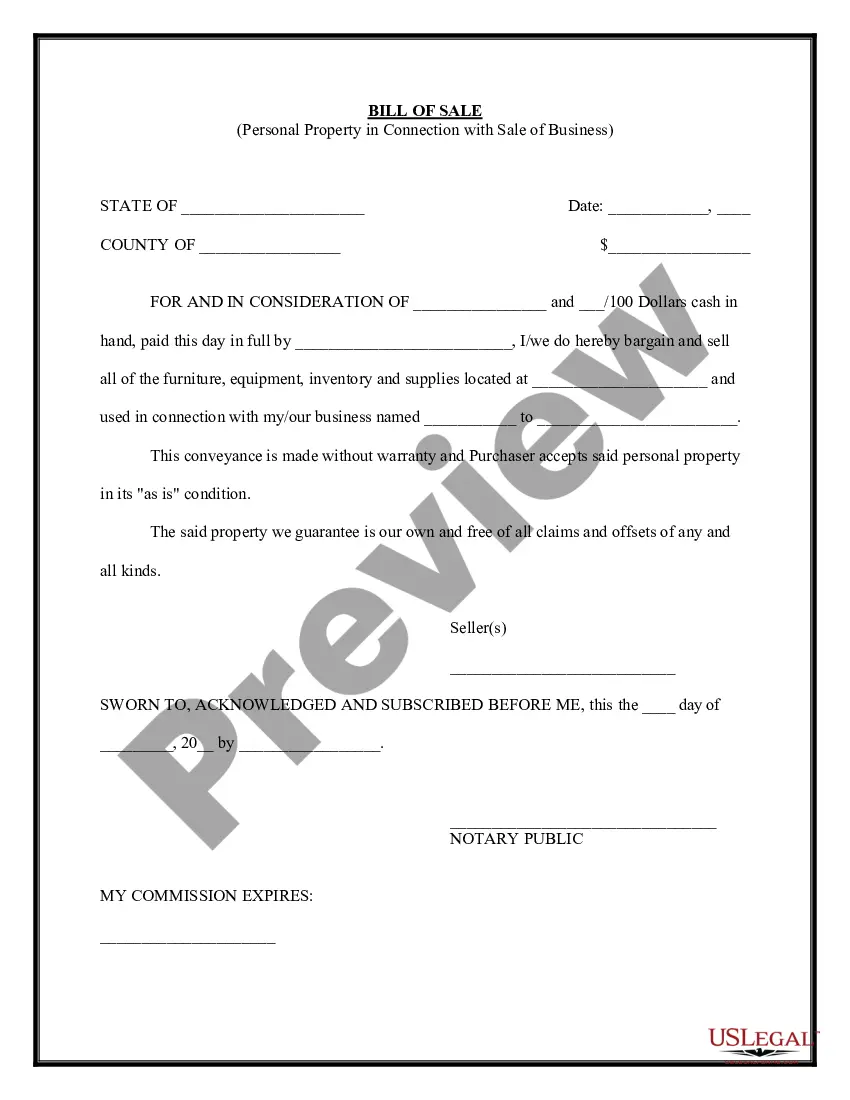
Bill Personal Property Form For Taxes In Los Angeles
Description
Get your form ready online
Our built-in tools help you complete, sign, share, and store your documents in one place.
Make edits, fill in missing information, and update formatting in US Legal Forms—just like you would in MS Word.
Download a copy, print it, send it by email, or mail it via USPS—whatever works best for your next step.
Sign and collect signatures with our SignNow integration. Send to multiple recipients, set reminders, and more. Go Premium to unlock E-Sign.
If this form requires notarization, complete it online through a secure video call—no need to meet a notary in person or wait for an appointment.
We protect your documents and personal data by following strict security and privacy standards.

Make edits, fill in missing information, and update formatting in US Legal Forms—just like you would in MS Word.

Download a copy, print it, send it by email, or mail it via USPS—whatever works best for your next step.

Sign and collect signatures with our SignNow integration. Send to multiple recipients, set reminders, and more. Go Premium to unlock E-Sign.

If this form requires notarization, complete it online through a secure video call—no need to meet a notary in person or wait for an appointment.

We protect your documents and personal data by following strict security and privacy standards.
Looking for another form?
Form popularity
FAQ
Personal property taxes are an ad-valorem (value based) property tax that is the liability of the person or entity assessed for the tax. Property that is not real property (such as land) is considered personal property and therefore is issued as an unsecured tax bill.
Certain U.S. citizens and U.S. residents who are officers, directors, or shareholders in certain foreign corporations (including specified foreign corporations (SFC) in IRC 965) are responsible for filing Form 5471, Information Return of U.S. Persons With Respect to Certain Foreign Corporations.
Business Property Statement (571-L Forms) Statements are due April 1.
Business Personal Property includes all supplies, equipment and any fixtures used in the operation of a business. Exempt from reporting are business inventory, application software and licensed vehicles (except Special Equipment (SE) tagged and off-road vehicles).
Where to Report Personal Property on Your Taxes. Claim the itemized deduction on Schedule A – State and local personal property taxes (Line 5c). Taxes you deduct elsewhere on your return — like for a home office or rental — don't qualify for this deduction.
If there are any remaining unpaid property taxes, and if you did not receive an Annual Secured Property Tax Bill from either the previous owner or the Treasurer and Tax Collector, you may request a copy by visiting ttc.lacounty/request-duplicate-bill.
Annual property tax bills are mailed every year in October to the owner of record as of January 1 of that year. If you do not receive the original bill by November 1, contact the County Tax Collector or Assessor for a duplicate bill. Note, the original bill may still have the prior owner's name on it the first year.
The county tax collector is responsible for preparing property tax bills. Bills for the regular secured assessment roll (generally real property) are mailed by November 1 and are due in two equal installments. The first installment is due November 1 and becomes delinquent December 10.
1. How do I get a copy of my property tax bill? Property tax bills are issued by the County of Los Angeles Treasurer and Tax Collector. If you did not receive or misplaced your tax bill, you can request a duplicate online at .
On the secured tax roll, the first installment is due November 1 and delinquent on December 10, and the second installment is due on February 1 and delinquent on April 10. Taxpayers have the option of paying both installments when the first installment is due. Penalties will not be waived due to not receiving a bill.