Stockholders Meeting Corporate Forum In Tarrant
Description
Get your form ready online
Our built-in tools help you complete, sign, share, and store your documents in one place.
Make edits, fill in missing information, and update formatting in US Legal Forms—just like you would in MS Word.
Download a copy, print it, send it by email, or mail it via USPS—whatever works best for your next step.
Sign and collect signatures with our SignNow integration. Send to multiple recipients, set reminders, and more. Go Premium to unlock E-Sign.
If this form requires notarization, complete it online through a secure video call—no need to meet a notary in person or wait for an appointment.
We protect your documents and personal data by following strict security and privacy standards.

Make edits, fill in missing information, and update formatting in US Legal Forms—just like you would in MS Word.

Download a copy, print it, send it by email, or mail it via USPS—whatever works best for your next step.

Sign and collect signatures with our SignNow integration. Send to multiple recipients, set reminders, and more. Go Premium to unlock E-Sign.

If this form requires notarization, complete it online through a secure video call—no need to meet a notary in person or wait for an appointment.

We protect your documents and personal data by following strict security and privacy standards.
Looking for another form?


Form popularity
FAQ
For management, the annual meeting presents an opportunity to obtain shareholder approval of matters required under state or federal law, including, most significantly, the election of directors. The primary purpose of the annual meeting is to have shareholders act on the matters presented to them for a vote.
While shareholders' meetings represent ownership, board meetings embody the company's leadership. The board of directors, acting as a bridge between management and shareholders, is responsible for making strategic decisions, overseeing management, and safeguarding the company's long-term interests.
While the shareholder is the owner of the company, the directors control the company's internal affairs and management, including the completion of various tax, regulatory and legal compliances. The same person can assume both the roles unless articles of association of the company explicitly prohibits it.
While corporate board members are present at shareholder meetings, the main voice in these settings is that of the investors. Owning company stock provides holders with equity and, depending on the type of stock they own, the right to vote during shareholder meetings.
A member of a governing body commits a crime if he or she participates in a closed meeting if they know that a certified agenda or tape recording of the closed meeting is not being made. This is a Class C misdemeanor punishable by a fine up to $500.
(c) If there is a failure to hold the annual meeting for a period of 60 days after the date designated therefor or, if no date has been designated, for a period of 15 months after the organization of the corporation or after its last annual meeting, the superior court of the proper county may summarily order a meeting ...
Directors who fail to follow the AGM requirements can be prosecuted in court, and may also face disqualification or debarment from being a director. In addition, ACRA can impose composition fines on companies that do not hold the required AGMs.
If your business is set up and registered as a Corporation, you're required by law to hold an annual shareholder meeting and to document the meeting with minutes.
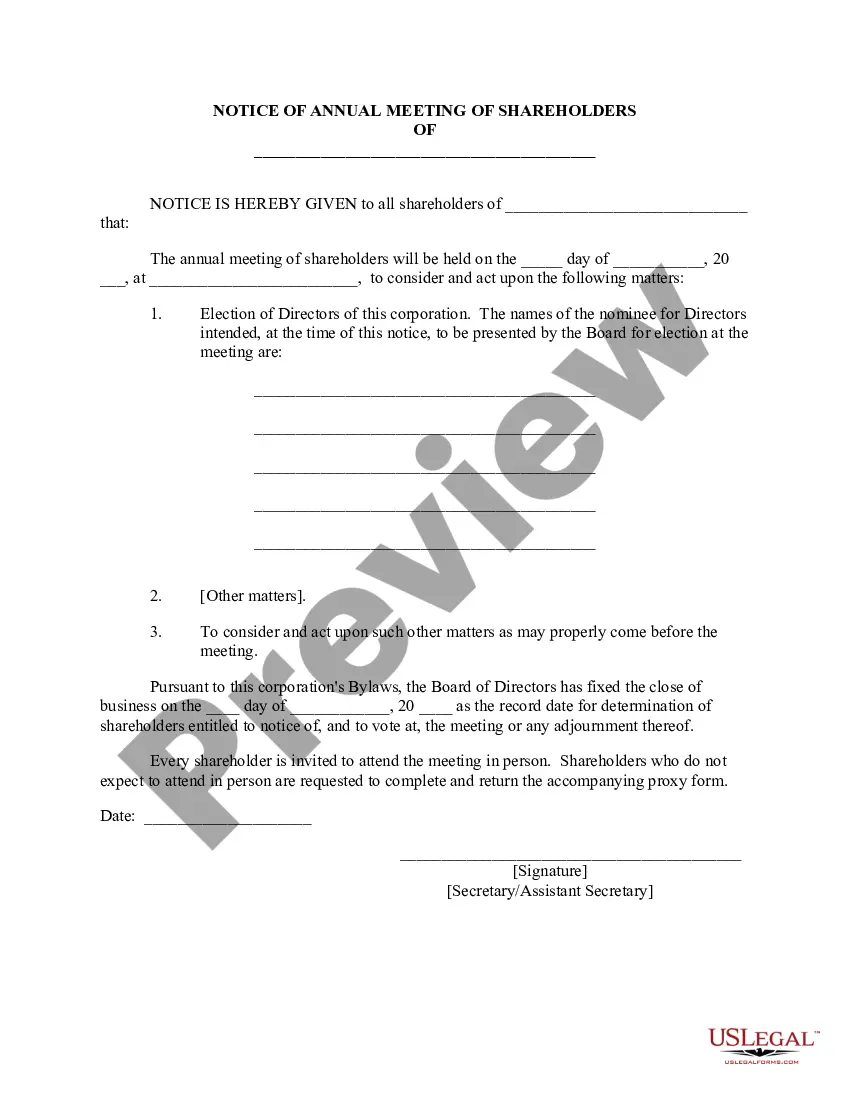
Shareholders who cannot attend the meeting in person are encouraged to vote by proxy, which can be done online or by filling out and mailing a form.
A limited liability company, or LLC, is a business entity that is formed under state law that combines characteristics of a corporation and a partnership. They are similar to corporations in that an LLC's members are not liable for the debts of the business, provided that certain formalities are observed.