First Stockholders Meeting With Ceo In Minnesota
Description


Get your form ready online
Our built-in tools help you complete, sign, share, and store your documents in one place.
Make edits, fill in missing information, and update formatting in US Legal Forms—just like you would in MS Word.
Download a copy, print it, send it by email, or mail it via USPS—whatever works best for your next step.
Sign and collect signatures with our SignNow integration. Send to multiple recipients, set reminders, and more. Go Premium to unlock E-Sign.
If this form requires notarization, complete it online through a secure video call—no need to meet a notary in person or wait for an appointment.
We protect your documents and personal data by following strict security and privacy standards.

Make edits, fill in missing information, and update formatting in US Legal Forms—just like you would in MS Word.

Download a copy, print it, send it by email, or mail it via USPS—whatever works best for your next step.

Sign and collect signatures with our SignNow integration. Send to multiple recipients, set reminders, and more. Go Premium to unlock E-Sign.

If this form requires notarization, complete it online through a secure video call—no need to meet a notary in person or wait for an appointment.

We protect your documents and personal data by following strict security and privacy standards.
Looking for another form?





Form popularity
FAQ
The owners of a company are its shareholders, who are some of its most important stakeholders. A company organizes a general meeting of shareholders to debate and resolve important business matters.
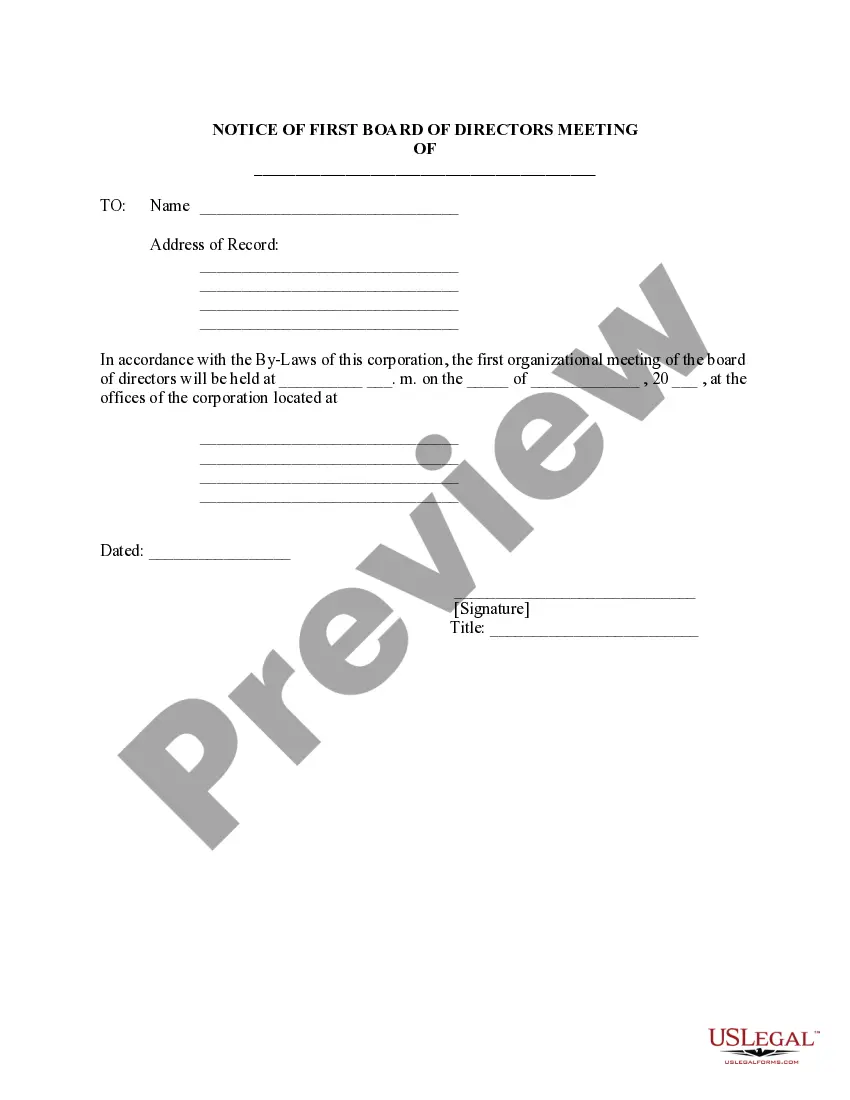
The first shareholder meeting is an organizational meeting where shareholders ratify and approve the actions of the incorporators. Shareholders also approve shares values, appoint directors and officers if needed, and wrap up other initial tasks.
Shareholders must be given clear advance notice of the meeting's date, time, place, and agenda, typically within a state-specified timeframe. A corporation's bylaws or certificate of incorporation may allow the board, executives, or qualifying shareholders to call a special meeting.
What should board of directors first meeting minutes include? Your corporation's first directors meeting typically focuses on initial organizational tasks, including electing officers, setting their salaries, resolving to open a bank account, and ratifying bylaws and actions of the incorporators.
While shareholders' meetings represent ownership, board meetings embody the company's leadership. The board of directors, acting as a bridge between management and shareholders, is responsible for making strategic decisions, overseeing management, and safeguarding the company's long-term interests.
The first AGM of the company, i.e. a newly incorporated company, should be held within nine months from the closing of the first financial year. Hence, the company doesn't need to hold an AGM in the year of its incorporation.
Notification of the meeting's date and time will include a copy of the meeting's agenda, which is often centered around the election of members to the board of directors, approval of an accounting firm to review the company's financial records, and an opportunity to vote on any proposals that are put before the board, ...
There are two main types of shareholders' resolution: 'ordinary' and 'special'. An ordinary resolution is passed by a simple majority of members, while a special resolution requires not less than 75% of the total voting rights of eligible members.
First shareholder resolutions This document allows the shareholders to appoint the directors of the corporation to oversee the corporation's management. It also confirms that the shareholders approve of the general rules set out in the organizational documents.
In shareholders' meetings, this means aligning the agenda with shareholder rights and interests. In board meetings, the agenda should focus on strategic and oversight matters.

