First S/a
Description
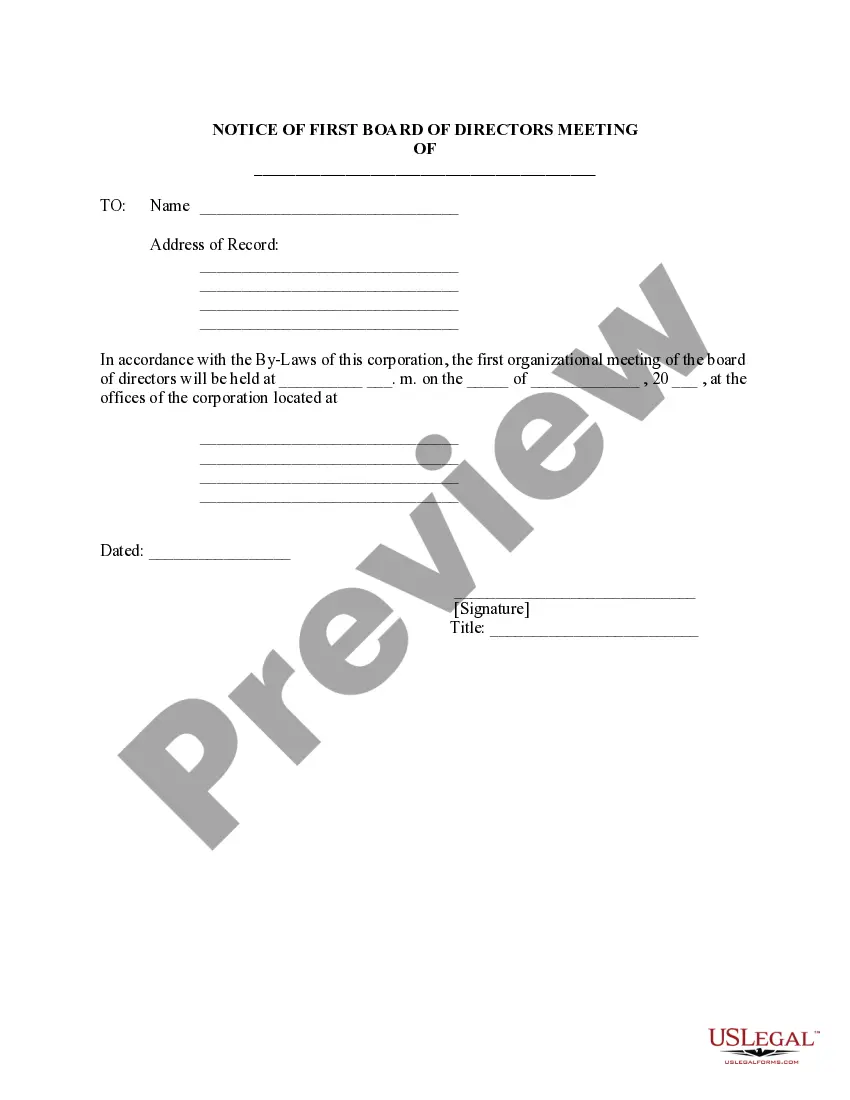


How to fill out Notice Of First Stockholders Meeting - Corporate Resolutions?
- For existing users, simply log in to your account and confirm your subscription's validity. If your subscription has lapsed, renew it according to your plan.
- If you're new to US Legal Forms, start by previewing the relevant form descriptions. Ensure the selected form meets your legal requirements and aligns with your local jurisdiction.
- If you need to switch templates, utilize the search tab to find a more suitable form. Verify it's appropriate for your needs before proceeding.
- To purchase a document, click the Buy Now button and choose the subscription plan that fits your needs. Create an account to access the entire library.
- Complete your payment using a credit card or PayPal account for your subscription.
- Download the form to your device. You can access it anytime through the My Forms section of your profile.
By following these steps, you’ll benefit from US Legal Forms’ extensive collection, offering more options than competitors, ensuring you find just what you need.
Ready to simplify your legal documentation? Explore US Legal Forms today and experience a hassle-free process!
Form popularity
FAQ
The .FA format is another file extension for FASTA sequences that serves the same purpose as the .fasta format. It contains nucleotide or protein sequences preceded by header lines for easy identification. By using the first s/a format when saving your sequences in a .FA file, you can ensure accessibility in various bioinformatics applications. This extension is widely recognized and utilized in genetic analysis.
To put something in FASTA format, follow these simple steps: create a header line that begins with '>', followed by a description. Below this line, enter your sequence, and if applicable, keep each line under 80 characters. This practice aligns with the first s/a and ensures that your sequences are structured for compatibility with research tools and software.
To convert a text file to FASTA format, you must first organize the text into sequence data. Start by adding a header line with a '>' symbol, followed by a unique identifier. Next, format the sequence data below the header, ensuring it complies with the first s/a structure for clarity. This organized approach makes your sequences easy to use with various bioinformatics applications.
The FASTA format comprises a header line followed by the actual sequence data. The header starts with a '>' symbol and includes an identifier that describes the sequence. Subsequent lines contain the sequence itself, which may include nucleotides or amino acids. The first s/a ensures your FASTA files are well-formed and accessible for further analysis and use.
FNA format is similar to FASTA but specifically used for DNA sequences. It contains nucleotide sequences in a plain text file, allowing for easy sharing and analysis in genomic projects. By following the first s/a structure, researchers can maintain consistency across their dataset. This format is essential for applications that require straightforward reference to genomic DNA.
Writing in FASTA format begins with a simple structure: a header line, followed by the sequence data. Ensure the header starts with a '>' followed by an identifier. Next, continue onto the sequence, entering your data line by line, ideally keeping each line within 80 characters. Utilizing the first s/a standards ensures your sequences are compatible with many bioinformatics tools.
To write a FASTA sequence, start with a header line that begins with a greater-than symbol followed by a description. Underneath this header, enter the sequence itself, which can be DNA, RNA, or protein. Make sure the sequence lines are no longer than 80 characters for better readability. Using the first s/a format helps ensure that your sequences are easy to interpret and share.
The A3M format is a multiple sequence alignment file format that provides a way to represent DNA or protein sequences aligned together. Utilizing the first s/a as a reference point, it stores aligned sequences in a way that shows gaps and conservation patterns. By using A3M, researchers can easily analyze evolutionary relationships and functional regions among sequences. This format is particularly useful in bioinformatics where alignment accuracy is crucial.
Yes, you can set up an S-Corp by yourself. You need to choose a unique business name, file the necessary paperwork with your state, and elect S Corporation status with the IRS. However, using a service like uslegalforms can simplify your First s/a process and help ensure accuracy.
While it is possible to set up an S Corp on your own, an accountant can be invaluable. They provide expert guidance to ensure compliance and help you avoid common pitfalls. Consider platforms like uslegalforms, which can also assist you in setting up your First s/a seamlessly.
