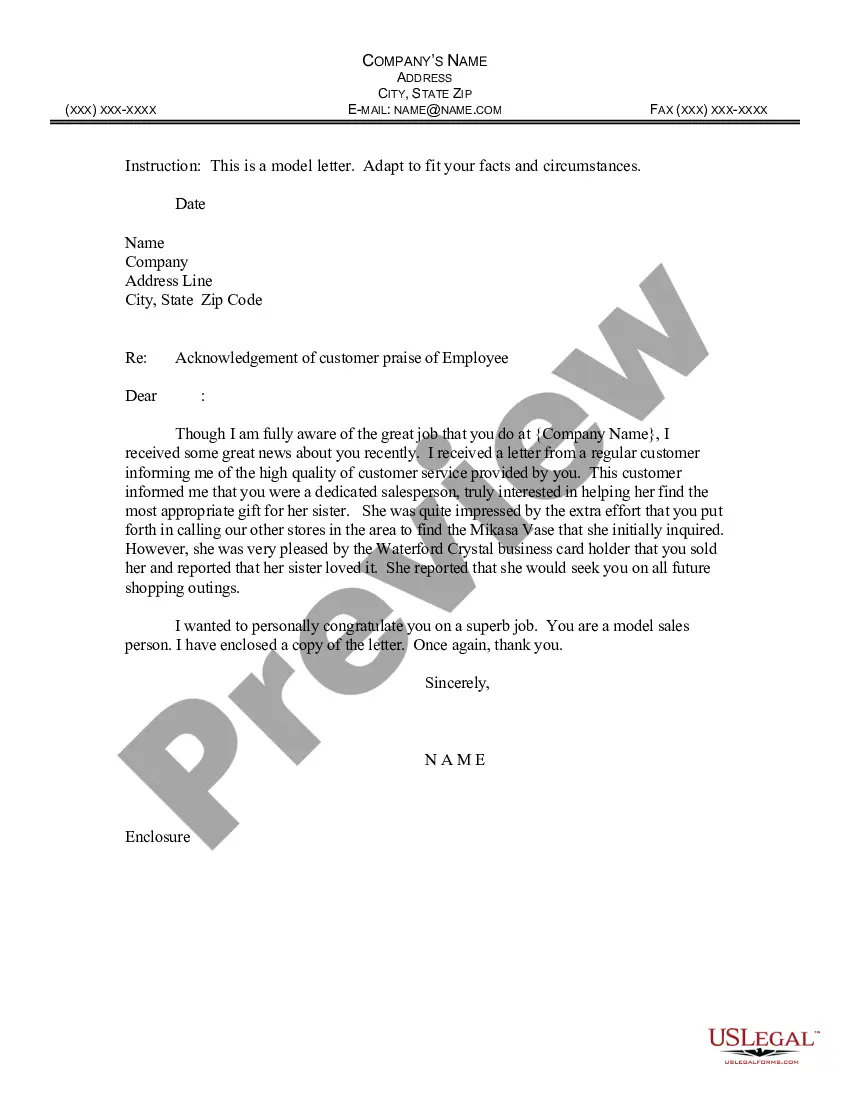
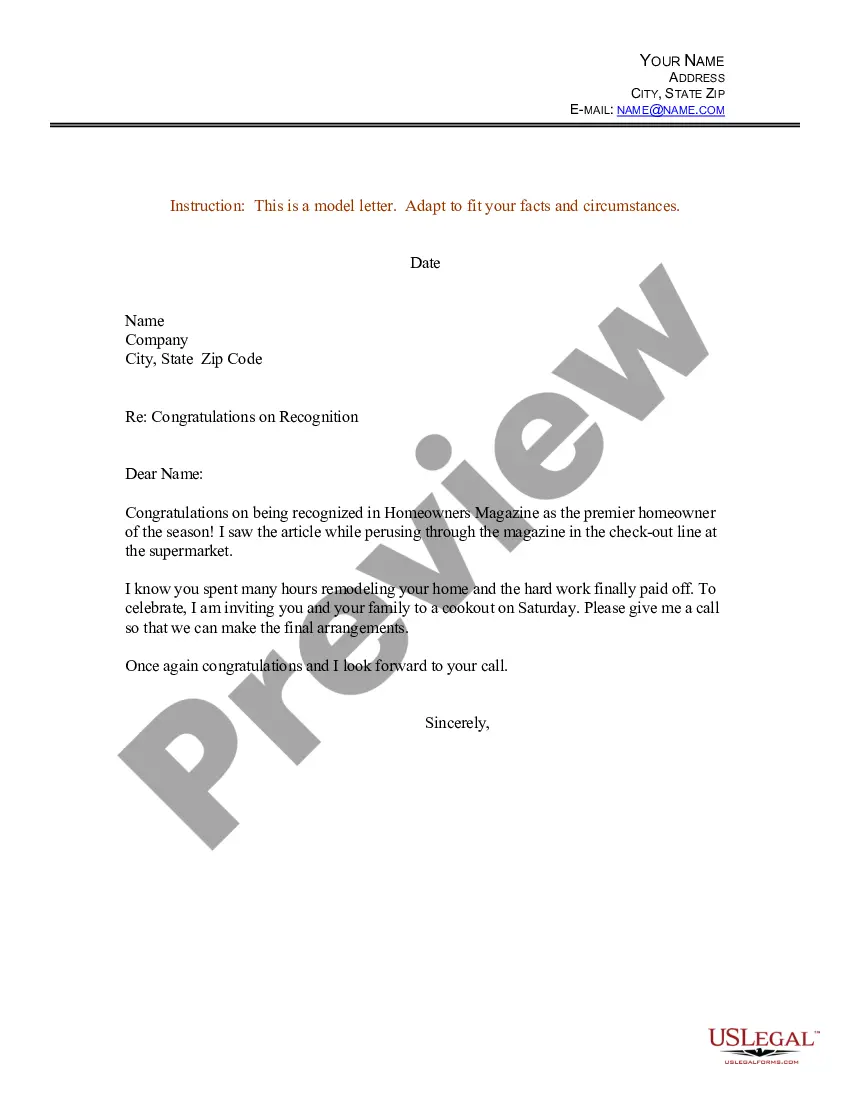
Employee Praise Letter Without Name In Texas
Description

Get your form ready online
Our built-in tools help you complete, sign, share, and store your documents in one place.
Make edits, fill in missing information, and update formatting in US Legal Forms—just like you would in MS Word.
Download a copy, print it, send it by email, or mail it via USPS—whatever works best for your next step.
Sign and collect signatures with our SignNow integration. Send to multiple recipients, set reminders, and more. Go Premium to unlock E-Sign.
If this form requires notarization, complete it online through a secure video call—no need to meet a notary in person or wait for an appointment.
We protect your documents and personal data by following strict security and privacy standards.

Make edits, fill in missing information, and update formatting in US Legal Forms—just like you would in MS Word.

Download a copy, print it, send it by email, or mail it via USPS—whatever works best for your next step.

Sign and collect signatures with our SignNow integration. Send to multiple recipients, set reminders, and more. Go Premium to unlock E-Sign.

If this form requires notarization, complete it online through a secure video call—no need to meet a notary in person or wait for an appointment.

We protect your documents and personal data by following strict security and privacy standards.
Looking for another form?









Form popularity
FAQ
If you cannot find the name and title of the recipient, you can use a generic salutation instead. A generic salutation is a general way of addressing a person or a group of people, such as "Dear Sir or Madam", "To Whom It May Concern", or "Dear Hiring Manager".
How to write a letter of recognition in 9 steps Choose the appropriate format. Personalize the message. Determine why you're writing the letter. Recognize specific achievements. Use active voice and positive vocabulary. Express your sincere appreciation. Share others' recognition. Choose the right time to deliver.
If you can't find the name of the person to address your cover letter to, here are a few options you can consider: Use a Generic Greeting: ``Dear Hiring Manager,'' or ``Dear (Company Name) Team,'' are widely accepted and professional.
Here are some examples of ways you can address your cover letter generally: Dear Hiring Manager. Dear Hiring Staff. To the Hiring Manager. Dear Hiring Team. Dear Hiring Committee. Dear Recruiting Team. To the Recruiting Team.
Keep it professional. In that case, instead of addressing the letter to an individual, you can address the letter to the job title of the reader. For example, “Dear Hiring Manager of Company.” If you can't narrow down a job title, there's always “To whom it may concern.”
If your cover letter isn't directed to anyone specific, start with a generic greeting such as "Dear Hiring Manager" or "Dear Hiring Team." Alternatively, you can begin with a brief introduction that focuses on your interest in the position and your qualifications.
Here are some examples of ways you can address your cover letter generally: Dear Hiring Manager. Dear Hiring Staff. To the Hiring Manager. Dear Hiring Team. Dear Hiring Committee. Dear Recruiting Team. To the Recruiting Team.
Don't Stress Too Much. If you have the relevant skills and experience for a job, addressing a cover letter to the wrong person might not be a big deal. So, if you can't find the hiring manager's name and wondering how to address a cover letter without a name, just write “Dear Hiring Manager.”
? Here are some key messages leaders can use to show their recognition to their workforce: “I want to express my sincere appreciation for your hard work. Your efforts haven't gone unnoticed and were acknowledged at our last leadership meeting!” “X told me it was your idea to suggest an improvement of our processes.
Here are nine key tips for writing an employee recognition letter: Choose the appropriate format. Personalize the message. Determine why you're writing the letter. Recognize specific achievements. Use active voice and positive vocabulary. Express your sincere appreciation. Share others' recognition.