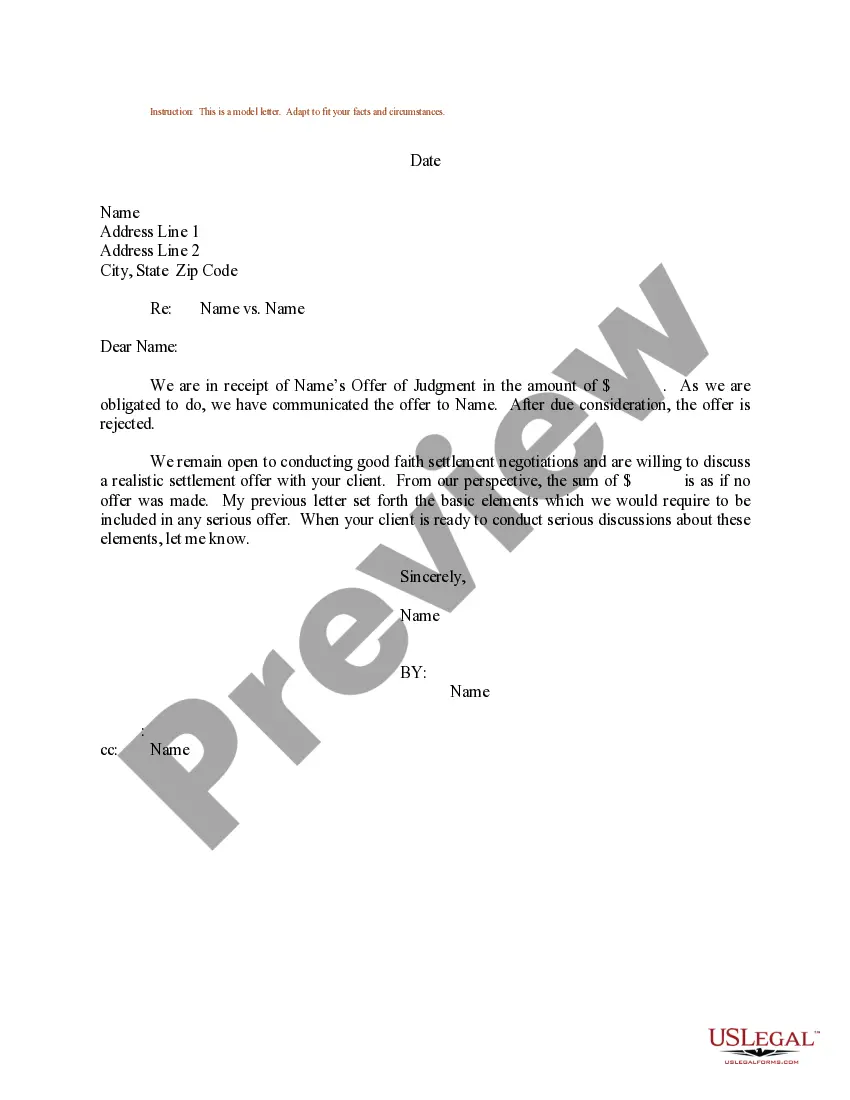
Settlement Offer Rejection Letter Sample For Collection Agency In Chicago
Description


Get your form ready online
Our built-in tools help you complete, sign, share, and store your documents in one place.
Make edits, fill in missing information, and update formatting in US Legal Forms—just like you would in MS Word.
Download a copy, print it, send it by email, or mail it via USPS—whatever works best for your next step.
Sign and collect signatures with our SignNow integration. Send to multiple recipients, set reminders, and more. Go Premium to unlock E-Sign.
If this form requires notarization, complete it online through a secure video call—no need to meet a notary in person or wait for an appointment.
We protect your documents and personal data by following strict security and privacy standards.

Make edits, fill in missing information, and update formatting in US Legal Forms—just like you would in MS Word.

Download a copy, print it, send it by email, or mail it via USPS—whatever works best for your next step.

Sign and collect signatures with our SignNow integration. Send to multiple recipients, set reminders, and more. Go Premium to unlock E-Sign.

If this form requires notarization, complete it online through a secure video call—no need to meet a notary in person or wait for an appointment.

We protect your documents and personal data by following strict security and privacy standards.
Looking for another form?






Form popularity
FAQ
Possible Legal Action: If negotiations don't yield a satisfactory offer, a lawsuit may become necessary, requiring additional time and resources. Risk of Lower Final Settlement: In some cases, litigation may lead to a settlement lower than the initial offer, depending on the court's decision.
Rather, ask why the adjuster has provided this extremely low figure. You should then write a formal letter of response in which you state that you don't find the initial low settlement offer acceptable, listing the reasons why and concluding with a demand for a higher settlement offer.
Tips for Writing Counter Offer Emails Clearly state your counter offer without beating around the bush. This shows respect for the recipient's time. Justify Your Request: Provide solid reasons for your counter offer. Whether it's market research, your experience, or the value you bring, back up your request with facts.
Within the letter, you can indicate that you reject the offer and highlight why you deserve a higher settlement amount. You should also counter their reasons for offering the lowball initial offer. Your explanation behind these reasons can be critical in getting a better second offer from the claims adjuster.
name of claims adjuster, I received your letter dated date of written settlement offer. I have reviewed your letter very carefully, including your settlement offer. Unfortunately, I cannot accept your offer for the reasons discussed below.
How Should I Respond to a Low Settlement Offer? Try to remain calm and examine the offer. After receiving a low settlement offer, the most important thing to do is to stay calm. Provide a formal, written response. Formulate your counteroffer. Settle after you've recovered.
It should be clear that you are not accepting the insurer's initial settlement offer. You will want to address the insurance company's position on why it made its offer. Address each of the insurer's points individually to explain why you disagree with its findings. Be as neutral and matter-of-fact as possible.

