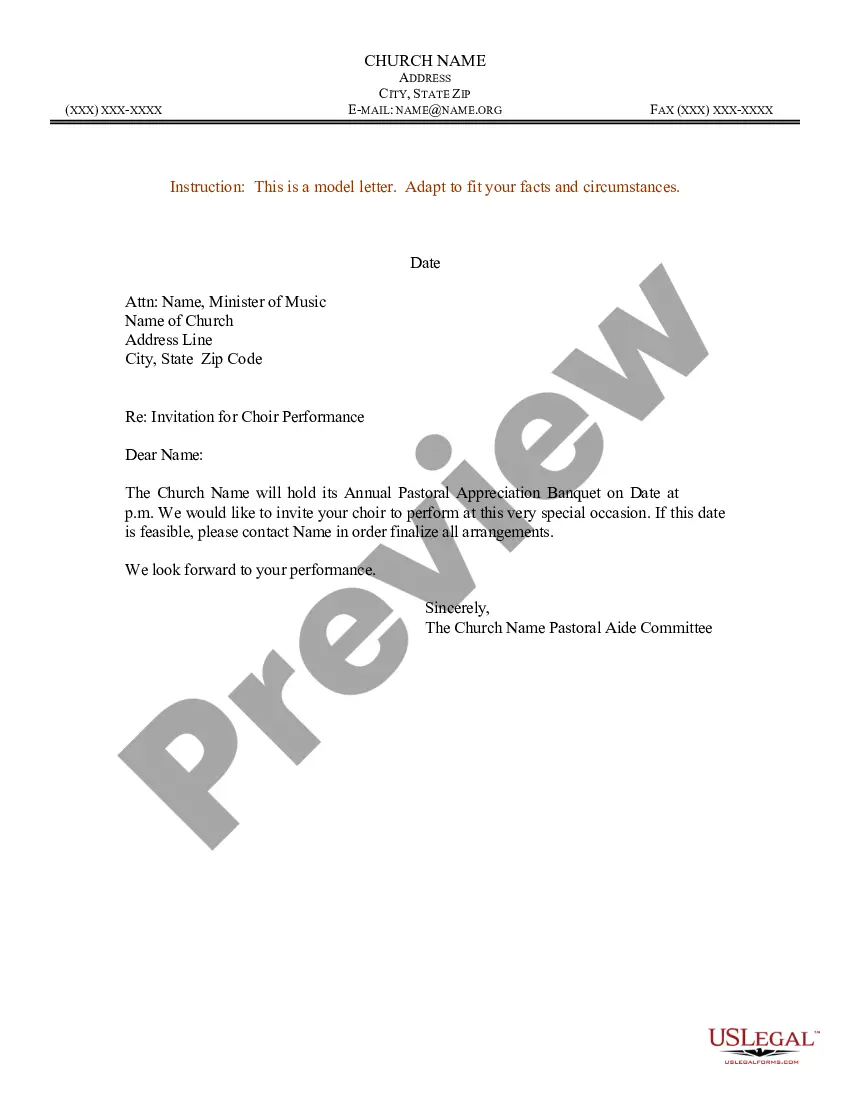
Sample Church Choir Invitation Letter With Music In Santa Clara
Description
Get your form ready online
Our built-in tools help you complete, sign, share, and store your documents in one place.
Make edits, fill in missing information, and update formatting in US Legal Forms—just like you would in MS Word.
Download a copy, print it, send it by email, or mail it via USPS—whatever works best for your next step.
Sign and collect signatures with our SignNow integration. Send to multiple recipients, set reminders, and more. Go Premium to unlock E-Sign.
If this form requires notarization, complete it online through a secure video call—no need to meet a notary in person or wait for an appointment.
We protect your documents and personal data by following strict security and privacy standards.

Make edits, fill in missing information, and update formatting in US Legal Forms—just like you would in MS Word.

Download a copy, print it, send it by email, or mail it via USPS—whatever works best for your next step.

Sign and collect signatures with our SignNow integration. Send to multiple recipients, set reminders, and more. Go Premium to unlock E-Sign.

If this form requires notarization, complete it online through a secure video call—no need to meet a notary in person or wait for an appointment.

We protect your documents and personal data by following strict security and privacy standards.
Looking for another form?

Form popularity
FAQ
If you are placing people based on how solidly they can sing their part, you would put stronger singers in the back and adjacent to other sections. You'd put weaker singers towards the center or front of their section, because then it is easier for them to follow the rest of the group.
How are choristers arranged ing to their voices in a choir? The sopranos are placed at the front, at the right end of the choir. The altos are placed in the middle of the choir's chorus, right next to the sopranos. Tenors are placed in the center of the choir, between altos and basses.
Start with a warm greeting and introduction. Thank the recipient for their involvement in the church and let them know you're writing to invite them to an upcoming event. Clearly state the name, date, time, and location of the event. Provide enough details so the recipient has all the key information.
In the body, explain why you're interested in joining the choir, any previous experience you might have, and how you could contribute to the choir. Finish with your contact details. Here's an example: Dear Choir Leader, I am writing to express my interest in joining the Church Choir.
Sectional formation is a widely used approach that organizes singers ing to their vocal parts, creating distinct groups for sopranos, altos, tenors, and basses.
On behalf of the leadership here at (name of church), I wanted to take this opportunity to invite you and your Choir to join with us for 2 nights of praise and worship on Friday, October 28th, from to PM, and then on Sunday, October 30th beginning at PM in the afternoon.
A common way to arrange voices is to use the four-part SATB system, where S stands for soprano, A for alto, T for tenor, and B for bass. This system allows you to create a balanced and harmonious sound, as each part covers a different range of pitches.
Using Proper Salutations and Closings Begin your letter with a formal greeting such as “Dear Church Members”. End your letter with a blessing or prayer, such as “May God Bless You” or “In Christ's Love”.
Reach Out: Contact the choir director or music ministry leader to express your interest in joining the choir. You can usually find their contact information on the church's website. Ask About Auditions: Some choirs may require an audition, while others may have open membership.