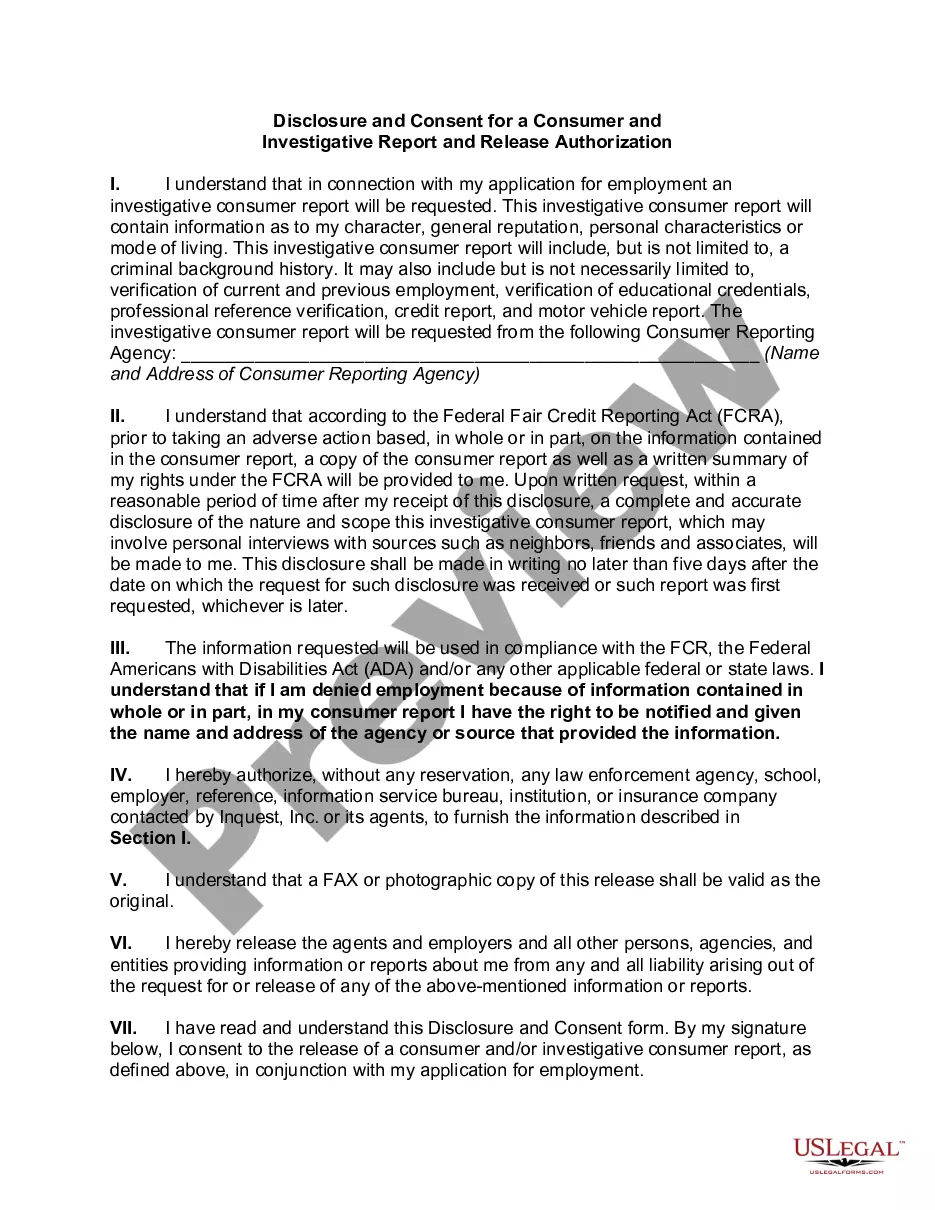
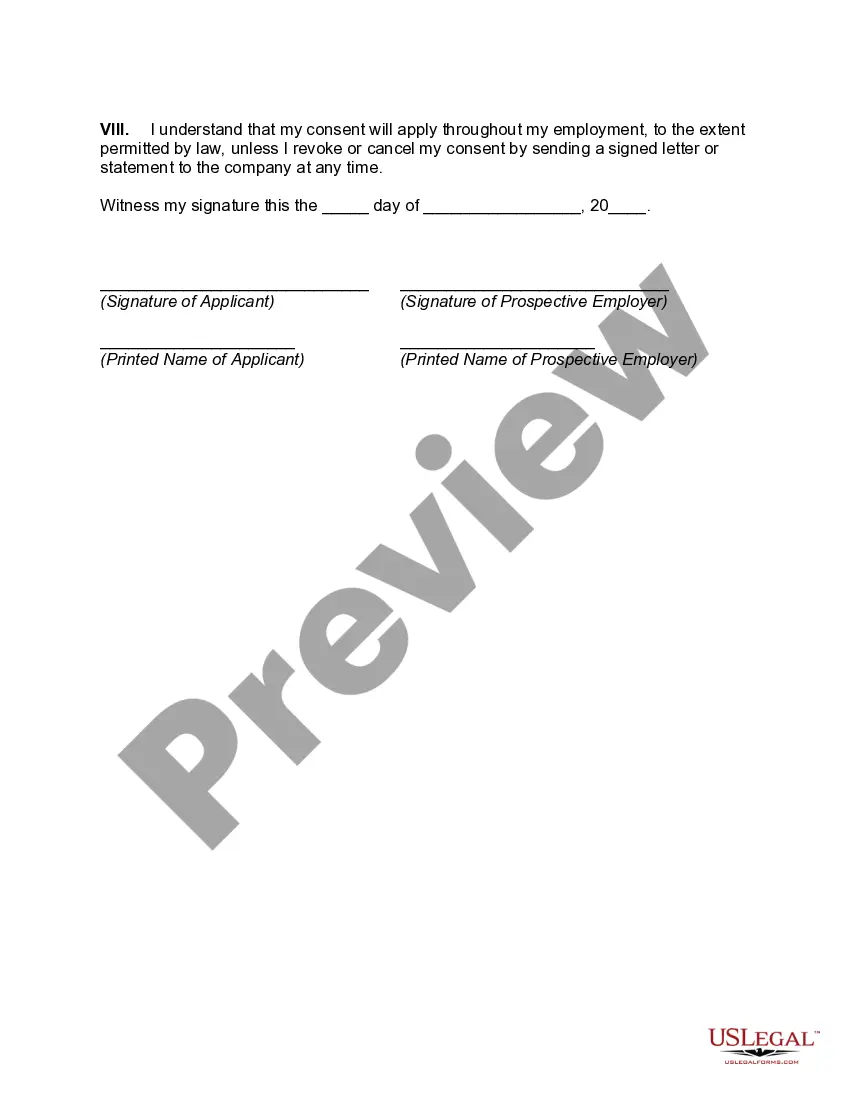
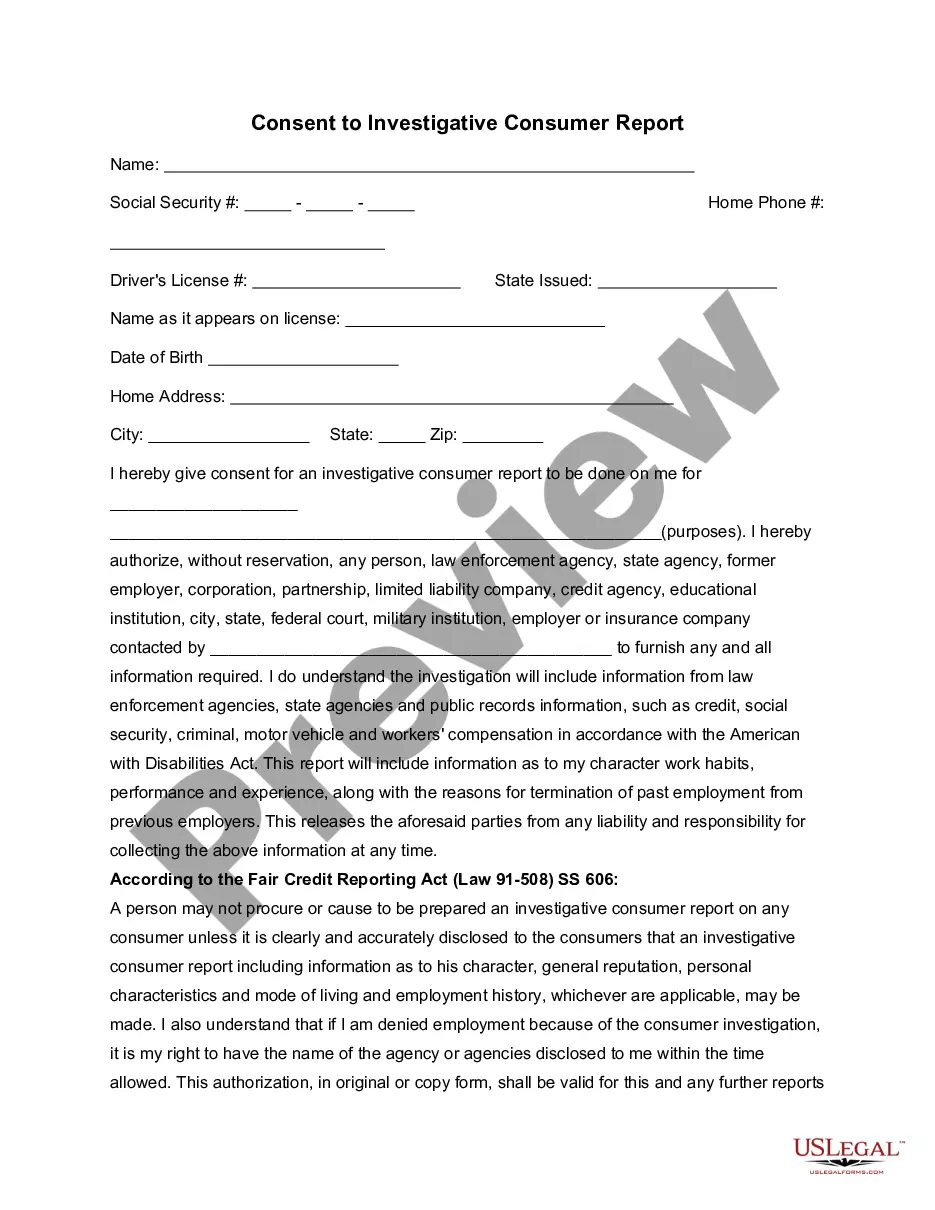
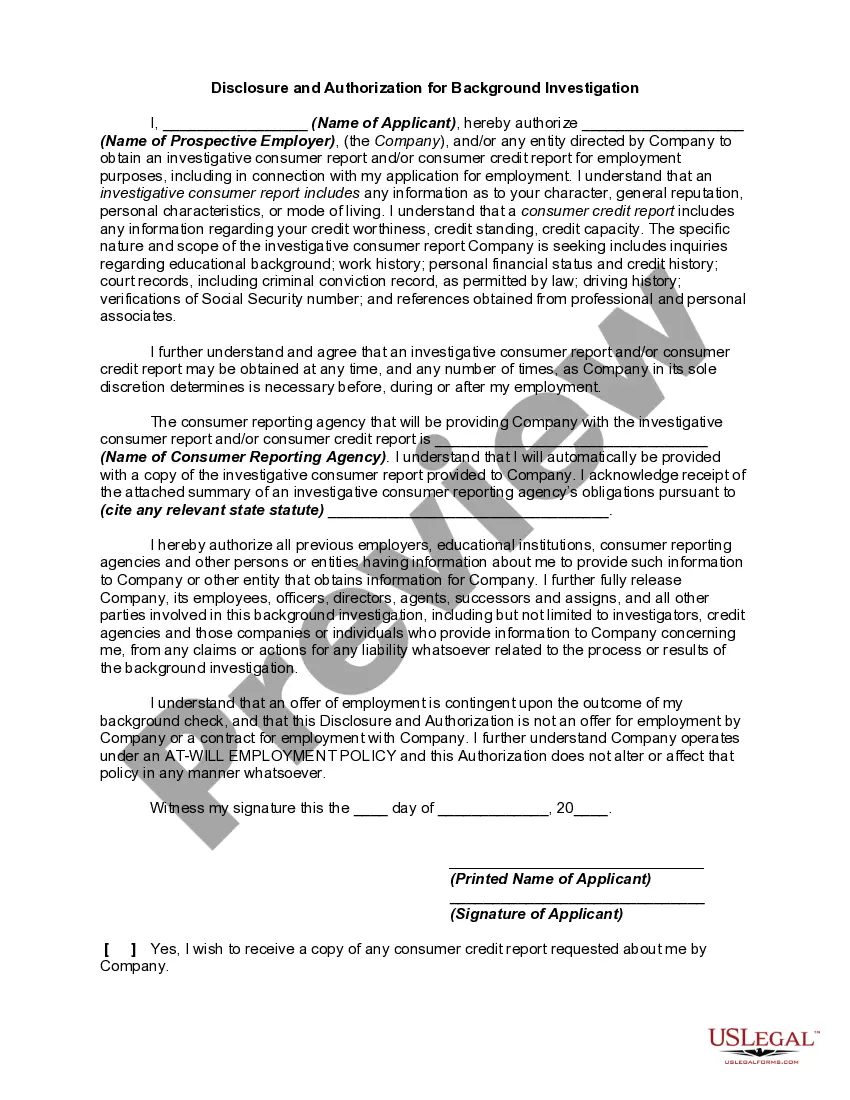
Consent Consumer Investigative For Employment In Florida
Description
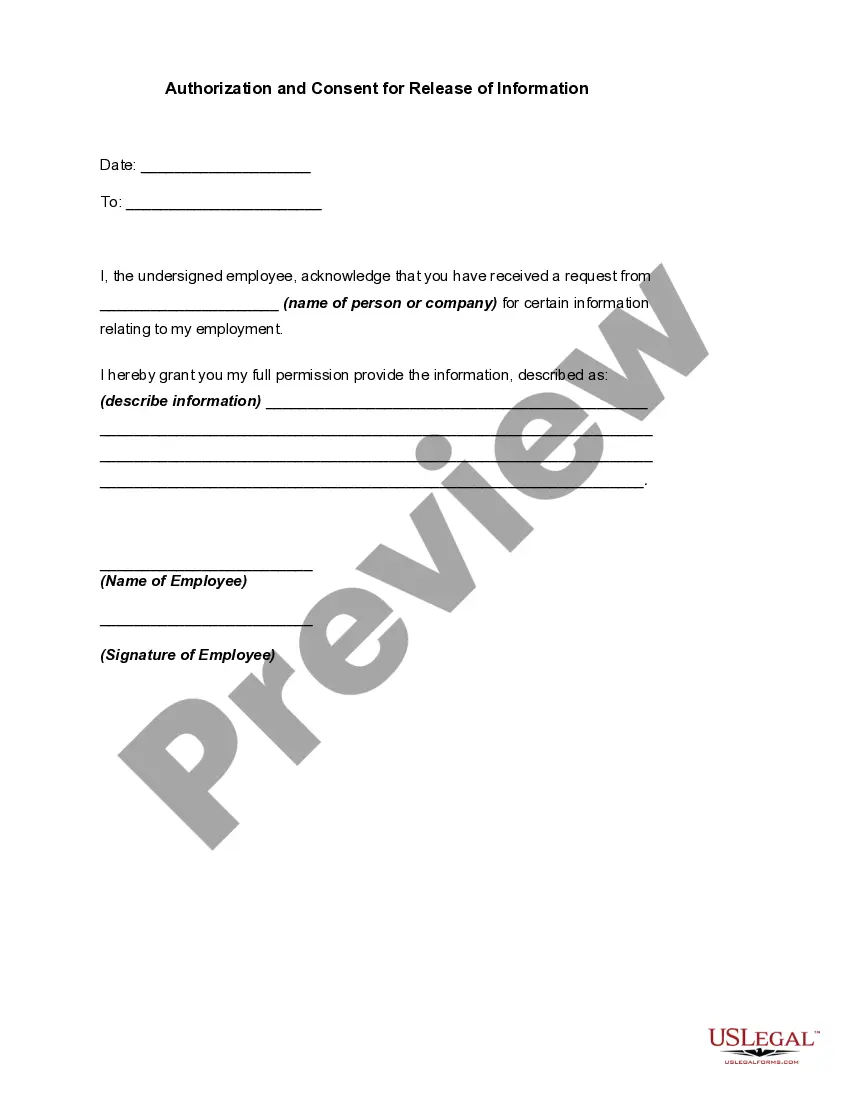
Get your form ready online
Our built-in tools help you complete, sign, share, and store your documents in one place.
Make edits, fill in missing information, and update formatting in US Legal Forms—just like you would in MS Word.
Download a copy, print it, send it by email, or mail it via USPS—whatever works best for your next step.
Sign and collect signatures with our SignNow integration. Send to multiple recipients, set reminders, and more. Go Premium to unlock E-Sign.
If this form requires notarization, complete it online through a secure video call—no need to meet a notary in person or wait for an appointment.
We protect your documents and personal data by following strict security and privacy standards.

Make edits, fill in missing information, and update formatting in US Legal Forms—just like you would in MS Word.

Download a copy, print it, send it by email, or mail it via USPS—whatever works best for your next step.

Sign and collect signatures with our SignNow integration. Send to multiple recipients, set reminders, and more. Go Premium to unlock E-Sign.

If this form requires notarization, complete it online through a secure video call—no need to meet a notary in person or wait for an appointment.

We protect your documents and personal data by following strict security and privacy standards.
Looking for another form?










Form popularity
FAQ
If you suspect the background check has been unable to verify dates of employment for a certain employer, contact the background check company and ask what you can do to facilitate the process. They may ask for additional information, ask you to contact the employer directly, or request copies of your W-2s.
You must: Tell the applicant or employee that you might use information in their consumer report for decisions related to their employment. Get written permission from the applicant or employee. Certify compliance to the company from which you are getting the applicant or employee's information.
Background checks and consumer reports are the same. The reason is that background checks are considered consumer reports under the Fair Credit Reporting Act (FCRA). Simply put, the term “Consumer report” is just another, less common way to refer to a background check.
Unable-to-verify rate is the percentage of verifications a background check company is unable to complete. This situation can occur because the employer went out of business, the candidate does not have adequate documentation or there is no third-party record of the information.
The denied individual may choose to pursue a challenge and/or apply to the Voluntary Appeal File. A “Delayed” message means the FBI needs to do additional research to verify the person's background. Our staff works closely with federal, state, local, and tribal law enforcement agencies and courts to verify eligibility.
Employers who fail to respond to federal employment-verification requests can suffer fines and denial of government contracts for up to one year. Failure to complete an employment-verification request from another third party can dilute trust with current and former employees alike.
Section 1681a of the Fair Credit Reporting Act defines an “investigative consumer report” as “a consumer report or portion thereof in which information on a consumer's character, general reputation, personal characteristics, or mode of living is obtained through personal interviews with neighbors, friends, or ...
Some of the implications of failing a background check include: Loss of job opportunity: Failure to pass a background check can result in the loss of a job opportunity. Companies may withdraw a job offer if a candidate fails the background check, as this may suggest that the candidate is unsuitable for the position.
Consumer Reports' product ratings are unique in that they combine product performance, measured through expert lab testing, with predicted reliability and owner satisfaction data gathered through surveys of product owners.
The Fair Credit Reporting Act (FCRA) only allows consumer reporting agencies (CRAs) to report civil suits, civil judgments, arrest records, and other adverse information that predates the report by seven years or fewer — with the clock starting as soon as the information is filed or entered into the record.
