Annual Meeting Date Rules In Palm Beach
Description




Get your form ready online
Our built-in tools help you complete, sign, share, and store your documents in one place.
Make edits, fill in missing information, and update formatting in US Legal Forms—just like you would in MS Word.
Download a copy, print it, send it by email, or mail it via USPS—whatever works best for your next step.
Sign and collect signatures with our SignNow integration. Send to multiple recipients, set reminders, and more. Go Premium to unlock E-Sign.
If this form requires notarization, complete it online through a secure video call—no need to meet a notary in person or wait for an appointment.
We protect your documents and personal data by following strict security and privacy standards.

Make edits, fill in missing information, and update formatting in US Legal Forms—just like you would in MS Word.

Download a copy, print it, send it by email, or mail it via USPS—whatever works best for your next step.

Sign and collect signatures with our SignNow integration. Send to multiple recipients, set reminders, and more. Go Premium to unlock E-Sign.

If this form requires notarization, complete it online through a secure video call—no need to meet a notary in person or wait for an appointment.

We protect your documents and personal data by following strict security and privacy standards.
Looking for another form?








Form popularity
FAQ
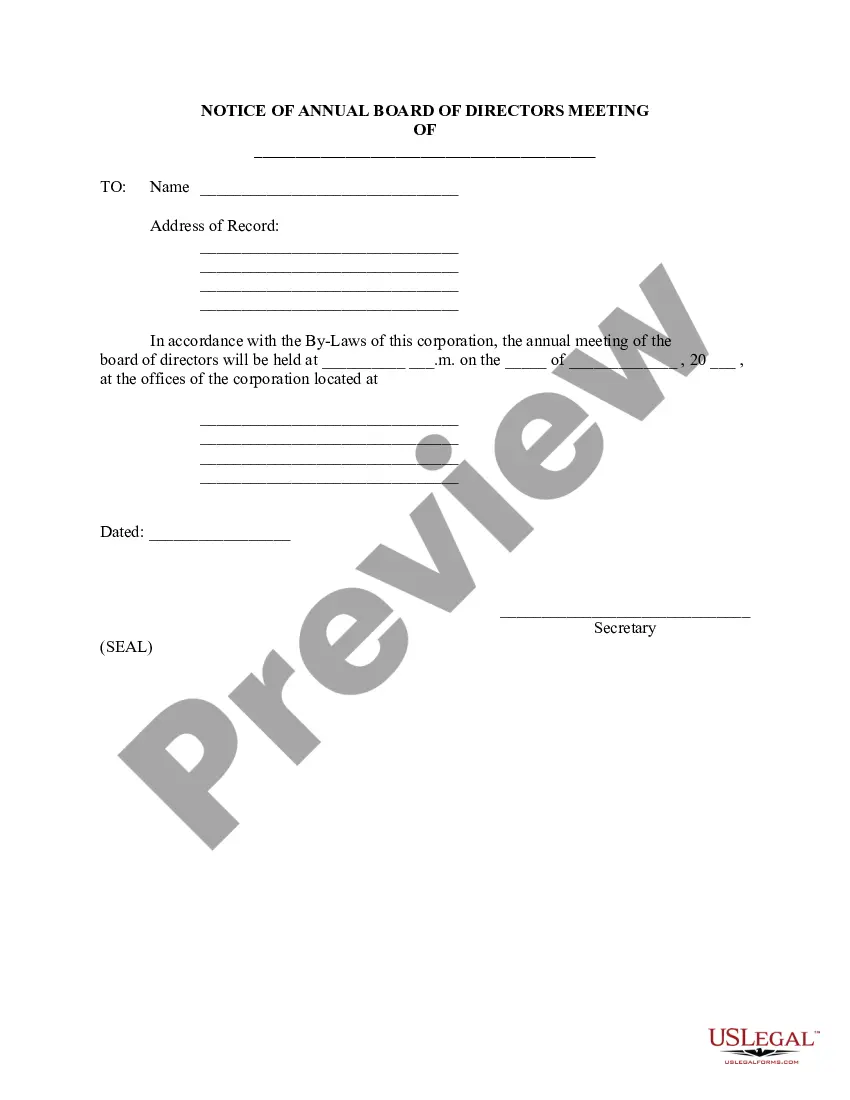
Written notice of an annual meeting must include an agenda; be mailed, hand delivered, or electronically transmitted to each unit owner at least 14 days before the annual meeting; and be posted in a conspicuous place on the condominium property or association property at least 14 continuous days before the annual ...
Brown Act is a “public access law” that ensures the public's right to attend the meetings of public agencies, facilitates public participation in all phases of local government decision-making, and curbs misuse of the democratic process by secret legislation.
Adequate notice of all board meetings, which must specifically identify all agenda items, must be posted conspicuously on the condominium property at least 48 continuous hours before the meeting except in an emergency.
The three basic requirements of the Sunshine Law are: (1) meetings of public boards or commissions must be open to the public; (2) reasonable notice of such meetings must be given; and (3) minutes of the meetings must be taken. WHAT AGENCIES ARE COVERED BY THE SUNSHINE LAW?
The Sunshine law requires that 1) meetings of boards or commissions must be open to the public; 2) reasonable notice of such meetings must be given, and 3) minutes of the meeting must be taken.
Meetings must: Be noticed in advance; Include only business described in the agenda; Take place within agency boundaries; Be completely accessible by the public. Notice and agenda for regular meeting must be: Posted 72 hours in advance; Posted in an accessible location; Mailed to persons who request notice.
Notice when the annual meeting is happening must be given at least 14 days before the meeting by mail delivery or electronic transmission.
Chapter 720 of the Florida Statutes governs homeowners' associations (HOAs) in Florida. Unlike condominiums or cooperatives, homeowners' associations typically govern single-family homes in a specific development or community.
Notices of all board meetings must specifically identify agenda items for the meetings and must be posted in a conspicuous place in the community at least 48 hours in advance of a meeting, except in an emergency.
Giving 24 to 48 hours' advance notice of scheduled employee meetings is sufficient to ensure you avoid unemployment compensation liability in the event employees choose to ignore attendance requirements.