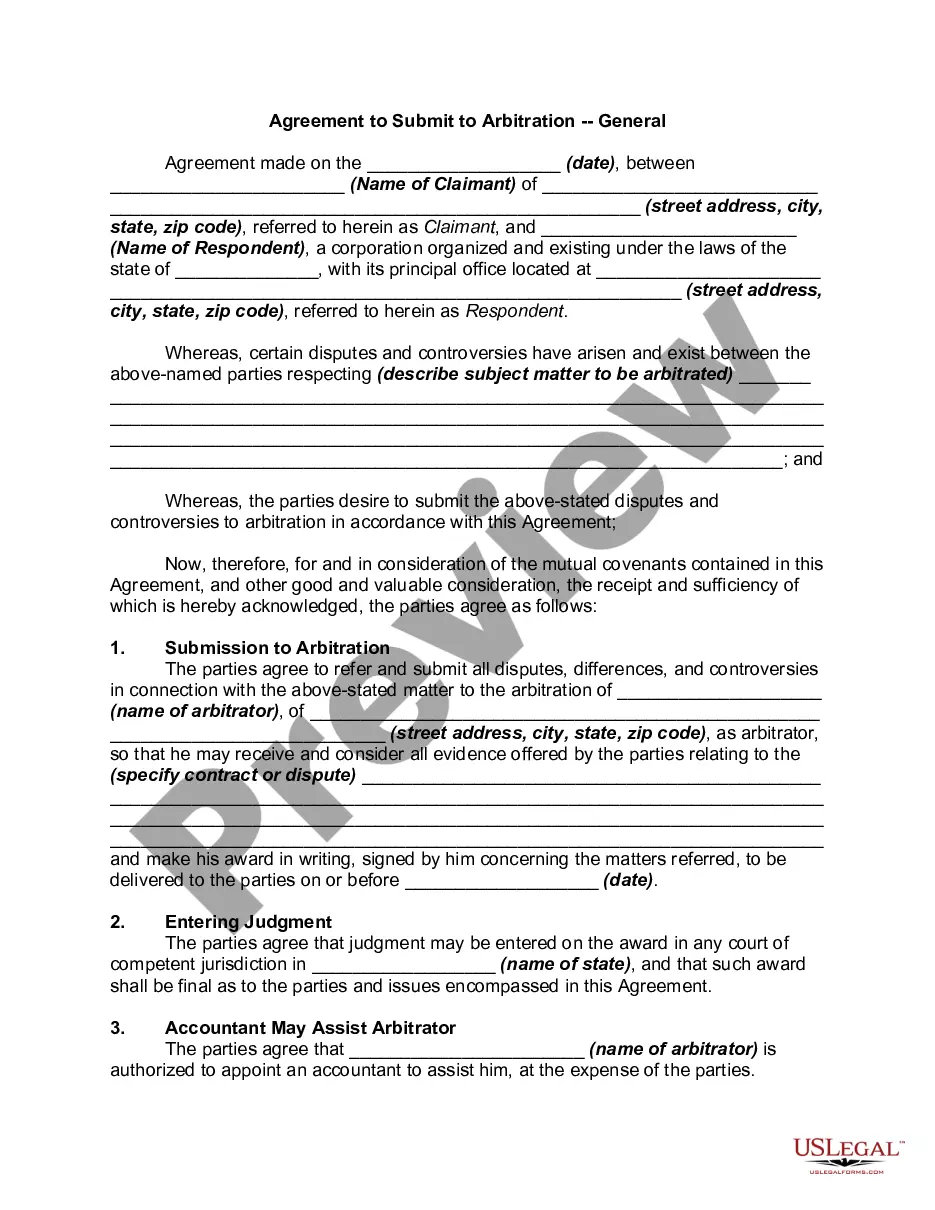
Arbitration Case Statement With Multiple Conditions In Bronx
Description



Get your form ready online
Our built-in tools help you complete, sign, share, and store your documents in one place.
Make edits, fill in missing information, and update formatting in US Legal Forms—just like you would in MS Word.
Download a copy, print it, send it by email, or mail it via USPS—whatever works best for your next step.
Sign and collect signatures with our SignNow integration. Send to multiple recipients, set reminders, and more. Go Premium to unlock E-Sign.
If this form requires notarization, complete it online through a secure video call—no need to meet a notary in person or wait for an appointment.
We protect your documents and personal data by following strict security and privacy standards.

Make edits, fill in missing information, and update formatting in US Legal Forms—just like you would in MS Word.

Download a copy, print it, send it by email, or mail it via USPS—whatever works best for your next step.

Sign and collect signatures with our SignNow integration. Send to multiple recipients, set reminders, and more. Go Premium to unlock E-Sign.

If this form requires notarization, complete it online through a secure video call—no need to meet a notary in person or wait for an appointment.

We protect your documents and personal data by following strict security and privacy standards.
Looking for another form?




Form popularity
FAQ
I have not performed exhaustive research on this, but at least three states have passed laws that expressly apply the statute of limitations to arbitration proceedings. These states are: New York (N.Y. C.P.L.R. § 7502), Georgia (Ga. Code Ann.
Now, let's talk about why signing these agreements might not be in your best interest. When you sign an arbitration agreement, you're effectively waiving your right to a trial by jury. This is a big deal because, in a courtroom, you have a judge, a jury of your peers, and a public record of proceedings.
Essentially, litigation means taking a dispute to court. Both sides present their case before a judge or jury, who will then render a decision. Arbitration, on the other hand, is a private process in which both parties agree that an arbitrator (a neutral third party) will render a binding decision.
Arbitration is a form of alternative dispute resolution (ADR) that offers parties involved in a legal dispute an alternative to traditional courtroom litigation. Unlike litigation, where disputes are resolved in court, arbitration takes place in a private setting, typically chosen by the parties involved.
Arbitration is another route to settlement, but unlike the two options discussed above, where resolution is voluntary, it is typically binding. Arbitration is a private court. Like mediation, the parties must voluntarily agree to enter into arbitration; you cannot be forced into arbitration.
At the conclusion of the arbitration hearing the arbitrator will issue an award in favor one party, which will be binding, unless one of the parties requests a trial de novo.
If your case involves factors like privacy concerns, the need for a quicker resolution, or the desire to avoid a public jury trial, arbitration might be an ideal solution. However, if you're worried about the finality of the arbitrator's decision or the potential for bias, you might prefer the traditional court route.
Some contracts give you the right to opt out of the forced arbitration clause within a certain period of time, often 30 to 60 days, after signing the agreement by notifying the company that you wish to opt out. Check your contract for the deadline and for specific instructions for opting out.
Some contracts give you the right to opt out of the forced arbitration clause within a certain period of time, often 30 to 60 days, after signing the agreement by notifying the company that you wish to opt out. Check your contract for the deadline and for specific instructions for opting out.
I have not performed exhaustive research on this, but at least three states have passed laws that expressly apply the statute of limitations to arbitration proceedings. These states are: New York (N.Y. C.P.L.R. § 7502), Georgia (Ga. Code Ann.