Contract Law With Good Faith In Allegheny
Description



Get your form ready online
Our built-in tools help you complete, sign, share, and store your documents in one place.
Make edits, fill in missing information, and update formatting in US Legal Forms—just like you would in MS Word.
Download a copy, print it, send it by email, or mail it via USPS—whatever works best for your next step.
Sign and collect signatures with our SignNow integration. Send to multiple recipients, set reminders, and more. Go Premium to unlock E-Sign.
If this form requires notarization, complete it online through a secure video call—no need to meet a notary in person or wait for an appointment.
We protect your documents and personal data by following strict security and privacy standards.

Make edits, fill in missing information, and update formatting in US Legal Forms—just like you would in MS Word.

Download a copy, print it, send it by email, or mail it via USPS—whatever works best for your next step.

Sign and collect signatures with our SignNow integration. Send to multiple recipients, set reminders, and more. Go Premium to unlock E-Sign.

If this form requires notarization, complete it online through a secure video call—no need to meet a notary in person or wait for an appointment.

We protect your documents and personal data by following strict security and privacy standards.
Looking for another form?

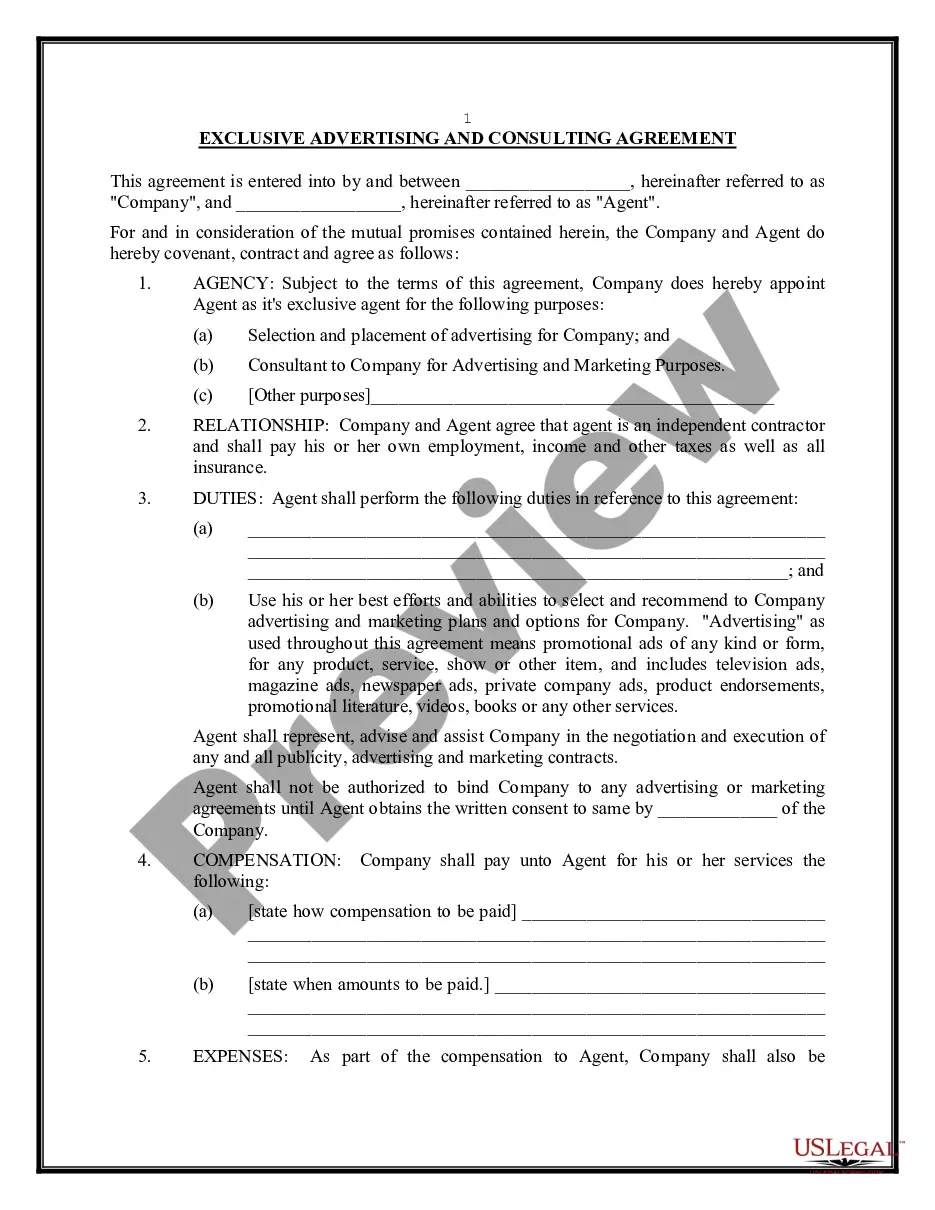




Form popularity
FAQ
The basic elements required for the agreement to be a legally enforceable contract are: mutual assent, expressed by a valid offer and acceptance; adequate consideration; capacity; and legality. In some states, elements of consideration can be satisfied by a valid substitute.
Implied covenant of good faith and fair dealing (often simplified to good faith) is a rule used by most courts in the United States that requires every party in a contract to implement the agreement as intended, not using means to undercut the purpose of the transaction.
A contract requires several legal requirements to be valid and enforceable: Consideration: The parties must exchange something of value. Without such an exchange, there is no agreement. Offer and Acceptance: One party must make an offer, and the other must accept it.
Parties cannot rely on the strict terms of a contract to justify dishonest conduct – the duty of honest performance imposes an obligation to act honestly and in good faith when performing contractual obligations, even if the terms of the contract allow for termination or other actions.
The principle of good faith has guided all contractual relationships in Canada since 2014. At a bare minimum, it imposes a duty not to lie in the performance of the contract itself and an obligation to exercise any contractual discretion reasonably.
Under common law, good faith requires parties to an agreement to exercise their powers reasonably and not arbitrarily or for some irrelevant purpose. Certain conduct may lack good faith if one party acts dishonestly or fails to have regard to the legitimate interests of the other party.
Implied covenant of good faith and fair dealing (often simplified to good faith) is a rule used by most courts in the United States that requires every party in a contract to implement the agreement as intended, not using means to undercut the purpose of the transaction.
The 'good faith' duties promote loyalty or fidelity to the contractual relationship, primarily by requiring honesty and cooperation in contract performance and by precluding the exercise of discretionary contractual powers in a manner that is unreasonable or outside the proper purposes of the power.
In Krull, the Court held that a good-faith exception to the exclusionary rule permits the introduction of evidence obtained by an officer in reliance upon a statute, even where that statute is thereafter determined to be unconstitutional.
1. The bona fide (good faith) principle is a key component of most historic and modern legal orders, 1 and a “general principle of international law”. The principle requires parties “to deal honestly and fairly with each other (…) and to refrain from taking unfair advantage”. 2.
