Laws About Contracts In California
Description












Get your form ready online
Our built-in tools help you complete, sign, share, and store your documents in one place.
Make edits, fill in missing information, and update formatting in US Legal Forms—just like you would in MS Word.
Download a copy, print it, send it by email, or mail it via USPS—whatever works best for your next step.
Sign and collect signatures with our SignNow integration. Send to multiple recipients, set reminders, and more. Go Premium to unlock E-Sign.
If this form requires notarization, complete it online through a secure video call—no need to meet a notary in person or wait for an appointment.
We protect your documents and personal data by following strict security and privacy standards.
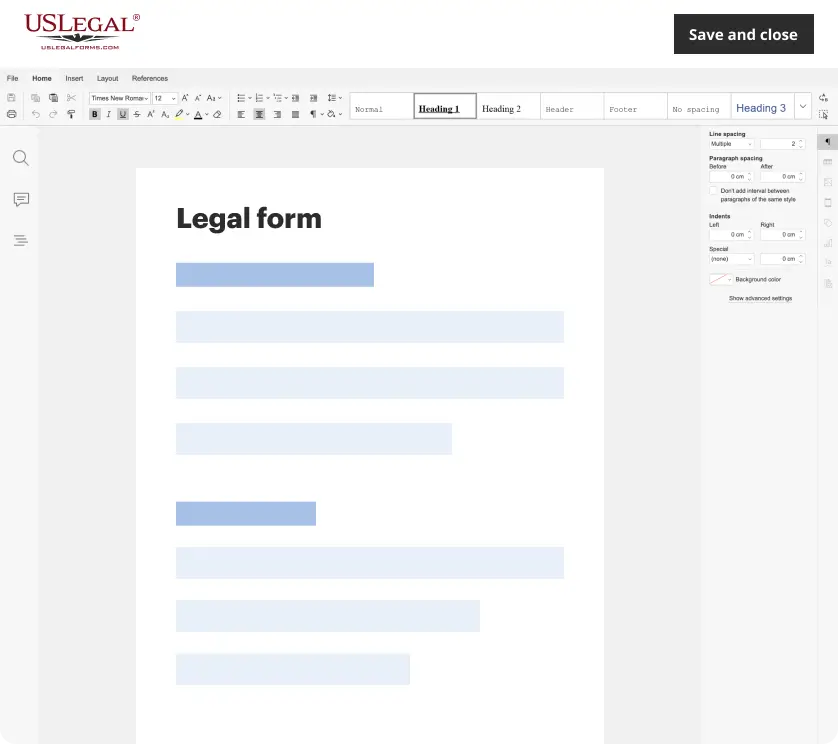
Make edits, fill in missing information, and update formatting in US Legal Forms—just like you would in MS Word.
Download a copy, print it, send it by email, or mail it via USPS—whatever works best for your next step.
Sign and collect signatures with our SignNow integration. Send to multiple recipients, set reminders, and more. Go Premium to unlock E-Sign.
If this form requires notarization, complete it online through a secure video call—no need to meet a notary in person or wait for an appointment.
We protect your documents and personal data by following strict security and privacy standards.
Looking for another form?










Form popularity
FAQ
Additionally, there are eight specific criteria a court will use to determine whether or not a contract is unenforceable: lack of capacity, coercion, undue influence, misrepresentation and nondisclosure, unconscionability, and public policy, mistake, and impossibility.
The following are common defenses to contract enforcement: one of the parties lacked the capacity to contract. one of the parties was under duress when they agreed to the contract. one of the parties exerted undue influence over the other party.
For a contract to be valid and enforceable in California, all parties must enter into the agreement voluntarily. If one of the contracting parties can prove that they entered into the contract under duress, coercion, or undue influence, the court may cancel or revoke the contract.
Coercion, threats, false statements or improper persuasion by one party to a contract can void the contract.
Mistake One: Failure to Put the Agreement in Writing. Mistake Two: Incomplete or Vague Contract Terms. Mistake Three: Ignoring or Misunderstanding Contractual Obligations. Mistake Four: Failing to Include or Understand Legal Provisions. Mistake Five: Failing to Seek Legal Help.
7 Essential Elements of A Contract Offer. For there to be a contract, there must first be an offer by one party and an acceptance by the other. Acceptance. Acceptance is the agreement to the specific conditions of an offer. Consideration. Intention to create legal relations. Authority and capacity. Certainty.
Someone subject to a direct threat cannot legally agree to a binding contract. Similarly, intense coercion can also affect the enforceability of a contract. Finally, intentional fraud on the part of one party could lead to an unenforceable contract due to their misrepresentation of the circumstances.
How? Generally, to be legally valid, most contracts must contain two elements: All parties must agree about an offer made by one party and accepted by the other. Something of value must be exchanged for something else of value.
There are four essential elements of forming a contract: offer, acceptance, consideration, and intention to create legal relations.
REQUIREMENTS FOR A CONTRACT In order for a contract to be valid, there must be an offer, an acceptance of the offer, an exchange between the parties of something of value, and an agreement to the terms.
