Law Us Legal Format In Georgia
Description



Get your form ready online
Our built-in tools help you complete, sign, share, and store your documents in one place.
Make edits, fill in missing information, and update formatting in US Legal Forms—just like you would in MS Word.
Download a copy, print it, send it by email, or mail it via USPS—whatever works best for your next step.
Sign and collect signatures with our SignNow integration. Send to multiple recipients, set reminders, and more. Go Premium to unlock E-Sign.
If this form requires notarization, complete it online through a secure video call—no need to meet a notary in person or wait for an appointment.
We protect your documents and personal data by following strict security and privacy standards.

Make edits, fill in missing information, and update formatting in US Legal Forms—just like you would in MS Word.

Download a copy, print it, send it by email, or mail it via USPS—whatever works best for your next step.

Sign and collect signatures with our SignNow integration. Send to multiple recipients, set reminders, and more. Go Premium to unlock E-Sign.

If this form requires notarization, complete it online through a secure video call—no need to meet a notary in person or wait for an appointment.

We protect your documents and personal data by following strict security and privacy standards.
Looking for another form?




Form popularity
FAQ
Courts in multiple Georgia Counties are collaborating to simplify civil e-filing in the state, and eFileGA provides one location for attorneys and courts to search for existing cases across counties. The system streamlines the filing processes and eliminates the need to file paper documents at the clerk's counter.
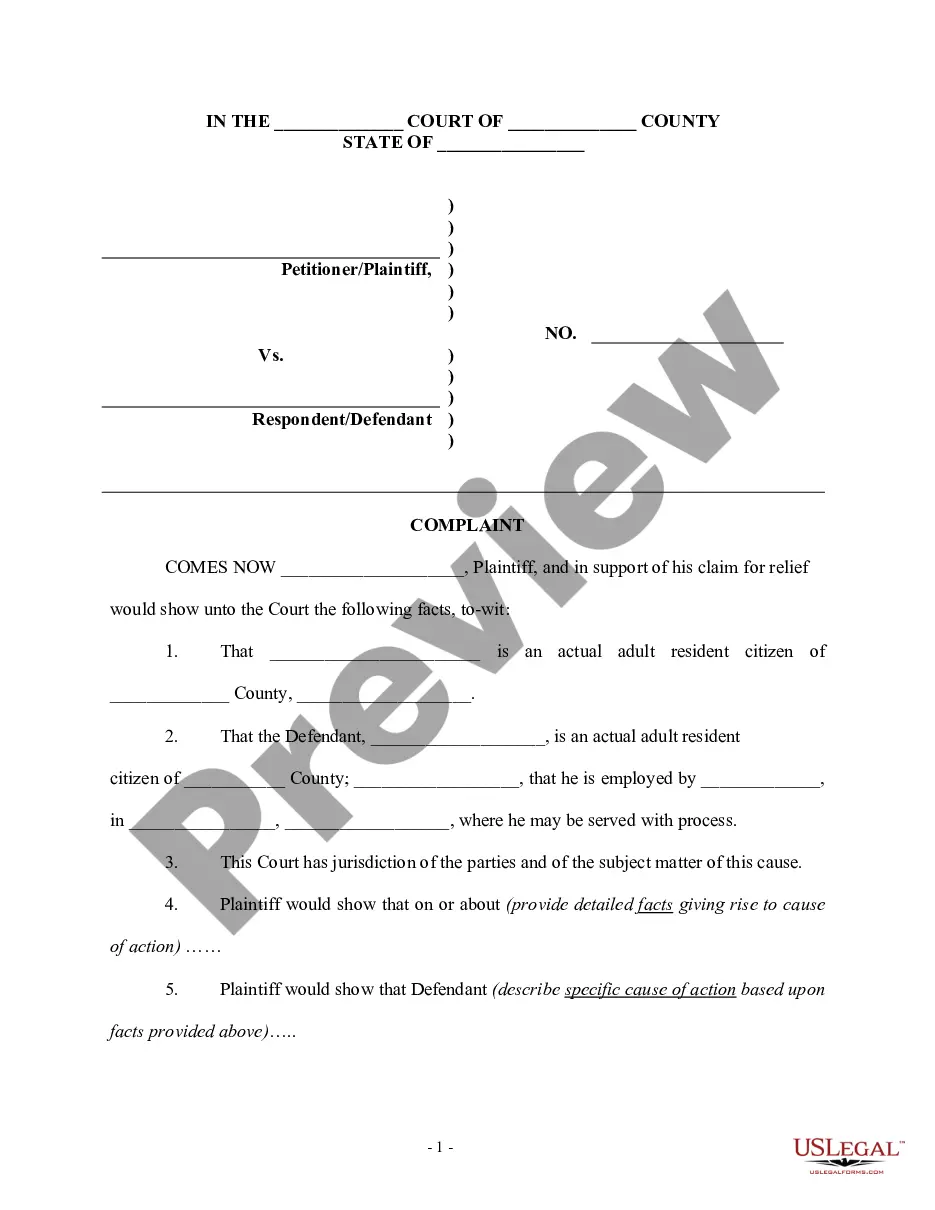
How do I file a complaint or petition in civil court? You file the complaint or petition with the clerk of court. You generally want to file in the court in the county where the person you are suing lives. Along with the complaint, the court must be told where to serve (give it a copy of it to) the defendant.
General format - each motion generally consists of a case caption, a title that briefly identifies the relief sought, a series of numbered paragraphs that explains -- in a logical way -- why you are entitled to that relief, a prayer for relief, a signature block, a certification that a copy of the motion was sent to ...
You start a lawsuit by filing a complaint. In some circumstances, you file a petition or a motion. The court has several complaint forms that you may use in drafting your complaint. The forms are available online and at the Pro Se Intake Unit.
You file the complaint or petition with the clerk of court. You generally want to file in the court in the county where the person you are suing lives. Along with the complaint, the court must be told where to serve (give it a copy of it to) the defendant.
Service upon the attorney or upon a party shall be made by delivering a copy to the person to be served or by mailing it to the person to be served at the person's last known address or, if no address is known, by leaving it with the clerk of the court.
If a bill has passed in both the U.S. House of Representatives and the U.S. Senate and has been approved by the President, or if a presidential veto has been overridden, the bill becomes a law and is enforced by the government.
So, for example, say a bill originates in the Georgia House of Representatives. After it passes committee, is presented to the House, and passes the House, it is then sent to the Georgia State Senate on Crossover Day. There, the senators discuss the bill and add their own amendments. Then the Senate takes a vote.
You'll want to start with a standard page size (8.5 x 11 inches) with 1-inch margins. Keep the font simple, such as Times New Roman, and avoid the use of color. Remember to break up text with headers and paragraphs for readability.
How a Bill Becomes a Law STEP 1: The Creation of a Bill. Members of the House or Senate draft, sponsor and introduce bills for consideration by Congress. STEP 2: Committee Action. STEP 3: Floor Action. STEP 4: Vote. STEP 5: Conference Committees. STEP 6: Presidential Action. STEP 7: The Creation of a Law.
