Requesting Discovery Form For Divorce In Sacramento
Description
Get your form ready online
Our built-in tools help you complete, sign, share, and store your documents in one place.
Make edits, fill in missing information, and update formatting in US Legal Forms—just like you would in MS Word.
Download a copy, print it, send it by email, or mail it via USPS—whatever works best for your next step.
Sign and collect signatures with our SignNow integration. Send to multiple recipients, set reminders, and more. Go Premium to unlock E-Sign.
If this form requires notarization, complete it online through a secure video call—no need to meet a notary in person or wait for an appointment.
We protect your documents and personal data by following strict security and privacy standards.

Make edits, fill in missing information, and update formatting in US Legal Forms—just like you would in MS Word.

Download a copy, print it, send it by email, or mail it via USPS—whatever works best for your next step.

Sign and collect signatures with our SignNow integration. Send to multiple recipients, set reminders, and more. Go Premium to unlock E-Sign.

If this form requires notarization, complete it online through a secure video call—no need to meet a notary in person or wait for an appointment.

We protect your documents and personal data by following strict security and privacy standards.
Looking for another form?






Form popularity
FAQ
Your answers should be short and concise. Only answer the actual question being asked of you. Type your responses, please do not handwrite your responses. Be truthful.
The purpose of discovery is to allow each side to learn the details of the case, assess strengths and weaknesses of the opposing party's claims and defenses, and identify the issues they will have to prove at trial.
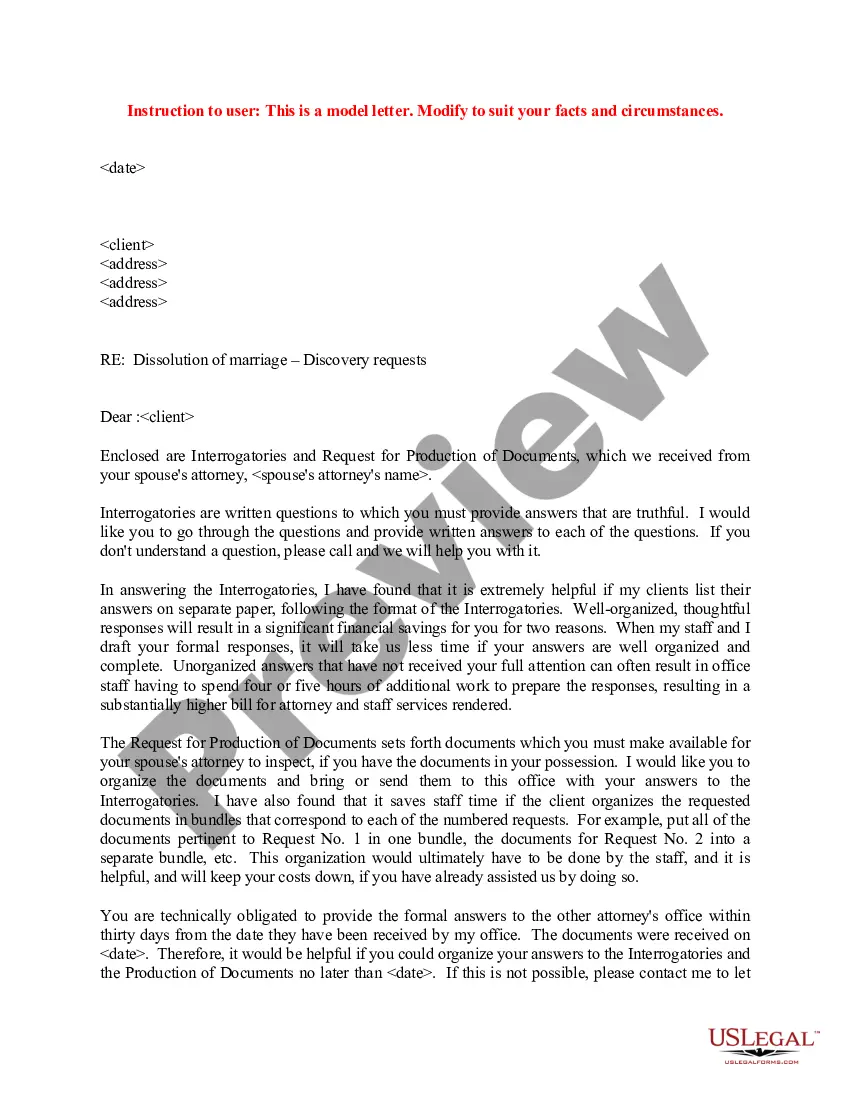
Discovery requests typically follow a common format that you can mirror. First, list instructions detailing the request for production. Be sure to mention Rule 34 and Rule 26(b), which outline the scope of the discovery request. It's also necessary to include a section with definitions.
One of the most important phases of the divorce process is “discovery.” This is the stage of a divorce where information is exchanged between the parties in order for them to make informed decisions — and successfully present their cases in court.
If the other person does not respond, or their response is still incomplete, you can ask the court to order them to respond. You have 45 days from the service of the most recent responses to ask the court to make an order requiring an answer. If the response was served by mail, 5 extra days are added.
Discovery is a process by which the parties gather and exchange information that is important to the case. What is the Purpose of Discovery? The purpose of discovery is to provide parties the opportunity to gather evidence relevant to proving or defending the case.
Discovery is designed to ensure fairness and transparency in the divorce process, and non-compliance by one spouse hinders this process. Consequently, if you don't comply with discovery requests, it can have serious legal repercussions and lead to adverse rulings against you in the divorce proceedings.
You can use Proof of Service by First Class Mail (form POS-030). It helps if you fill in the top part of the form with the case and court information. Your server can then fill in the information about how, when, and where they served the papers. Your server must then sign the form.
Also, an uncontested divorce does not require a trial, discovery, or other time consuming legal procedures. That means that legal fees will be much less expensive in an uncontested divorce than a contested divorce. Uncontested divorces are not appealable, but certain agreements may be modifiable.
Seven years seems like a long time to go back, but every divorce matter is different and there might be a legitimate reason why that many years is being requested. If you do not comply with discovery requests, you do risk your pleadings being struck.

