Arbitration Agreement With Employer In Texas
Description

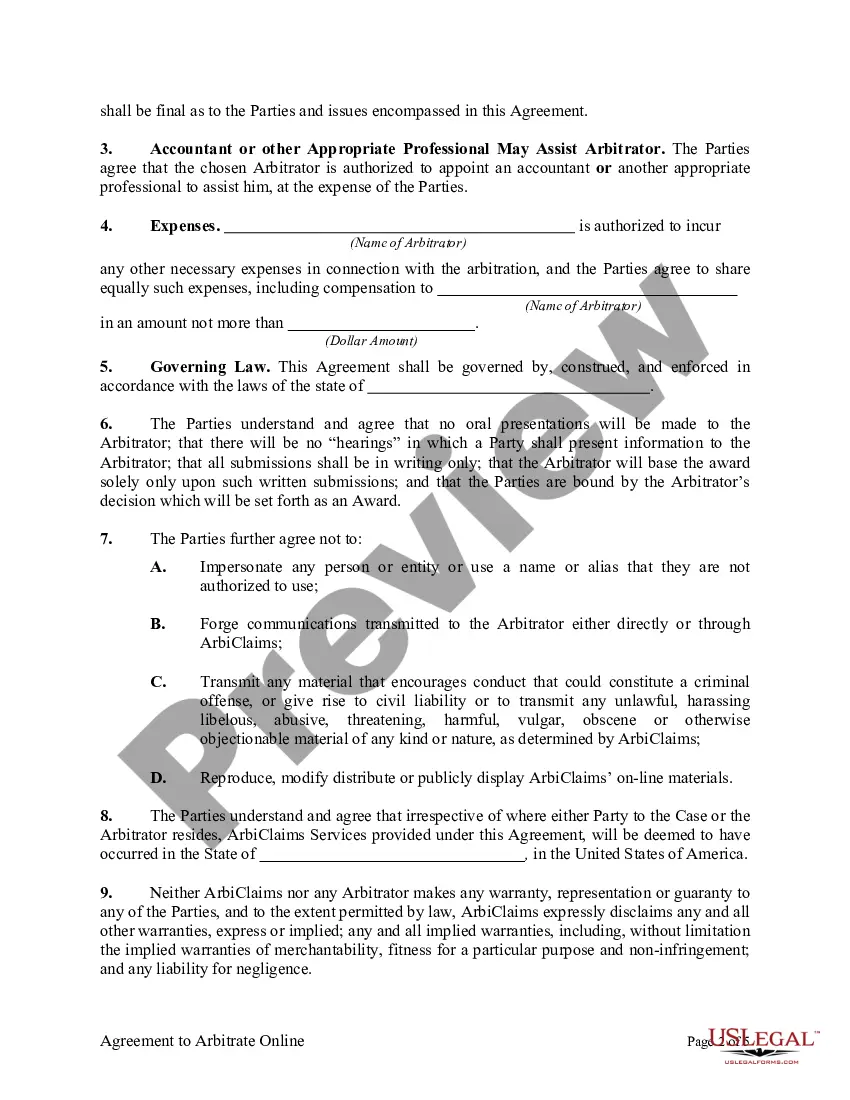




Get your form ready online
Our built-in tools help you complete, sign, share, and store your documents in one place.
Make edits, fill in missing information, and update formatting in US Legal Forms—just like you would in MS Word.
Download a copy, print it, send it by email, or mail it via USPS—whatever works best for your next step.
Sign and collect signatures with our SignNow integration. Send to multiple recipients, set reminders, and more. Go Premium to unlock E-Sign.
If this form requires notarization, complete it online through a secure video call—no need to meet a notary in person or wait for an appointment.
We protect your documents and personal data by following strict security and privacy standards.

Make edits, fill in missing information, and update formatting in US Legal Forms—just like you would in MS Word.

Download a copy, print it, send it by email, or mail it via USPS—whatever works best for your next step.

Sign and collect signatures with our SignNow integration. Send to multiple recipients, set reminders, and more. Go Premium to unlock E-Sign.

If this form requires notarization, complete it online through a secure video call—no need to meet a notary in person or wait for an appointment.

We protect your documents and personal data by following strict security and privacy standards.
Looking for another form?





Form popularity
FAQ
A claimant will typically start arbitration by sending a document known as a “request for arbitration” or a “notice to arbitrate” to its opponent.
Either Party to a contract in which there is an Arbitration clause can either himself or through an authorised agent may invoke Arbitration so as to refer the dispute to arbitration, as per provisions of the arbitration clause.
Validity of Arbitration Agreements Under Section 171.001 of the TAA, written agreements to arbitrate are generally valid and enforceable in Texas. This section ensures that, barring any specific legal exceptions, parties bound by a written agreement to arbitrate must settle their disputes outside of court.
A claimant will typically start arbitration by sending a document known as a “request for arbitration” or a “notice to arbitrate” to its opponent.
There are typically seven stages of the arbitration process: Claimant Files a Claim. Respondent Submits Answer. Parties Select Arbitrators. Parties Attend Initial Prehearing Conference. Parties Exchange Discovery. Parties Attend Hearings. Arbitrators Deliberate and Render Award.
Contact the Texas Comptroller's Arbitration team at 800-252-9121 or ptad.arbitration@cpa.texas. You have certain rights under Government Code Chapters 552 and 559 to review, request and correct information we have on file about you. Contact us at the email address or phone number listed in these instructions.
An arbitration clause is typically found in an employment agreement, application, or employee handbook. An arbitration clause requires workers to go to arbitration, rather than file a lawsuit, for some or all kinds of employment-related claims. 1 See below some examples of arbitration clauses.
Arbitration is a procedure in which a dispute is submitted, by agreement of the parties, to one or more arbitrators who make a binding decision on the dispute. In choosing arbitration, the parties opt for a private dispute resolution procedure instead of going to court.
An arbitration clause is typically found in an employment agreement, application, or employee handbook. An arbitration clause requires workers to go to arbitration, rather than file a lawsuit, for some or all kinds of employment-related claims. 1 See below some examples of arbitration clauses.
Arbitration is similar to going to court, but faster, cheaper and less complex than litigation. If the case settles, an arbitration will last around one year. If the case goes to hearing, an arbitration typically takes 16 months.
