Agreement Arbitrate Sample For Insurance In Suffolk
Description





Get your form ready online
Our built-in tools help you complete, sign, share, and store your documents in one place.
Make edits, fill in missing information, and update formatting in US Legal Forms—just like you would in MS Word.
Download a copy, print it, send it by email, or mail it via USPS—whatever works best for your next step.
Sign and collect signatures with our SignNow integration. Send to multiple recipients, set reminders, and more. Go Premium to unlock E-Sign.
If this form requires notarization, complete it online through a secure video call—no need to meet a notary in person or wait for an appointment.
We protect your documents and personal data by following strict security and privacy standards.

Make edits, fill in missing information, and update formatting in US Legal Forms—just like you would in MS Word.

Download a copy, print it, send it by email, or mail it via USPS—whatever works best for your next step.

Sign and collect signatures with our SignNow integration. Send to multiple recipients, set reminders, and more. Go Premium to unlock E-Sign.

If this form requires notarization, complete it online through a secure video call—no need to meet a notary in person or wait for an appointment.

We protect your documents and personal data by following strict security and privacy standards.
Looking for another form?





Form popularity
FAQ
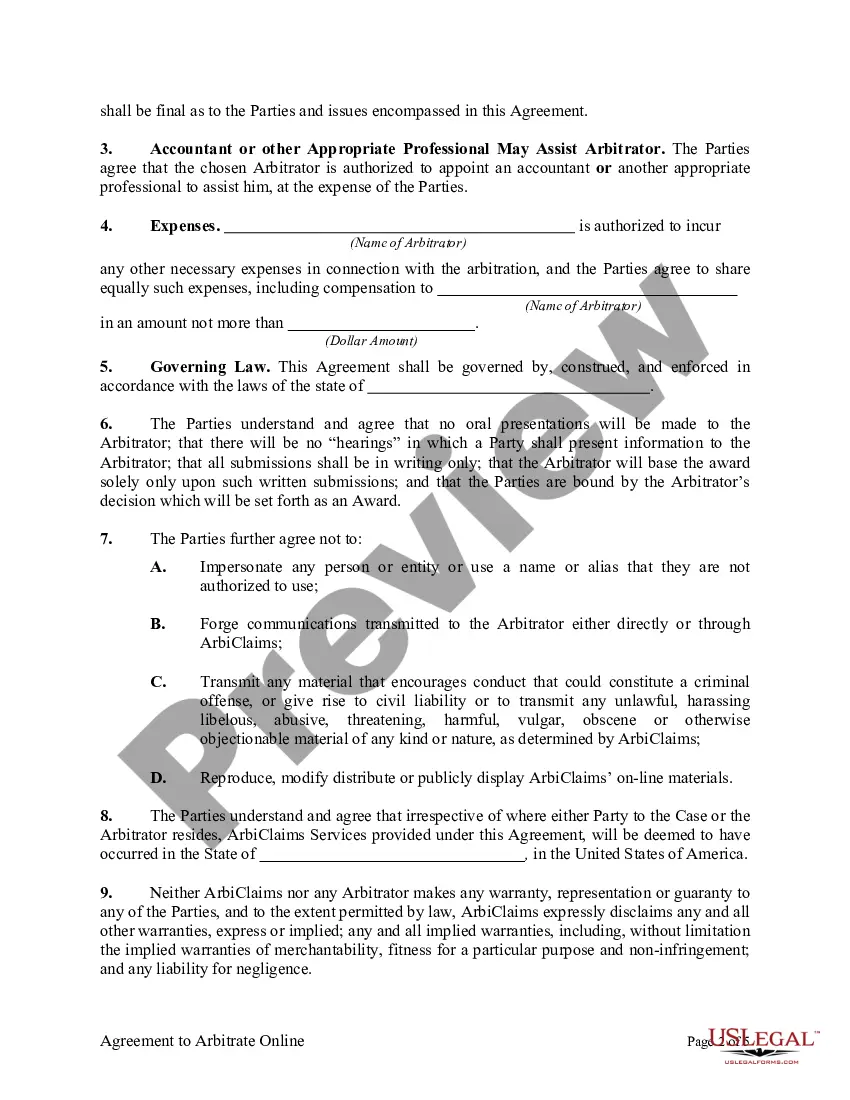
Necessary Elements Details of the Parties. Details of the relationship between the parties. Demand for Arbitration. The mention of agreement/contract (if any). The mention of already existing arbitration agreement between the parties pursuant to which the concerned notice of arbitration has been sent (if any).
In general, a Request for Arbitration or a Notice of Arbitration must contain the names of each of the parties, the names of the parties' representatives, a description of the dispute giving rise to claims, a statement of the relief sought, a description of the agreement containing the arbitration clause, the choice of ...
The Scope of the Clause. This section of the clause is critical; it sets the boundaries for which disputes the tribunal is authorised to determine. Choice of Rules. The Number of Arbitrators. Appointing Authority. Choice of Venue. The language of the proceedings. Finality. Exclusion of the right of appeal.
In voluntary or non-binding arbitration, the insurer and the policyholder agree to meet with an arbitrator to review the claim. Once the arbitrator makes their decision on the claim, both parties then have the option to accept or reject it. If the decision is ultimately denied, the case can then be appealed.
In voluntary or non-binding arbitration, the insurer and the policyholder agree to meet with an arbitrator to review the claim. Once the arbitrator makes their decision on the claim, both parties then have the option to accept or reject it. If the decision is ultimately denied, the case can then be appealed.
It's typically a clause in a broader contract in which you agree to settle out of court, through arbitration cases, any dispute that arises with your counterpart.
Arbitration agreements are a way that employers try to avoid being sued by employees for employment law violations, such as wage and hour violations or sexual harassment.
In arbitration, the parties communicate only with the arbitrator, and the arbitrator decides what should happen. In mediation, the parties speak with the mediator and each other. The mediator does not decide what should happen, but assists the participants to reach an agreement that is acceptable to both parties. 6.
Arbitration might be the right choice for some cases. Limited discovery rights and costs might be useful when less is at stake. Arbitration might feel less adversarial, which could be an advantage where ongoing relationships are hoped to be preserved. Arbitration lends some confidentiality.
