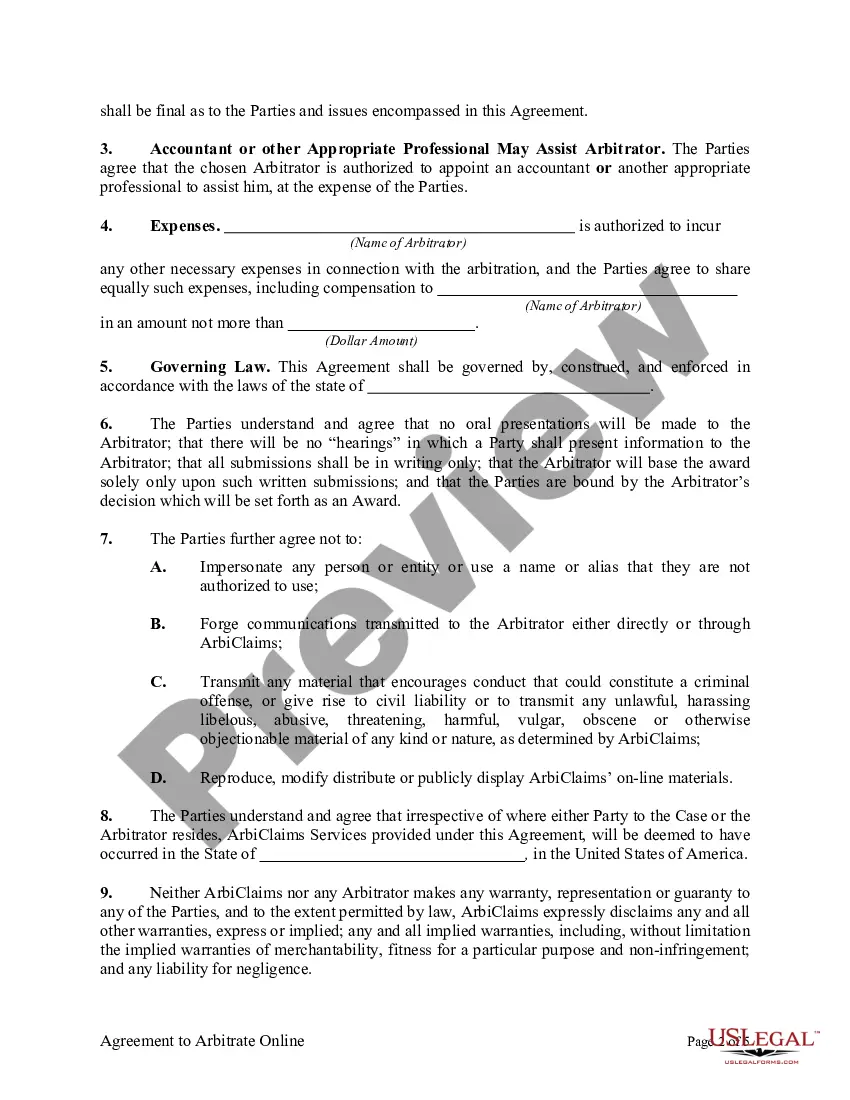
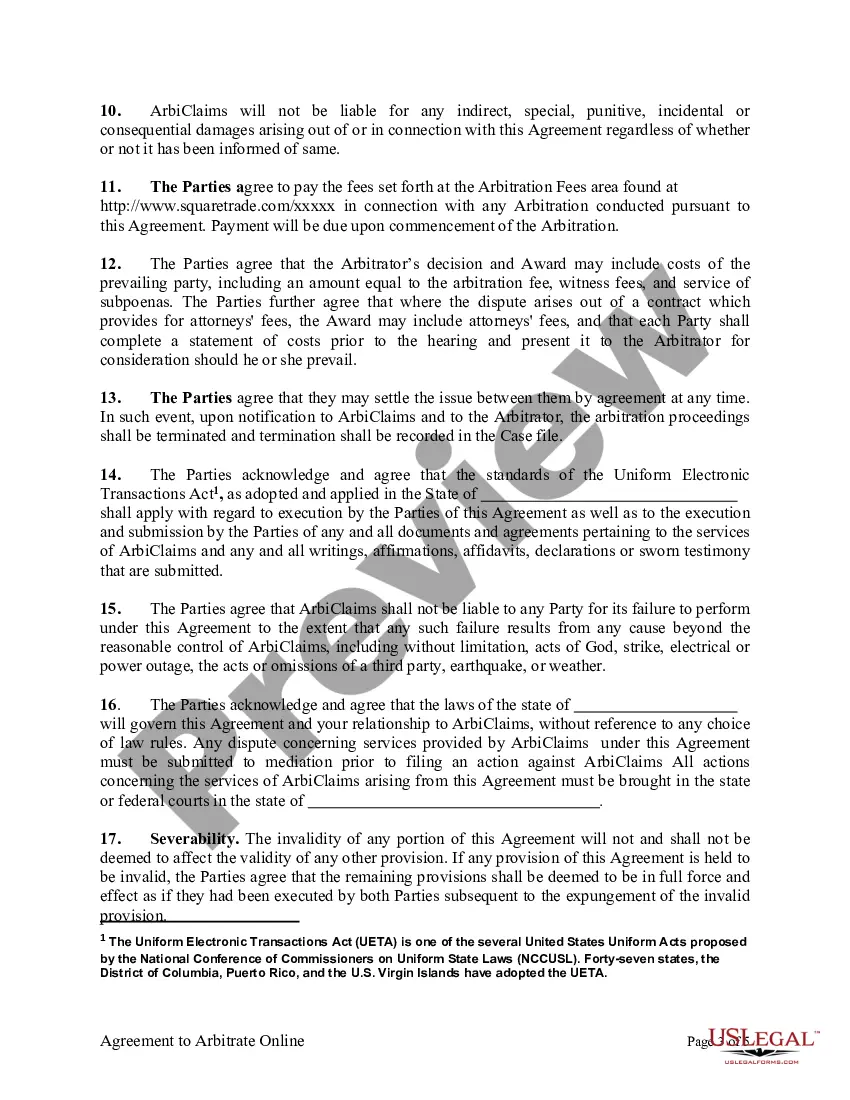
Agreement Arbitration Document For Medical Malpractice In Ohio
Description





Get your form ready online
Our built-in tools help you complete, sign, share, and store your documents in one place.
Make edits, fill in missing information, and update formatting in US Legal Forms—just like you would in MS Word.
Download a copy, print it, send it by email, or mail it via USPS—whatever works best for your next step.
Sign and collect signatures with our SignNow integration. Send to multiple recipients, set reminders, and more. Go Premium to unlock E-Sign.
If this form requires notarization, complete it online through a secure video call—no need to meet a notary in person or wait for an appointment.
We protect your documents and personal data by following strict security and privacy standards.

Make edits, fill in missing information, and update formatting in US Legal Forms—just like you would in MS Word.

Download a copy, print it, send it by email, or mail it via USPS—whatever works best for your next step.

Sign and collect signatures with our SignNow integration. Send to multiple recipients, set reminders, and more. Go Premium to unlock E-Sign.

If this form requires notarization, complete it online through a secure video call—no need to meet a notary in person or wait for an appointment.

We protect your documents and personal data by following strict security and privacy standards.
Looking for another form?







Form popularity
FAQ
The Affidavit of Merit is a legal document that plaintiffs must file when initiating a medical malpractice lawsuit in the state. It is designed to ensure that the plaintiff's claim has a reasonable basis and is not frivolous.
Ohio has a public policy favoring the enforcement of arbitration provisions in contracts and ORC 2711.01(A) provides that such provisions will be enforced unless grounds exist in law or equity for revocation of the contract.
If a court finds any evidence of substantive unconscionability, it will deem the agreement unenforceable. It does not take more than a low level of substantive unconscionability for the agreement to be thrown out.
1 Arbitration agreements for medical malpractice are written contracts between health care providers and patients in which both agree to arbitrate any dispute or claim arising from the medical care provided to the patient by the health care provider.
Arbitration agreements are generally enforceable in all 50 states; particularly in commercial settings between sophisticated parties. However, courts in many states are hostile to “fine print” arbitration agreements, particularly between employers and employees.
While parties are not required to have an attorney to participate in arbitration, arbitration is a final, legally-binding process that may impact a party's rights. As such, parties may want to consider consulting an attorney at any time before, during, or after the arbitration.
Some contracts give you the right to opt out of the forced arbitration clause within a certain period of time, often 30 to 60 days, after signing the agreement by notifying the company that you wish to opt out. Check your contract for the deadline and for specific instructions for opting out.
Arbitration is a procedure in which a dispute is submitted, by agreement of the parties, to one or more arbitrators who make a binding decision on the dispute. In choosing arbitration, the parties opt for a private dispute resolution procedure instead of going to court.
A party is deceived, intimidated, or coerced during the execution of the arbitration agreement and requests a declaration that such arbitration agreement is invalid; and. The arbitration agreement violates prohibitions specified by the law.
