Agreement Arbitration Sample Withdrawal In Illinois
Description

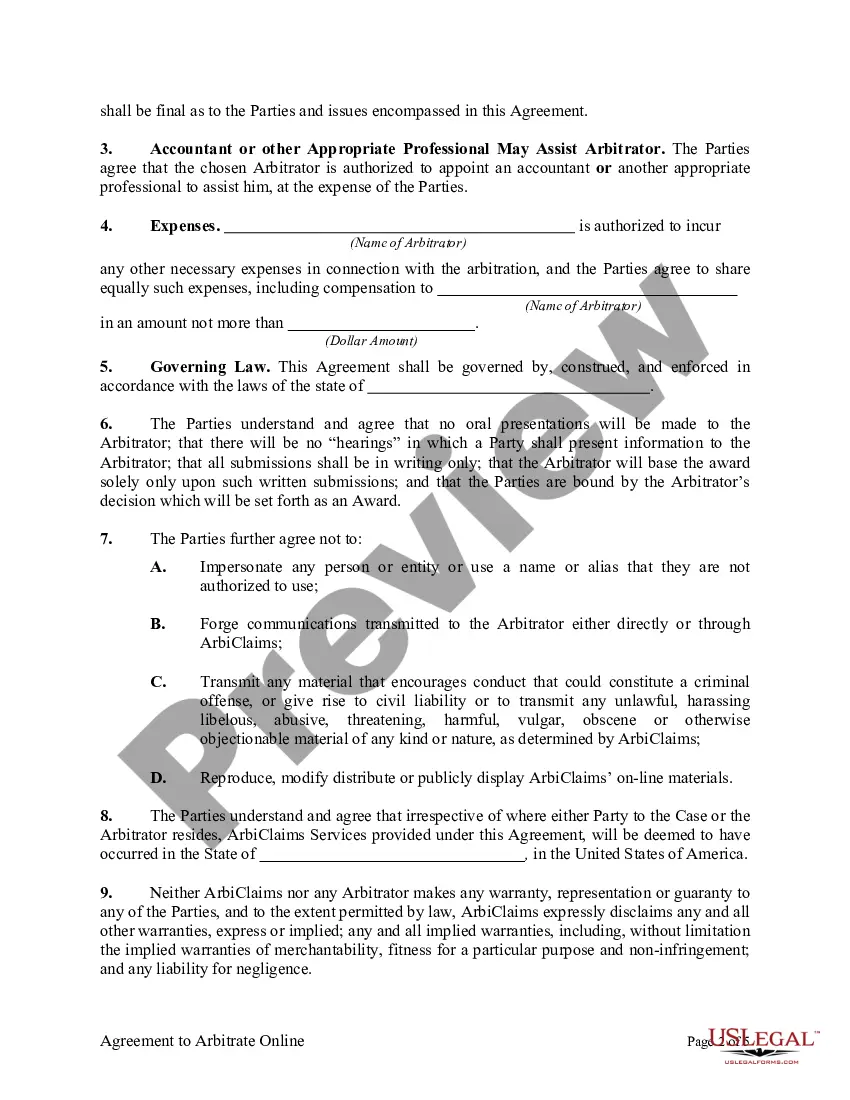




Get your form ready online
Our built-in tools help you complete, sign, share, and store your documents in one place.
Make edits, fill in missing information, and update formatting in US Legal Forms—just like you would in MS Word.
Download a copy, print it, send it by email, or mail it via USPS—whatever works best for your next step.
Sign and collect signatures with our SignNow integration. Send to multiple recipients, set reminders, and more. Go Premium to unlock E-Sign.
If this form requires notarization, complete it online through a secure video call—no need to meet a notary in person or wait for an appointment.
We protect your documents and personal data by following strict security and privacy standards.

Make edits, fill in missing information, and update formatting in US Legal Forms—just like you would in MS Word.

Download a copy, print it, send it by email, or mail it via USPS—whatever works best for your next step.

Sign and collect signatures with our SignNow integration. Send to multiple recipients, set reminders, and more. Go Premium to unlock E-Sign.

If this form requires notarization, complete it online through a secure video call—no need to meet a notary in person or wait for an appointment.

We protect your documents and personal data by following strict security and privacy standards.
Looking for another form?







Form popularity
FAQ
When faced with unconscionability in an arbitration agreement, courts may either sever the unconscionable provision(s), or declare the entire agreement void. (Civ. Code, § 1670.5 (a); Wherry v. Award, Inc.
While courts cannot, in applying California's unconscionability doctrine, “mandate procedural rules that are inconsistent with fundamental attributes of arbitration,” California courts may still refuse to enforce an arbitration agreement if it finds that the totality of the agreement is unconscionable.
A clause that requires arbitration is known as a mandatory arbitration clause. Today's question is: Are such clauses enforceable in Illinois? The short answer is yes, and the long answer doesn't really change much.
Some contracts give you the right to opt out of the forced arbitration clause within a certain period of time, often 30 to 60 days, after signing the agreement by notifying the company that you wish to opt out. Check your contract for the deadline and for specific instructions for opting out.
Once registered, the request for arbitration can no longer be withdrawn and a claimant seeking to withdraw from the proceedings will need to seek the “discontinuance” of the proceedings.
Your letter of arbitration should be concise, professional, and factual. Follow the standard business letter format, including your name and contact information at the top. Ensure that your writing is clear, and avoid using jargon or technical terms that may not be familiar to the reader.
The Scope of the Clause. This section of the clause is critical; it sets the boundaries for which disputes the tribunal is authorised to determine. Choice of Rules. The Number of Arbitrators. Appointing Authority. Choice of Venue. The language of the proceedings. Finality. Exclusion of the right of appeal.
"A dispute having arisen between the parties concerning , the parties hereby agree that the dispute shall be referred to and finally resolved by arbitration under the LCIA Rules. The number of arbitrators shall be one/three. The seat, or legal place, of arbitration shall be City and/or Country.
Necessary Elements Details of the Parties. Details of the relationship between the parties. Demand for Arbitration. The mention of agreement/contract (if any). The mention of already existing arbitration agreement between the parties pursuant to which the concerned notice of arbitration has been sent (if any).
