Agreement To Arbitrate Pdf In Georgia
Description

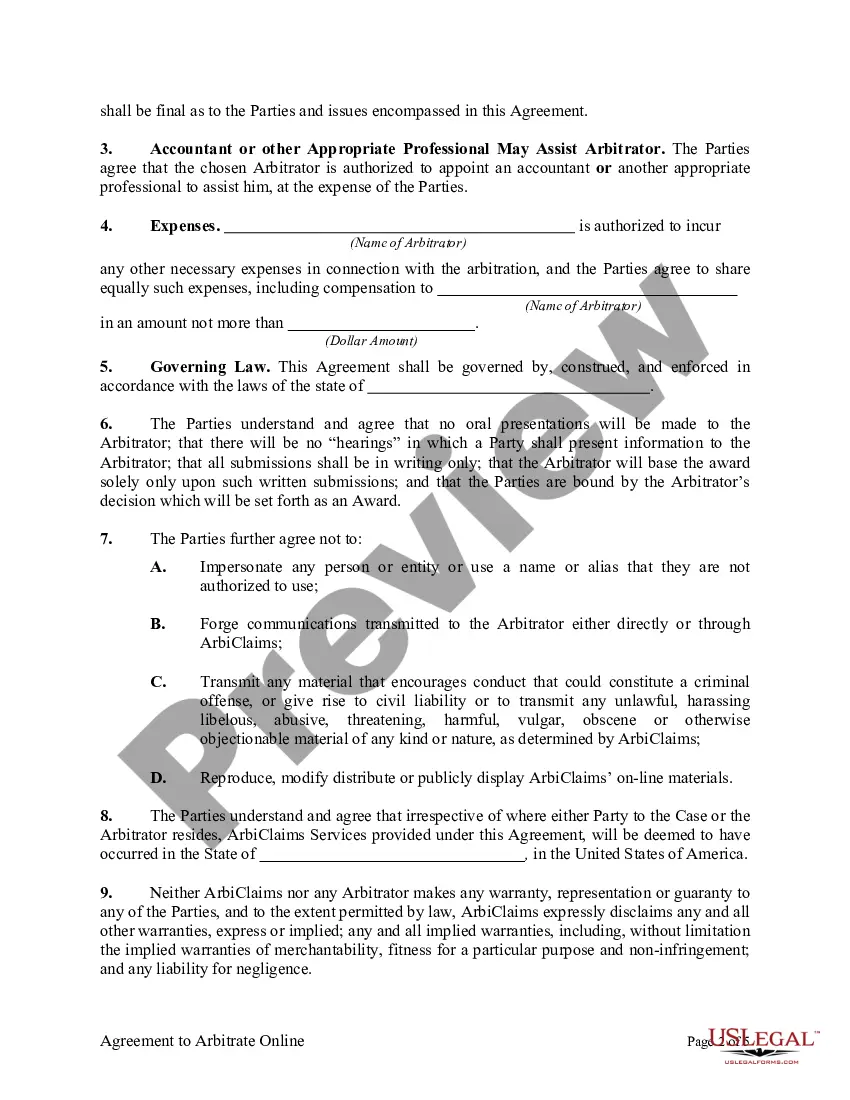
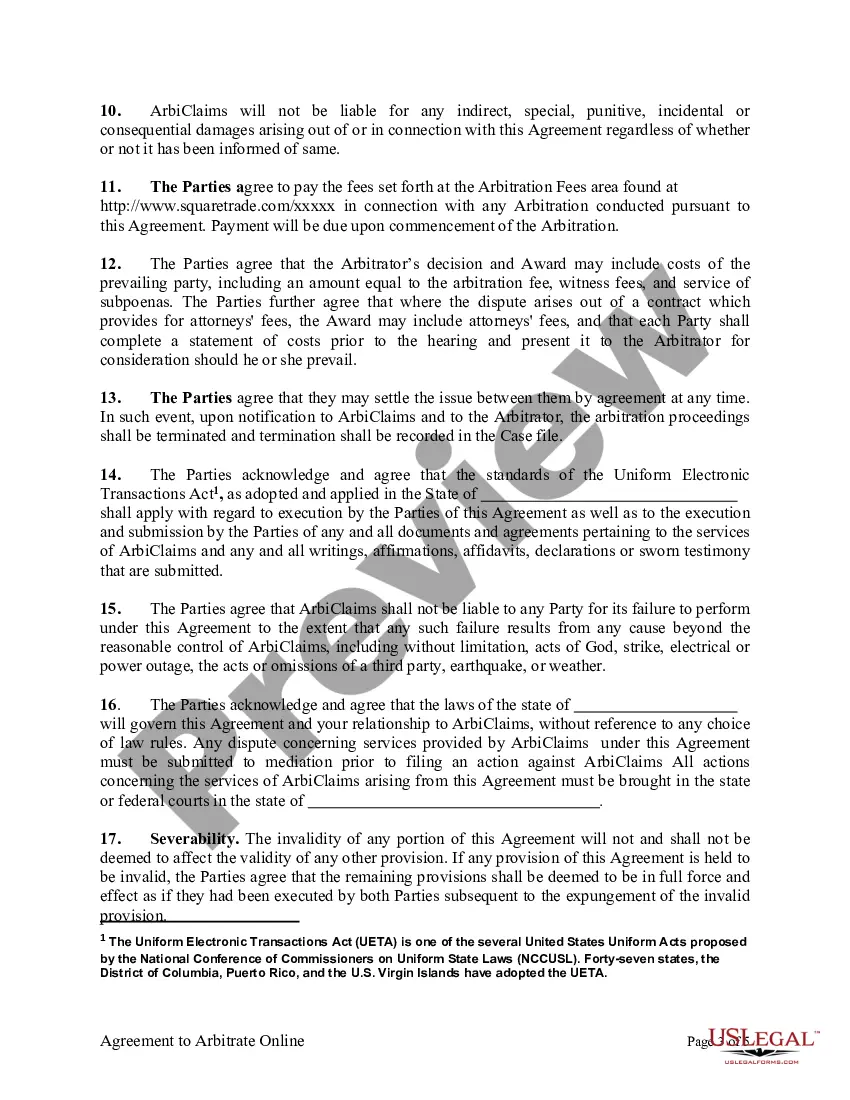




Get your form ready online
Our built-in tools help you complete, sign, share, and store your documents in one place.
Make edits, fill in missing information, and update formatting in US Legal Forms—just like you would in MS Word.
Download a copy, print it, send it by email, or mail it via USPS—whatever works best for your next step.
Sign and collect signatures with our SignNow integration. Send to multiple recipients, set reminders, and more. Go Premium to unlock E-Sign.
If this form requires notarization, complete it online through a secure video call—no need to meet a notary in person or wait for an appointment.
We protect your documents and personal data by following strict security and privacy standards.

Make edits, fill in missing information, and update formatting in US Legal Forms—just like you would in MS Word.

Download a copy, print it, send it by email, or mail it via USPS—whatever works best for your next step.

Sign and collect signatures with our SignNow integration. Send to multiple recipients, set reminders, and more. Go Premium to unlock E-Sign.

If this form requires notarization, complete it online through a secure video call—no need to meet a notary in person or wait for an appointment.

We protect your documents and personal data by following strict security and privacy standards.
Looking for another form?










Form popularity
FAQ
A claimant will typically start arbitration by sending a document known as a “request for arbitration” or a “notice to arbitrate” to its opponent.
States have varying requirements for arbitrators, but most require you to have at least a bachelor's degree in law, political science or a similar field. You can gain experience for this role by completing internships and working in entry-level positions under the supervision of an experienced arbitrator.
The Scope of the Clause. This section of the clause is critical; it sets the boundaries for which disputes the tribunal is authorised to determine. Choice of Rules. The Number of Arbitrators. Appointing Authority. Choice of Venue. The language of the proceedings. Finality. Exclusion of the right of appeal.
A claimant will typically start arbitration by sending a document known as a “request for arbitration” or a “notice to arbitrate” to its opponent.
In general, a Request for Arbitration or a Notice of Arbitration must contain the names of each of the parties, the names of the parties' representatives, a description of the dispute giving rise to claims, a statement of the relief sought, a description of the agreement containing the arbitration clause, the choice of ...
Most of our arbitration hearings are conducted by two experienced attorneys and one non-attorney. Like judges, arbitrators hear arguments from both sides and decide the outcome of the dispute. Arbitrators and both parties are allowed to request reasonable discovery if/when a hearing date is set.
Arbitration might be the right choice for some cases. Limited discovery rights and costs might be useful when less is at stake. Arbitration might feel less adversarial, which could be an advantage where ongoing relationships are hoped to be preserved. Arbitration lends some confidentiality.
Is forced arbitration legal? Generally, yes. The United States Supreme Court decided in 2001 that the FAA applies broadly to employment contracts. Most decisions before this limited the ability of employers to force employees to agree to arbitration provisions under the FAA.
There is no public policy in favor of forcing arbitration of issues the parties have not agreed to arbitrate. Citation. It follows that when presented with a petition to compel arbitration, the trial court's first task is to determine whether the parties have in fact agreed to arbitrate the dispute.
1 The ICC Rules, Article 6(8) provides, “If any of the parties refuses or fails to take part in the arbitration or any stage thereof, the arbitration shall proceed notwithstanding such refusal or failure.” Similar provisions are also provided for in the LCIA Rules, Article 15.8; SIAC Rules, Rule 20.9; UNCITRAL Rules, ...
