Agreement Arbitration Sample With Bank In Alameda
Description





Get your form ready online
Our built-in tools help you complete, sign, share, and store your documents in one place.
Make edits, fill in missing information, and update formatting in US Legal Forms—just like you would in MS Word.
Download a copy, print it, send it by email, or mail it via USPS—whatever works best for your next step.
Sign and collect signatures with our SignNow integration. Send to multiple recipients, set reminders, and more. Go Premium to unlock E-Sign.
If this form requires notarization, complete it online through a secure video call—no need to meet a notary in person or wait for an appointment.
We protect your documents and personal data by following strict security and privacy standards.

Make edits, fill in missing information, and update formatting in US Legal Forms—just like you would in MS Word.

Download a copy, print it, send it by email, or mail it via USPS—whatever works best for your next step.

Sign and collect signatures with our SignNow integration. Send to multiple recipients, set reminders, and more. Go Premium to unlock E-Sign.

If this form requires notarization, complete it online through a secure video call—no need to meet a notary in person or wait for an appointment.

We protect your documents and personal data by following strict security and privacy standards.
Looking for another form?









Form popularity
FAQ
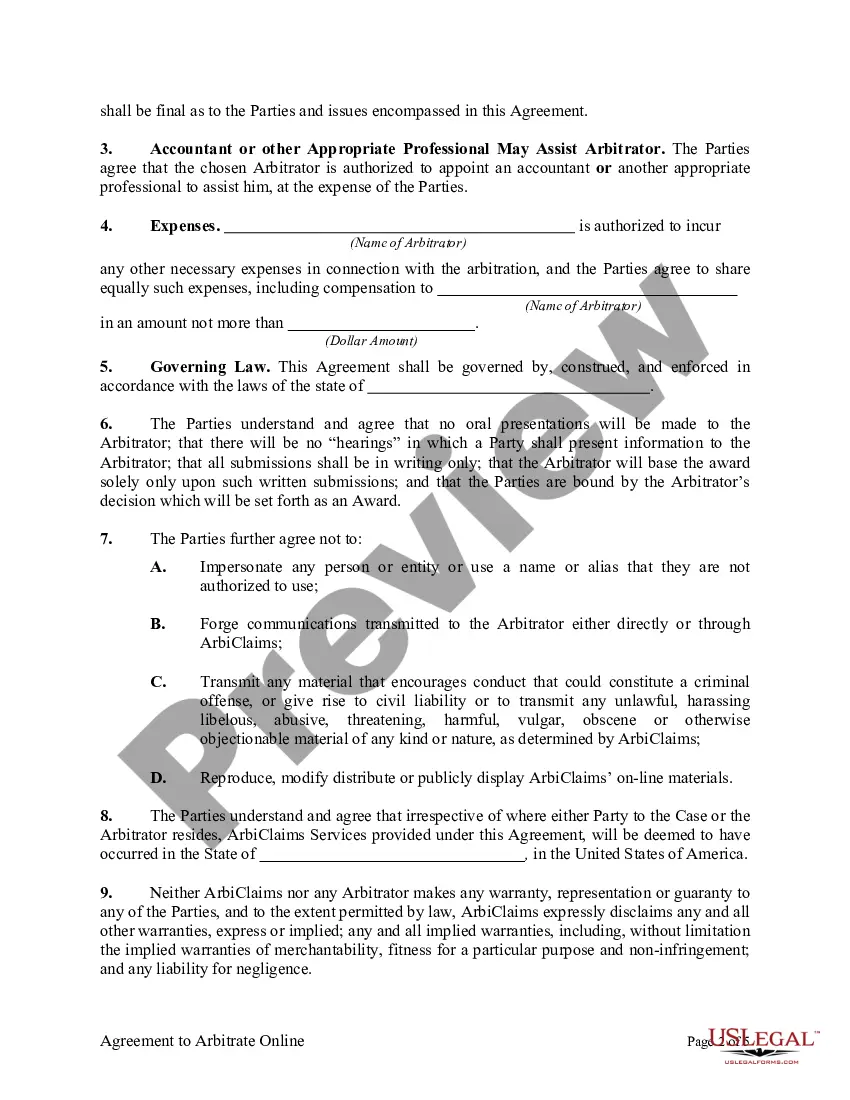
Example 1. Arbitration. All claims and disputes arising under or relating to this Agreement are to be settled by binding arbitration in the state of insert state in which parties agree to arbitrate or another location mutually agreeable to the parties.
Opting out of the arbitration agreement isn't damaging to you. You can always do arbitration if you would prefer that, although if you'd like to join class actions or sue the judge will throw out your case if you are still in this agreement.
This means that any disputes between customers and banks over account fees, identity theft, or other charges will be decided by an arbitrator that the bank helps choose, rather than an impartial judge.
LCCP 2 We, the undersigned parties, hereby agree to submit to arbitration administered by the American Arbitration Association under its applicable Procedures for Large, Complex Commercial Disputes the following controversy describe briefly. Judgment of any court having jurisdiction may be entered on the award.
Arbitration agreements are almost always signed at the beginning of a legal relationship, whether it's a business contract or within the context of employment. This means you must sign away your right to bring a lawsuit before you have any idea what issues might need to be resolved in the future.
The Arbitration Agreement All and any disputes or differences arising out of or in connection with this Agreement, or the breach, termination or invalidity thereof shall be finally settled by arbitration. In ance with the UNCITRAL Arbitration Rules. The number of arbitrators shall be one/three.
Your letter of arbitration should be concise, professional, and factual. Follow the standard business letter format, including your name and contact information at the top. Ensure that your writing is clear, and avoid using jargon or technical terms that may not be familiar to the reader.
Drafting the “perfect” arbitration agreement Clear and precise language. Clarity and brevity are key to avoiding an unenforceable arbitration clause and the costs and delays that follow. Scope. Seat of arbitration. Governing law. Arbitral Rules. Language. Arbitrators. Other common issues.