Sample Character Letter To Judge Asking For Leniency In Queens
Description

Get your form ready online
Our built-in tools help you complete, sign, share, and store your documents in one place.
Make edits, fill in missing information, and update formatting in US Legal Forms—just like you would in MS Word.
Download a copy, print it, send it by email, or mail it via USPS—whatever works best for your next step.
Sign and collect signatures with our SignNow integration. Send to multiple recipients, set reminders, and more. Go Premium to unlock E-Sign.
If this form requires notarization, complete it online through a secure video call—no need to meet a notary in person or wait for an appointment.
We protect your documents and personal data by following strict security and privacy standards.
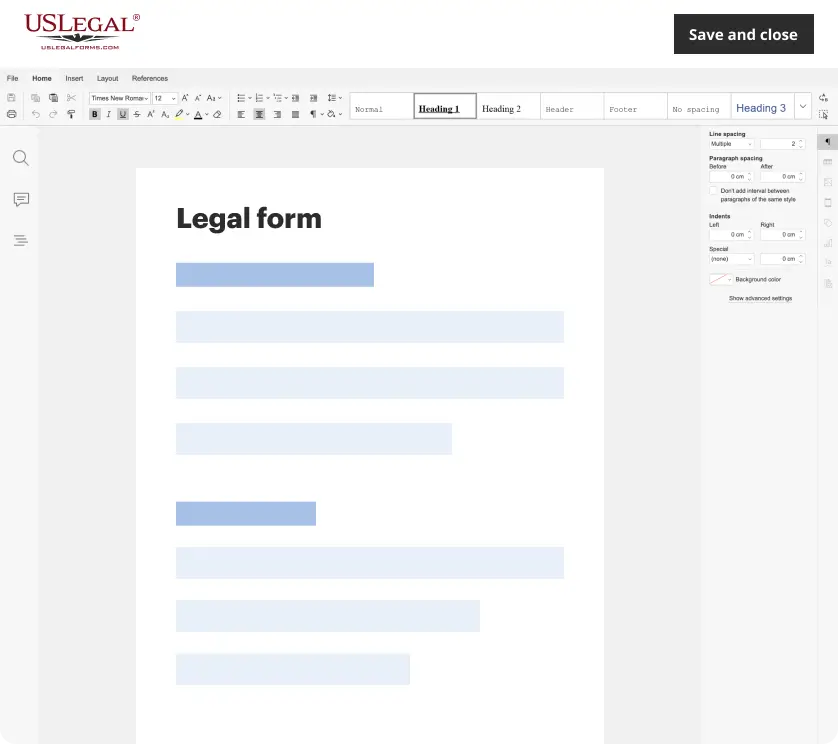
Make edits, fill in missing information, and update formatting in US Legal Forms—just like you would in MS Word.
Download a copy, print it, send it by email, or mail it via USPS—whatever works best for your next step.
Sign and collect signatures with our SignNow integration. Send to multiple recipients, set reminders, and more. Go Premium to unlock E-Sign.

If this form requires notarization, complete it online through a secure video call—no need to meet a notary in person or wait for an appointment.

We protect your documents and personal data by following strict security and privacy standards.
Looking for another form?







Form popularity
FAQ
When writing, avoid simply describing the defendant in terms like “he is loyal.” Instead, tell a story about his loyalty, or how he has been an upstanding member of the community. A story will stand out in the judge's mind more than adjectives will, making your letter more effective.
The letter should highlight your good qualities and achievements. The writer should give specific examples of how you have demonstrated these qualities in your personal, professional, or social life. For example, they could mention your work ethic, your family values, your charity work, your hobbies, or your awards.
{Name} operates with integrity, and never has a bad word to say about anyone. {He/she} is also hard working and dedicated, and never leaves a job unfinished. On a personal level, may I just say that I really like {Name}, and I have no doubts about {his/her} abilities to succeed in the future.
In most cases, your letter of recommendation should include the following: 1 Date. Provide the date you send your letter, especially if there are specific application cycles or deadlines to adhere to. 2 Greeting. 3 Introduction. 4 Overview. 5 Personal anecdote. 6 Closing statement. 7 Signature.
(s)he is highly organised, has great communication skills and I have always been very impressed with the way that (s)he has approached work. I highly recommend name for any job in your company and I'm sure that (s)he will do a great job. (s)he would be a great asset for any business.
You don't know me and you don't owe anything to me or (name of defendant). Yet, I am asking you be as lenient as possible in delivering your sentence. May you find mercy in your heart.
Introduce yourself in the opening paragraph. Outline your relationship with the person who is the subject of the legal proceedings. Acknowledge the charges that have been brought against the person. State your opinion of the person's general character.
Dear Judge Name or Honorable Name, I am writing to you in my capacity as Your Relationship to the Person, to advocate for Name of the Person, whom I have known for Number of Years years. It is an honor to vouch for their character and integrity in my time knowing them.
You can follow these five steps to write a character reference letter: Start by explaining your relationship to the candidate. Include how long you've known the candidate. Add positive personal qualities with specific examples. Close with a statement of recommendation. Offer your contact information.

