Meeting For Company In Wake
Description



Get your form ready online
Our built-in tools help you complete, sign, share, and store your documents in one place.
Make edits, fill in missing information, and update formatting in US Legal Forms—just like you would in MS Word.
Download a copy, print it, send it by email, or mail it via USPS—whatever works best for your next step.
Sign and collect signatures with our SignNow integration. Send to multiple recipients, set reminders, and more. Go Premium to unlock E-Sign.
If this form requires notarization, complete it online through a secure video call—no need to meet a notary in person or wait for an appointment.
We protect your documents and personal data by following strict security and privacy standards.

Make edits, fill in missing information, and update formatting in US Legal Forms—just like you would in MS Word.

Download a copy, print it, send it by email, or mail it via USPS—whatever works best for your next step.

Sign and collect signatures with our SignNow integration. Send to multiple recipients, set reminders, and more. Go Premium to unlock E-Sign.

If this form requires notarization, complete it online through a secure video call—no need to meet a notary in person or wait for an appointment.

We protect your documents and personal data by following strict security and privacy standards.
Looking for another form?






Form popularity
FAQ
Current Members of the Board of Adjustment: Jeffrey Goebel, Chair. Britany Waddell, Vice Chair. Irene Butler. Joe Cebina.
Most board meeting agendas follow a classic meeting structure: Calling meeting to order – ensure you have quorum. Approve the agenda and prior board meeting minutes. Executive and committee reports – allow 25% of time here for key topic discussion. Old/new/other business. Close the meeting and adjourn.
Under Robert's Rules, the agenda is initially written up by the secretary and approved by the presiding officer or chairperson. However, the adoption of the agenda for each meeting should be voted on by the majority of the assembly at the beginning of the meeting, and only at this point is it binding.
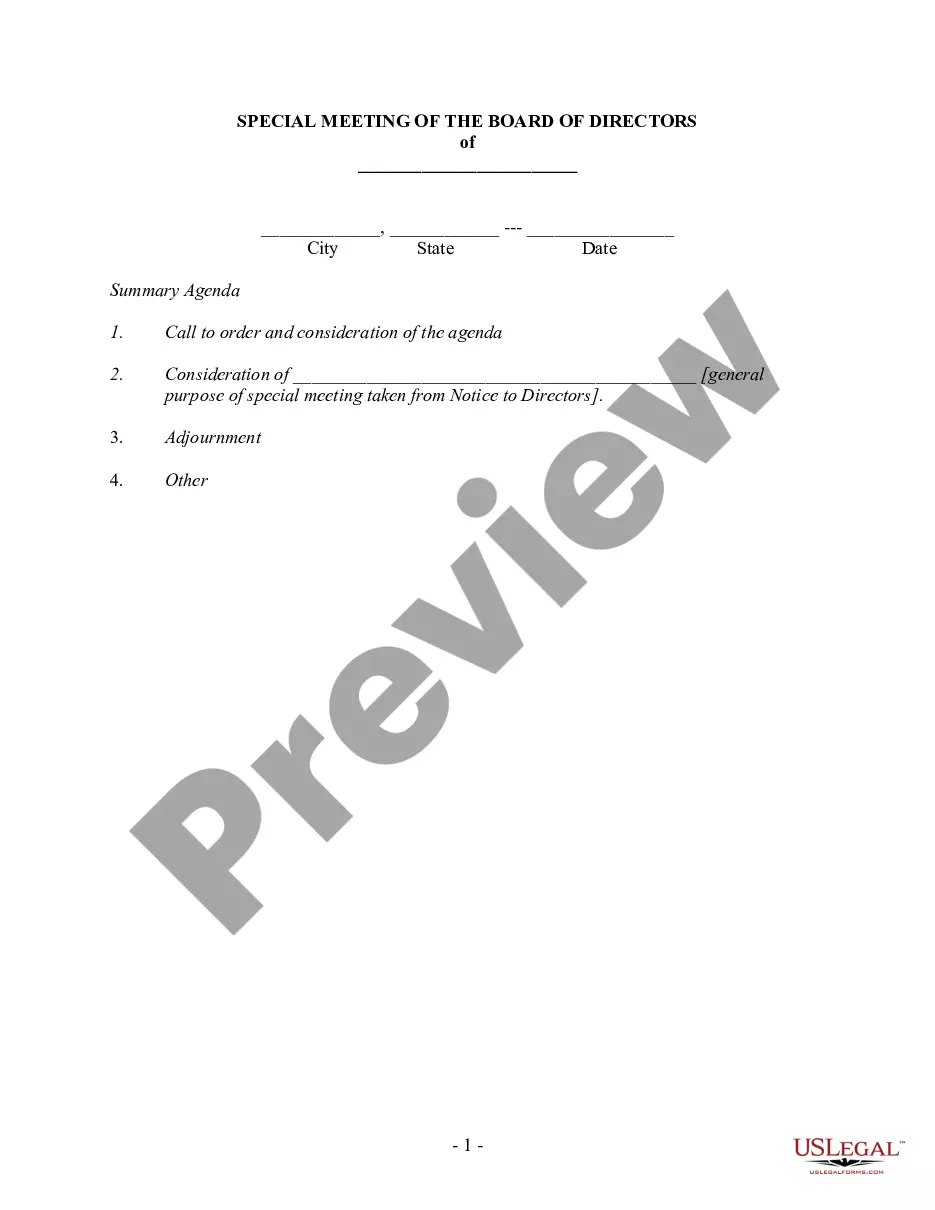
An agenda is a list of meeting activities in the order in which they are to be taken up, beginning with the call to order and ending with adjournment. It usually includes one or more specific items of business to be acted upon. It may, but is not required to, include specific times for one or more activities.
Inspired by the work of researchers Kim Cameron and David Whetten, here are some proven methods for how to have an effective meeting every time by following the four Ps: purpose, product, people, and process.
The order of items discussed in a meeting. The topics must be listed, past knowledge must be heard, and the outcome must be guessed.
The agenda should include the meeting's goal, a list of topics to be discussed with their purposes, time allocations, and assigned facilitators. This structure provides a clear roadmap for the meeting, ensuring that all important points are covered.
A meeting of the Board shall be called by giving not less than seven days' notice in writing to every director at his address registered with the company and such notice shall be sent by hand delivery or by post or by electronic means Provided that a meeting of the Board may be called at shorter notice to transact ...
4. Set an agenda for the meeting Determine the goals of the meeting . Write down the questions you want to address. Ask attendees for input. Estimate the amount of time you need to spend on each topic. Determine the purpose of each task. Identify who will lead each topic. Conclude each meeting with a review.

