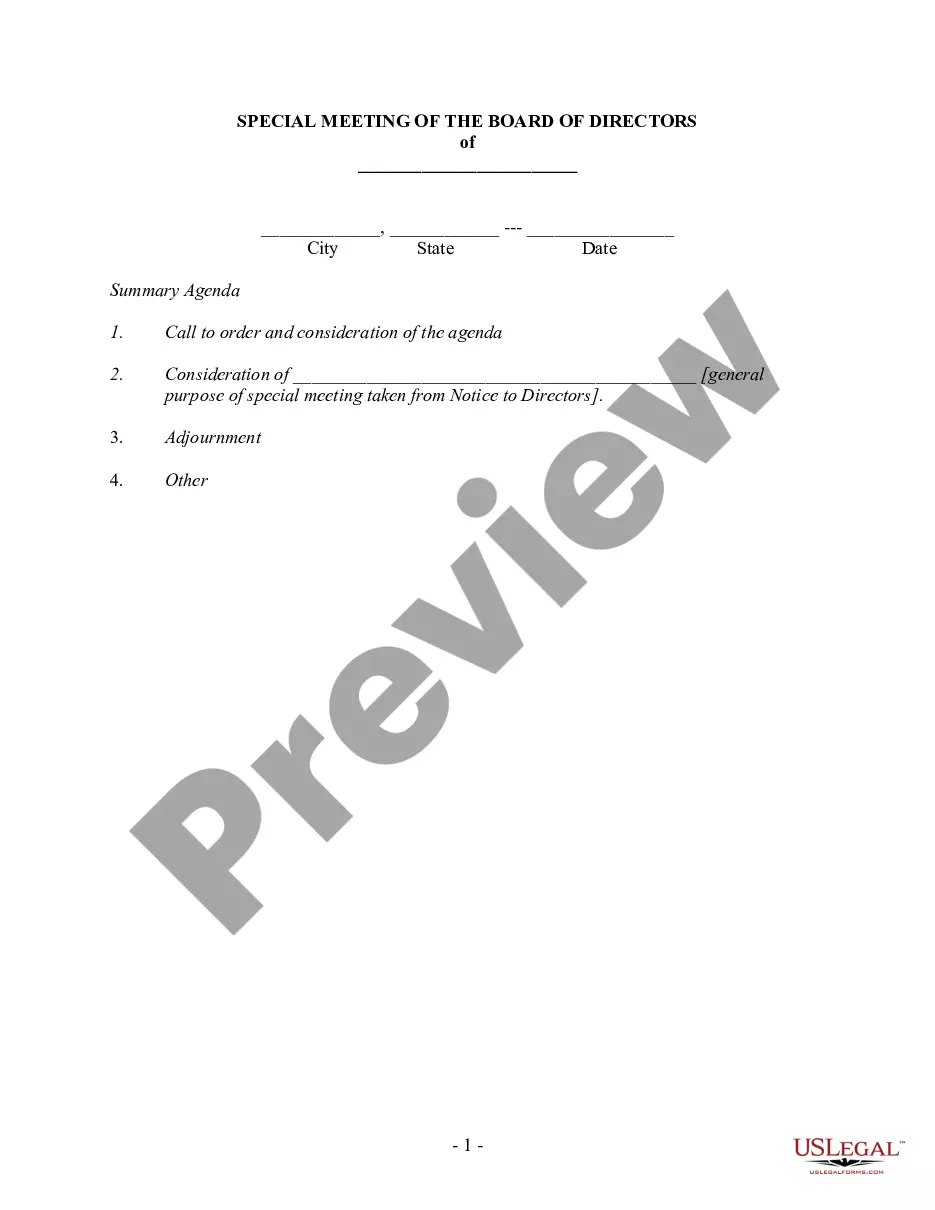
Board Meeting For In Riverside
Description



Get your form ready online
Our built-in tools help you complete, sign, share, and store your documents in one place.
Make edits, fill in missing information, and update formatting in US Legal Forms—just like you would in MS Word.
Download a copy, print it, send it by email, or mail it via USPS—whatever works best for your next step.
Sign and collect signatures with our SignNow integration. Send to multiple recipients, set reminders, and more. Go Premium to unlock E-Sign.
If this form requires notarization, complete it online through a secure video call—no need to meet a notary in person or wait for an appointment.
We protect your documents and personal data by following strict security and privacy standards.

Make edits, fill in missing information, and update formatting in US Legal Forms—just like you would in MS Word.

Download a copy, print it, send it by email, or mail it via USPS—whatever works best for your next step.

Sign and collect signatures with our SignNow integration. Send to multiple recipients, set reminders, and more. Go Premium to unlock E-Sign.

If this form requires notarization, complete it online through a secure video call—no need to meet a notary in person or wait for an appointment.

We protect your documents and personal data by following strict security and privacy standards.
Looking for another form?



Form popularity
FAQ
The chair owns the agenda Who prepares the first draft? Usually the company secretary, the CEO or the board secretary. This then needs to be approved or amended by the chair. The agenda and the board papers need to be sent to all directors at least 5 days plus a weekend, prior to the board meeting.
Introduce yourself and other speakers at the start of the meeting. If it is a small meeting, ask everyone to introduce themselves. Sometimes it works well to get people to say a bit more about themselves as part of the introductions. Tell people what the meeting is about.
Board chair: The board chair is at the helm of every meeting and is responsible for following board meeting best practices. They set the agenda and collaborate with the corporate secretary to create it. They guide all conversations and decisions using the agenda, ensuring every board member feels heard.
Most board meeting agendas follow a classic meeting structure: Calling meeting to order – ensure you have quorum. Approve the agenda and prior board meeting minutes. Executive and committee reports – allow 25% of time here for key topic discussion. Old/new/other business. Close the meeting and adjourn.
Ultimately it is for the Chair to decide where on the agenda an item should be placed if there is any doubt. However, the Secretary should draft the agenda in full with a proposal for where items should be positioned.
In most cases, the board secretary will set the agenda for a board meeting, although any board member can do it. The secretary often puts the board meeting agenda together in collaboration with the board president. The secretary typically asks board members if they have any items they want to be added to the agenda.
Here's how to create an agenda for a board meeting: Include discrete, standalone items, phrased as questions. Add a description of each item, including an objective. Identify an overall meeting leader, as well as a leader for each agenda item. Give clear timings for each agenda item.
The officers of the organization prepare the agenda with assistance from the organization advisor. An agenda starts with a list of general business items. Specific topics that are to be discussed at the meeting are placed under the proper agenda item in an outline format.
7 Step Meeting Process Clarify Aim/Purpose. Assign Roles. Review Agenda. Work through Agenda. Review meeting record. Plan Next Steps and Next Agenda. Evaluate.
Starting the Meeting: ``Good (morning/afternoon), everyone. Thank you for joining us today. I'd like to welcome you to this meeting. Our agenda includes (briefly outline the agenda items). Let's begin with our first topic.''

