Board Meeting For Directors In Clark
Description



Get your form ready online
Our built-in tools help you complete, sign, share, and store your documents in one place.
Make edits, fill in missing information, and update formatting in US Legal Forms—just like you would in MS Word.
Download a copy, print it, send it by email, or mail it via USPS—whatever works best for your next step.
Sign and collect signatures with our SignNow integration. Send to multiple recipients, set reminders, and more. Go Premium to unlock E-Sign.
If this form requires notarization, complete it online through a secure video call—no need to meet a notary in person or wait for an appointment.
We protect your documents and personal data by following strict security and privacy standards.

Make edits, fill in missing information, and update formatting in US Legal Forms—just like you would in MS Word.

Download a copy, print it, send it by email, or mail it via USPS—whatever works best for your next step.

Sign and collect signatures with our SignNow integration. Send to multiple recipients, set reminders, and more. Go Premium to unlock E-Sign.

If this form requires notarization, complete it online through a secure video call—no need to meet a notary in person or wait for an appointment.

We protect your documents and personal data by following strict security and privacy standards.
Looking for another form?








Form popularity
FAQ
What defines a qualified board member? Three things: Natural capability, fuelled by experience and leadership ability. Formal qualifications in one or more core governance topics like ESG or cybersecurity.
How to Become a Board Member Build Relevant Experience. Develop a Strong Professional Network. Develop a Value Proposition. Identify Open Positions. Participate in the Selection Process.
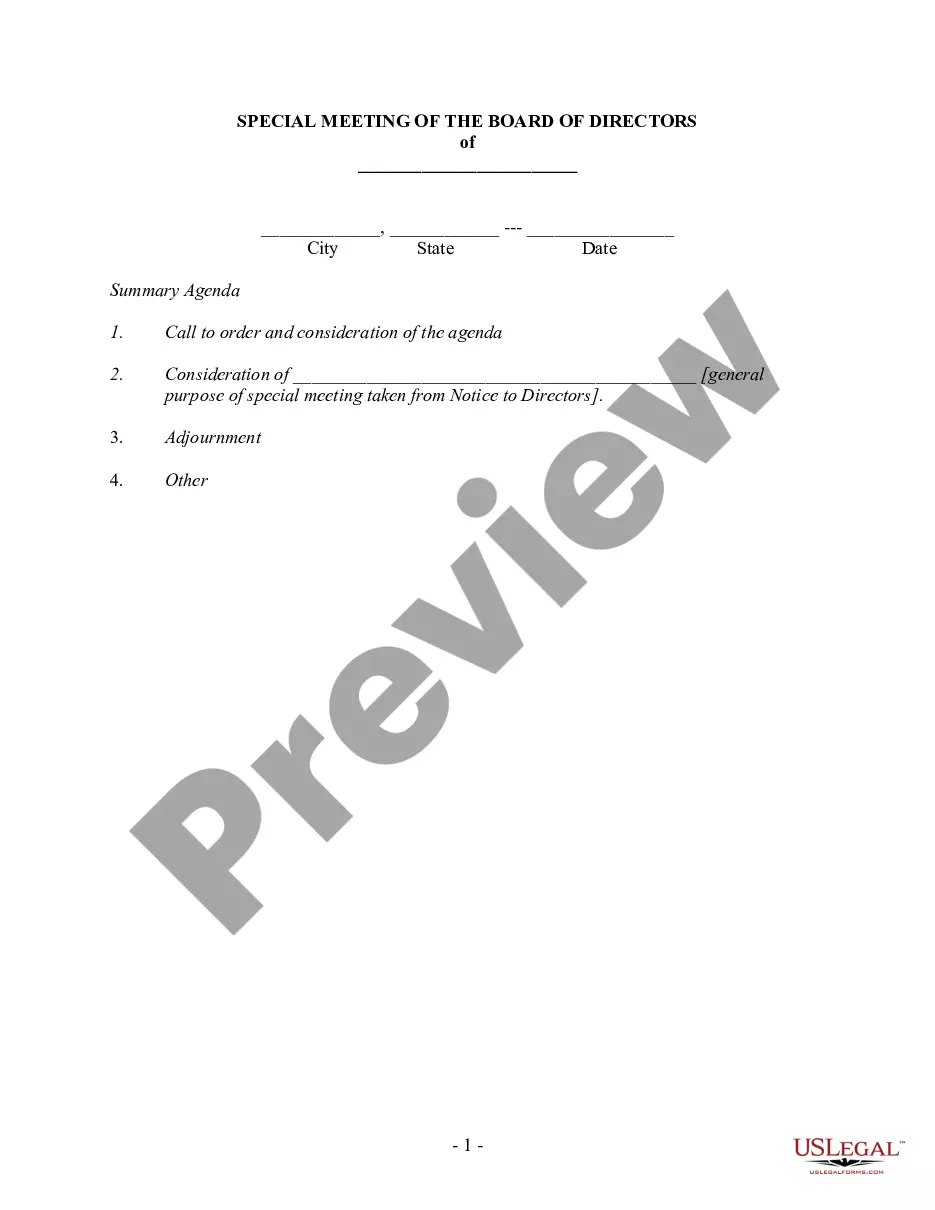
Most board meeting agendas follow a classic meeting structure: Calling meeting to order – ensure you have quorum. Approve the agenda and prior board meeting minutes. Executive and committee reports – allow 25% of time here for key topic discussion. Old/new/other business. Close the meeting and adjourn.
How to Become a Board Member Build Relevant Experience. Develop a Strong Professional Network. Develop a Value Proposition. Identify Open Positions. Participate in the Selection Process.
Usually, they are nominated by the Board for a vacancy or recruited by the Board or CEO because they have specific experience in a field...or they have strong relationships within the industry. I always advise people to contact every director of any company of interest and either meet with them in person or by phone.
For a smaller board, the process often involves being interviewed, whereas larger organizations tend to have a more formalized review before nominating someone for a seat. In publicly traded companies, board members are approved by shareholders at the recommendation of management.
Agendas work hand-in-hand with meeting minutes to direct and document your meetings successfully. Before the meeting starts, outline an agenda of key items the group will discuss, including a review of past decisions, follow up on previous assignments, and new questions or problems to address.
Most board meeting agendas follow a classic meeting structure: Calling meeting to order – ensure you have quorum. Approve the agenda and prior board meeting minutes. Executive and committee reports – allow 25% of time here for key topic discussion. Old/new/other business. Close the meeting and adjourn.
Best practices for taking board meeting minutes Use concise language and avoid jargon, complex sentences, or ambiguities. Also, proofread and edit the document before sharing it with stakeholders for feedback and board members for approval. Be selective about the information you include in board meeting minutes.
profit looking for a better way to schedule board meetings needs to keep in mind only 3 simple steps. Work within a date range that works for the organization's calendar. Work within days/times that works for board members' calendars. Make the final decision quickly and stick with it.

