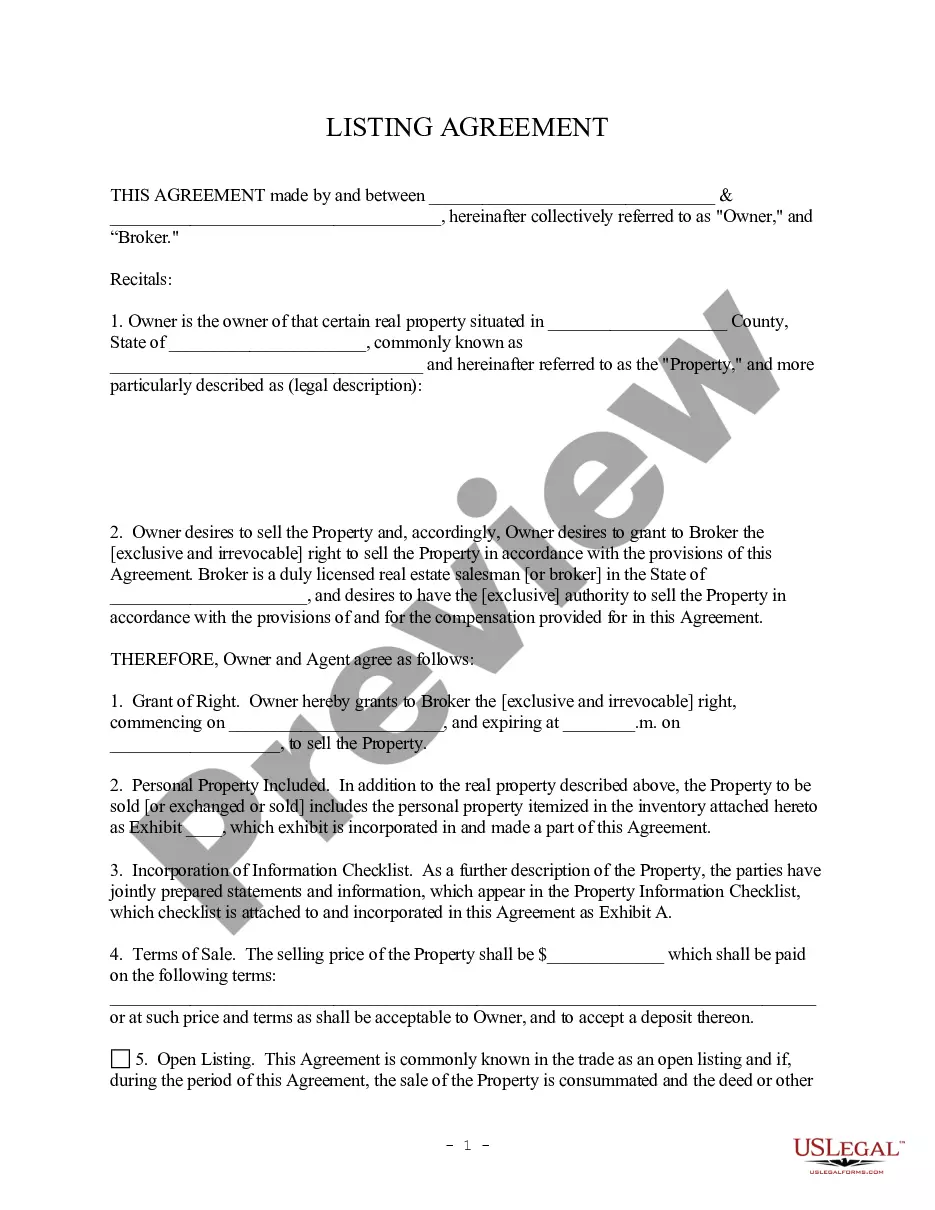
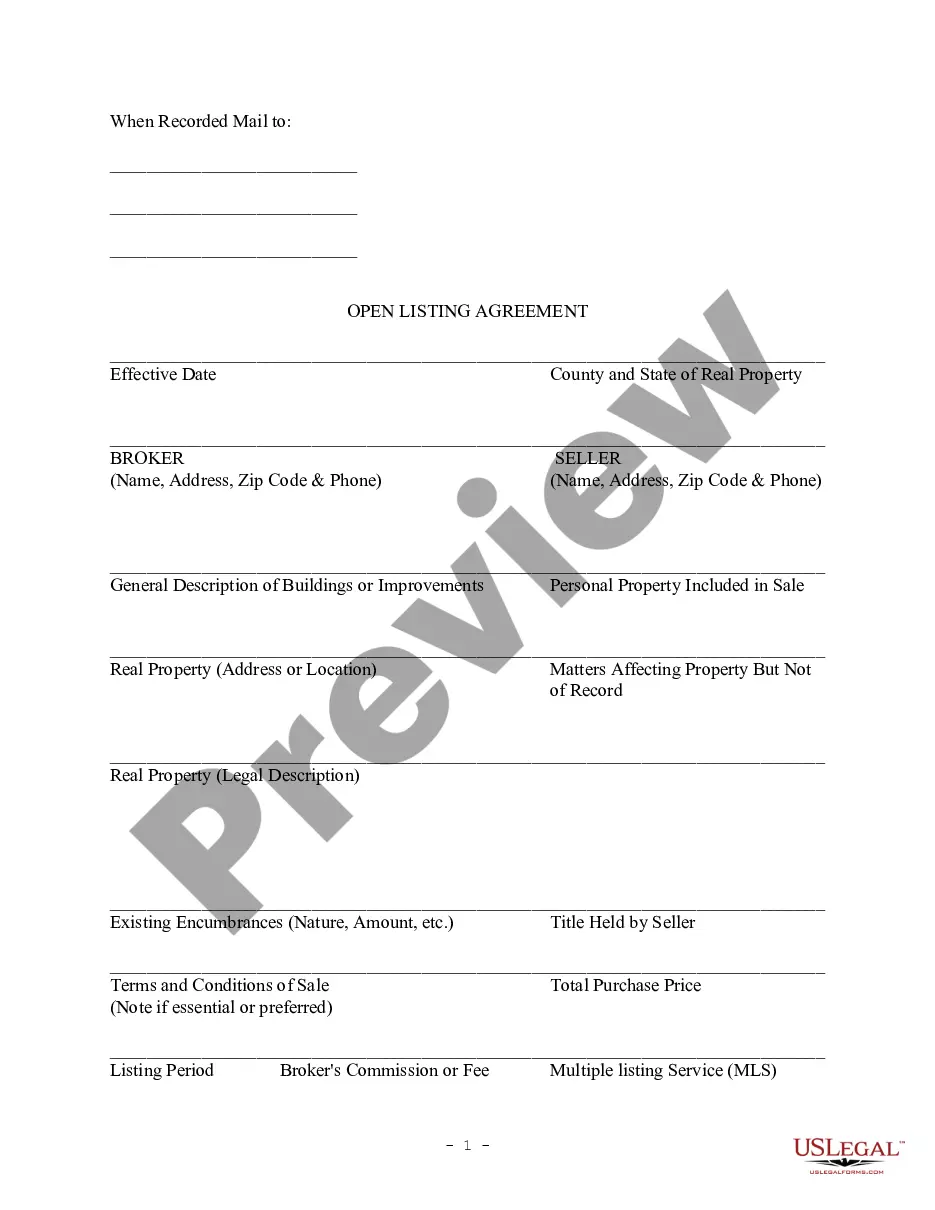
Listing Agreement Contract Format In Santa Clara
Description
Get your form ready online
Our built-in tools help you complete, sign, share, and store your documents in one place.
Make edits, fill in missing information, and update formatting in US Legal Forms—just like you would in MS Word.
Download a copy, print it, send it by email, or mail it via USPS—whatever works best for your next step.
Sign and collect signatures with our SignNow integration. Send to multiple recipients, set reminders, and more. Go Premium to unlock E-Sign.
If this form requires notarization, complete it online through a secure video call—no need to meet a notary in person or wait for an appointment.
We protect your documents and personal data by following strict security and privacy standards.

Make edits, fill in missing information, and update formatting in US Legal Forms—just like you would in MS Word.

Download a copy, print it, send it by email, or mail it via USPS—whatever works best for your next step.

Sign and collect signatures with our SignNow integration. Send to multiple recipients, set reminders, and more. Go Premium to unlock E-Sign.

If this form requires notarization, complete it online through a secure video call—no need to meet a notary in person or wait for an appointment.

We protect your documents and personal data by following strict security and privacy standards.
Looking for another form?







Form popularity
FAQ
Write the contract in six steps Start with a contract template. Open with the basic information. Describe in detail what you have agreed to. Include a description of how the contract will be ended. Write into the contract which laws apply and how disputes will be resolved. Include space for signatures.
Similarly, real estate agents may use electronic listing agreement forms to create an enforceable agency relationship with a client, as though it were a printed document manually signed by the client.
Writing your own contracts is perfectly possible, and legal. But it's also an incredibly bad idea. There's two reasons for this: Property law is complicated. Because it's such a fundamental part of legislation, it's often lots and lots of different laws layered on top of each other.
The three types of real estate listing agreements are open listing, exclusive agency listing, and exclusive right-to-sell listing.
Real estate contracts commonly include the following information: Parties involved: The names and contact information of the buyer(s) and seller(s). Property description: A detailed description of the property, including its address, legal description, and any specific features.
Eight Listing Traps to Avoid Approach to Conflicts of Interest. Non-Disclosed Referral Fees. Lack of Specificity in the Listing Agreement. Unquantifiable Efforts. Long Listing Agreements. Seller Costs. Focus on Brokerage Rather Than Agent. Paying Out of Escrow.
To be legally enforceable, a listing agreement must satisfy four requirements. It must contain a property description, include a promise of compensation, specify a fixed figure for the compensation (either a percentage or a dollar amount), and be in writing and signed by the seller.
Every valid contract in California needs to have four essential elements. (1) The parties must be capable of contracting, (2) the parties must consent to the contract, (3) the contract must have a lawful object (they cannot be for illegal services), and (4) the contract must be supported by consideration.
A listing agreement is a contract between a property owner and a real estate broker that authorizes the broker to represent the seller and find a buyer for the property. The three types of real estate listing agreements are open listing, exclusive agency listing, and exclusive right-to-sell listing.

