One Time Showing Form With Two Points In San Diego
Description

Get your form ready online
Our built-in tools help you complete, sign, share, and store your documents in one place.
Make edits, fill in missing information, and update formatting in US Legal Forms—just like you would in MS Word.
Download a copy, print it, send it by email, or mail it via USPS—whatever works best for your next step.
Sign and collect signatures with our SignNow integration. Send to multiple recipients, set reminders, and more. Go Premium to unlock E-Sign.
If this form requires notarization, complete it online through a secure video call—no need to meet a notary in person or wait for an appointment.
We protect your documents and personal data by following strict security and privacy standards.

Make edits, fill in missing information, and update formatting in US Legal Forms—just like you would in MS Word.

Download a copy, print it, send it by email, or mail it via USPS—whatever works best for your next step.

Sign and collect signatures with our SignNow integration. Send to multiple recipients, set reminders, and more. Go Premium to unlock E-Sign.

If this form requires notarization, complete it online through a secure video call—no need to meet a notary in person or wait for an appointment.

We protect your documents and personal data by following strict security and privacy standards.
Looking for another form?









Form popularity
FAQ
With a Tier 2 license, the STRO could be rented as a whole home STRO for up to 90 days per calendar year when the Host does not reside onsite. If the Host was planning on operating an STRO for 20 days or less per year, a Tier 1 license would be applicable. A Host does not need to reside onsite with a Tier 1 license.
Recorded Documents: The San Diego County Recorder's Office provides online access to recorded documents such as deeds, liens, and mortgages.
Let's take a look at California first. This state's short term rental definition is fairly standard, with STRs being rentals that last fewer than 30 days. However, property managers in major cities like Los Angeles and San Diego are also required to follow registration and licensing rules specific to the city.
If you only host for 31 days or more at a time, you do not need a license number or a tax number to publish your listing. If you host for 1 to 30 days at a time, you are required to add a short-term residential occupancy license (STRO) and a Transient Occupancy Tax number (TOT) to your listing.
STRO is the occupancy of a legal dwelling unit or part thereof for less than a month. STRO can also be a home-share operation typically sharing a portion of a dwelling.
Tier 3 (whole-home rentals excluding Mission Beach): renting the entire home for more than 20 days per year where the owner does not reside onsite.
The duration of an Exclusive Right to Sell agreement can vary and is typically negotiable between the seller and the real estate agent or broker. However, the most common length of such agreements is around 90 to 180 days (3 to 6 months).
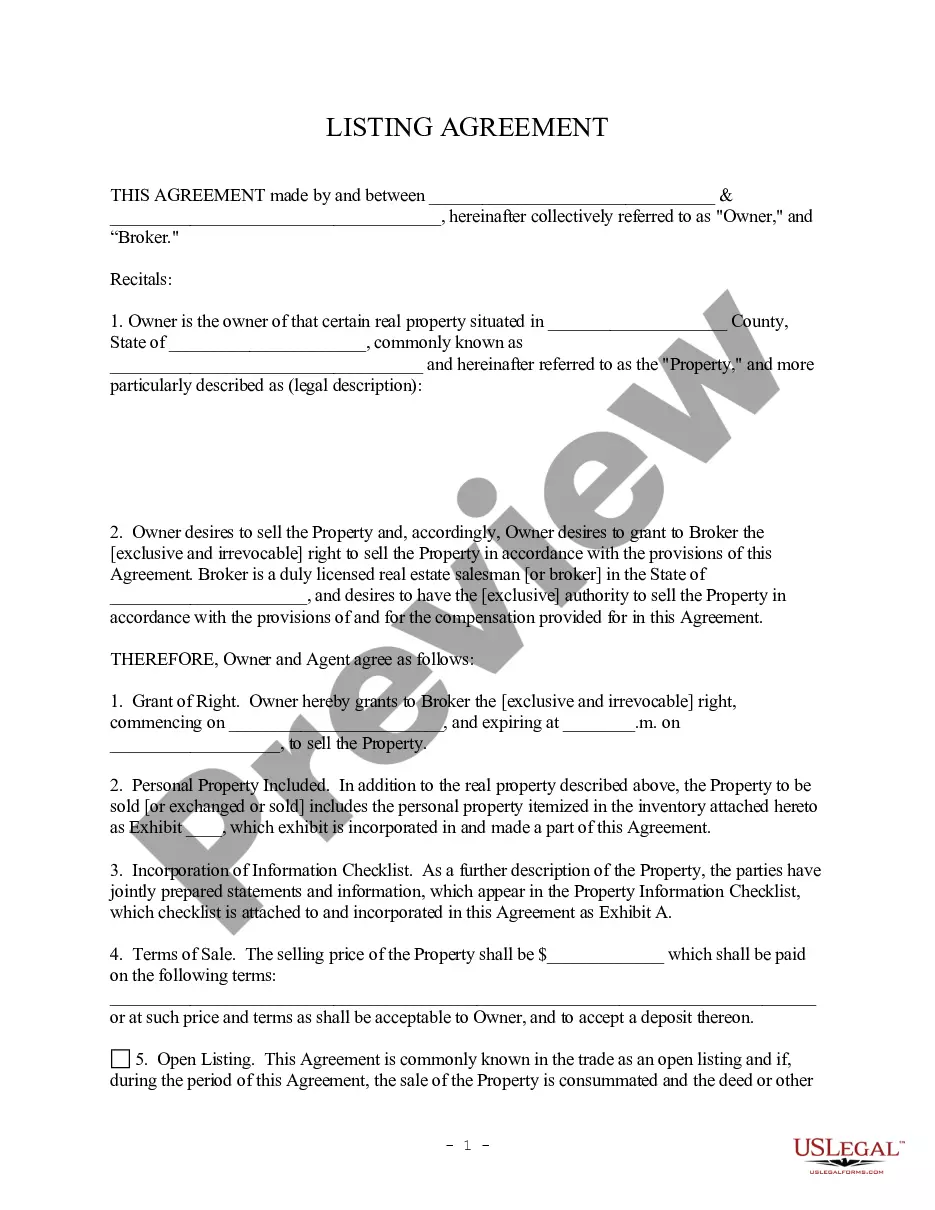
A listing agreement is between the parties that own a property and the agents or brokers who will find a buyer for it. Typically, a real estate listing agreement involves the property owner and a real estate agent. The property owner, or seller, grants the agent the right to market and sell the property.
Listing agreements usually cover a duration of between three and six months. The real estate agent wants to make sure they have enough time to perform the necessary work to find the right buyer and sell your home.
There is no standard time for these agreements. We have seen agents present agreements to their clients ranging from 60-days up to 1- year. In our opinion, you should not be signing contracts for more than 4 months when you first start working with a listing agent.

