Good Faith Exam Template With Calculator In Tarrant
Description

Get your form ready online
Our built-in tools help you complete, sign, share, and store your documents in one place.
Make edits, fill in missing information, and update formatting in US Legal Forms—just like you would in MS Word.
Download a copy, print it, send it by email, or mail it via USPS—whatever works best for your next step.
Sign and collect signatures with our SignNow integration. Send to multiple recipients, set reminders, and more. Go Premium to unlock E-Sign.
If this form requires notarization, complete it online through a secure video call—no need to meet a notary in person or wait for an appointment.
We protect your documents and personal data by following strict security and privacy standards.

Make edits, fill in missing information, and update formatting in US Legal Forms—just like you would in MS Word.

Download a copy, print it, send it by email, or mail it via USPS—whatever works best for your next step.

Sign and collect signatures with our SignNow integration. Send to multiple recipients, set reminders, and more. Go Premium to unlock E-Sign.

If this form requires notarization, complete it online through a secure video call—no need to meet a notary in person or wait for an appointment.

We protect your documents and personal data by following strict security and privacy standards.
Looking for another form?




Form popularity
FAQ
This is called a “good faith estimate.” A good faith estimate isn't a bill. The good faith estimate shows the list of expected charges for items or services from your provider or facility.
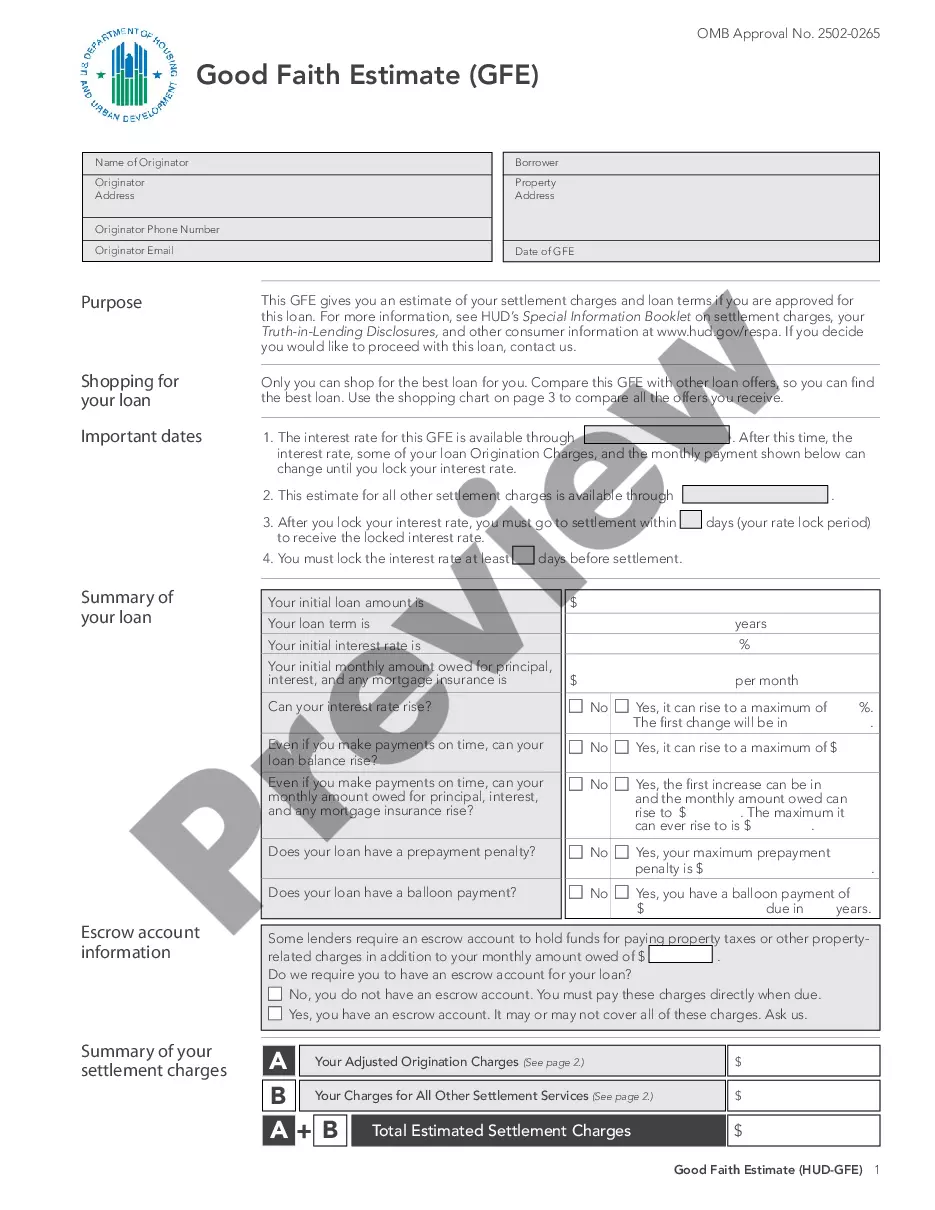
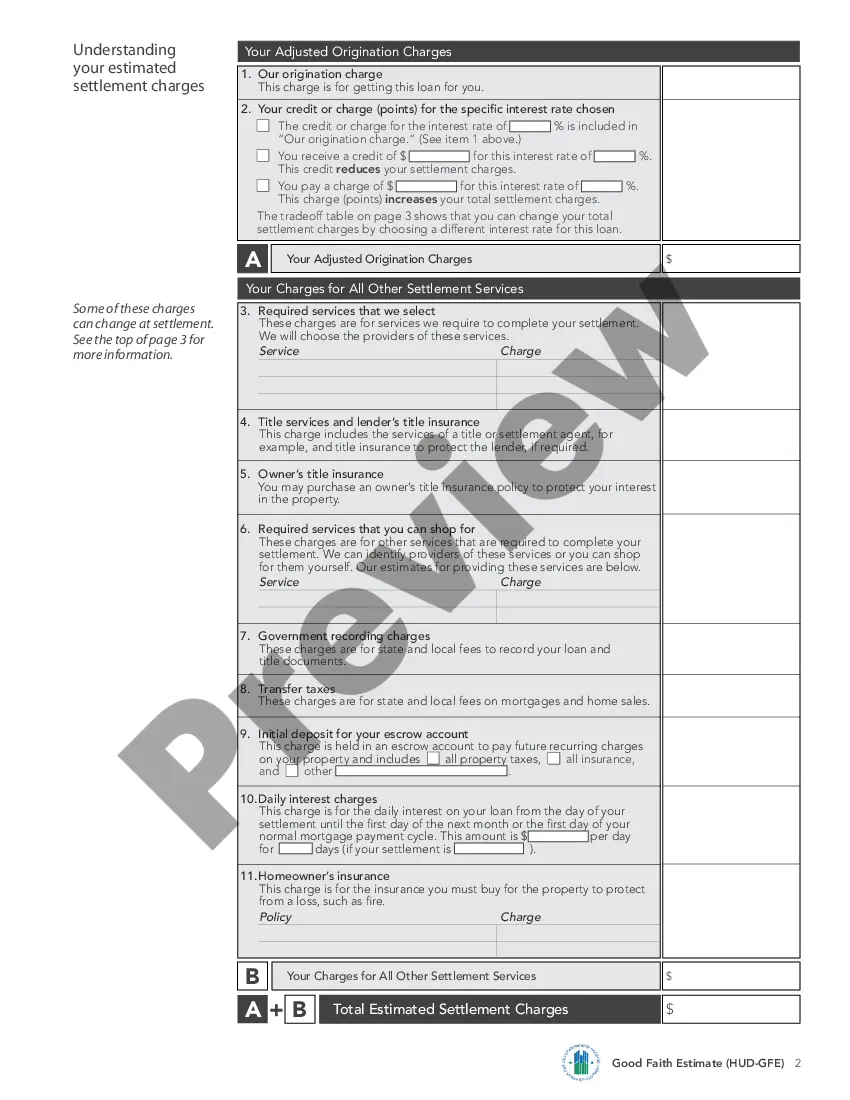
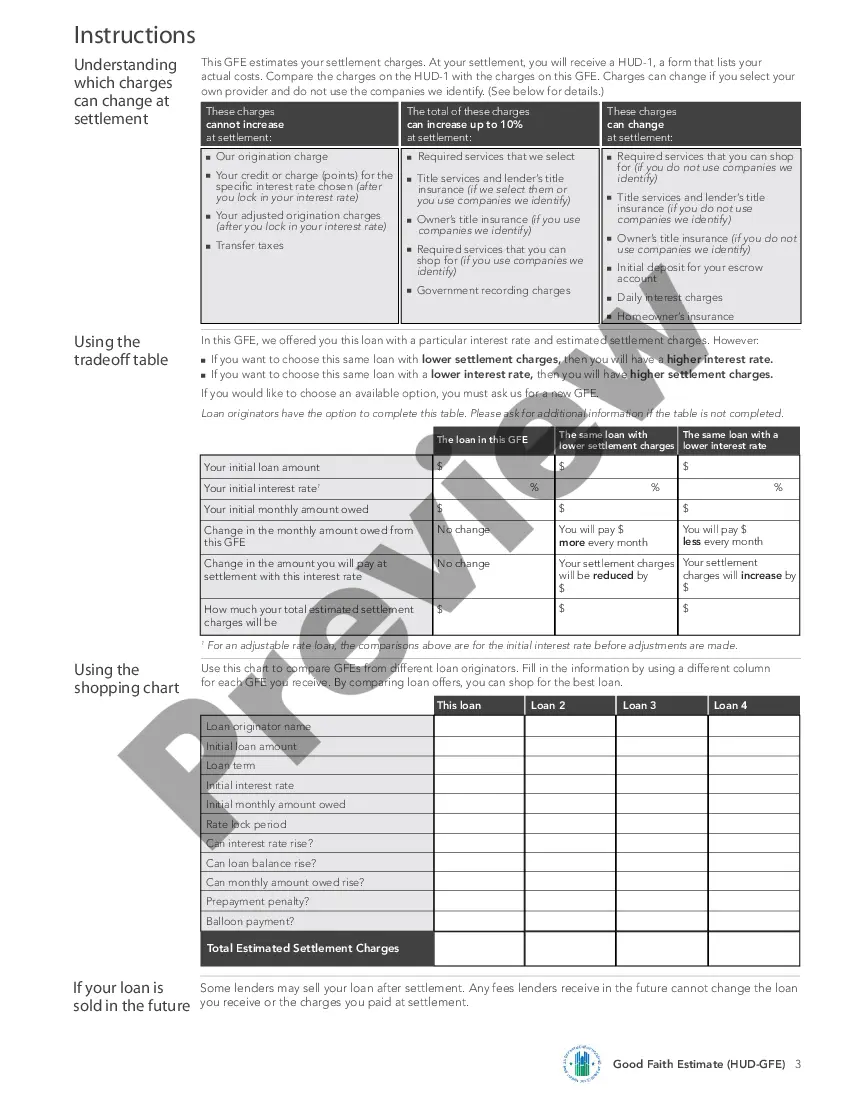
The Good Faith Estimate (GFE) and the HUD-1 Settlement Statement are the primary disclosure documents lenders provide to mortgage applicants. As its name implies, the GFE lists the lender or mortgage broker's best estimate, in "good faith," of closing costs.
A good faith estimate isn't a bill Generally, the good faith estimate must include expected charges for: The primary item or service • Any other items or services you're reasonably expected to get as part of the primary item or service for that period of care.
A good faith estimate should include expected charges for the scheduled health care items and services, including facilities fees, hospital fees, and room and board provided by the provider or facility. Good faith estimates only list expected charges for a single provider or facility.
In Colorado, medical spa treatments that require a good faith evaluation (GFE) include various procedures considered part of medical practice. These treatments, which involve FDA-approved drugs or devices, necessitate an initial evaluation by a licensed medical professional to ensure patient safety and suitability.
What is a Good Faith Evaluation? A good faith evaluation in Texas is a thorough assessment by qualified professionals to ensure the suitability and safety of medical spa treatments.
Good faith exams, also known as pre-authorization exams, are done before any medical procedure or surgery to evaluate whether it is safe or necessary to proceed with the treatment.
Like any other medical procedure, A Good Faith Evaluation ( GFE ) is essential. It is the initial screening done by professionals before you proceed with any treatment. It guarantees safety and accuracy. A physician (or a trained physician assistant or nurse practitioner) must do the evaluation.
When applying the good faith test, courts looked to whether the trustee exercised his or her discretion “reasonably.” Thus, in ordinary situations, a trustee must exercise his or her discretion in “good faith” and “reasonably.” Reasonableness is generally viewed as an objective standard – something that a court could ...
Procedures Involved in Conducting a GFE Firstly, patients are usually asked to fill out forms detailing their medical history and current symptoms. This is followed by a physical examination where the doctor assesses vital signs and checks various body systems.
