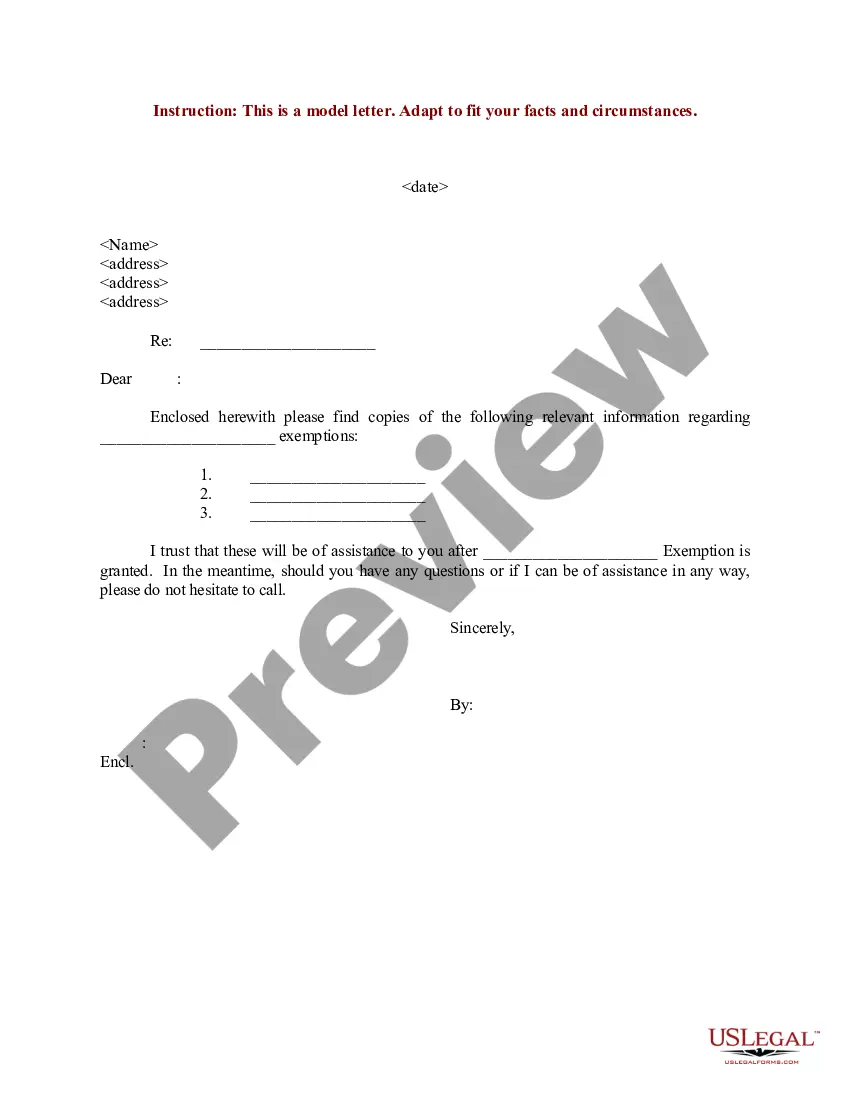
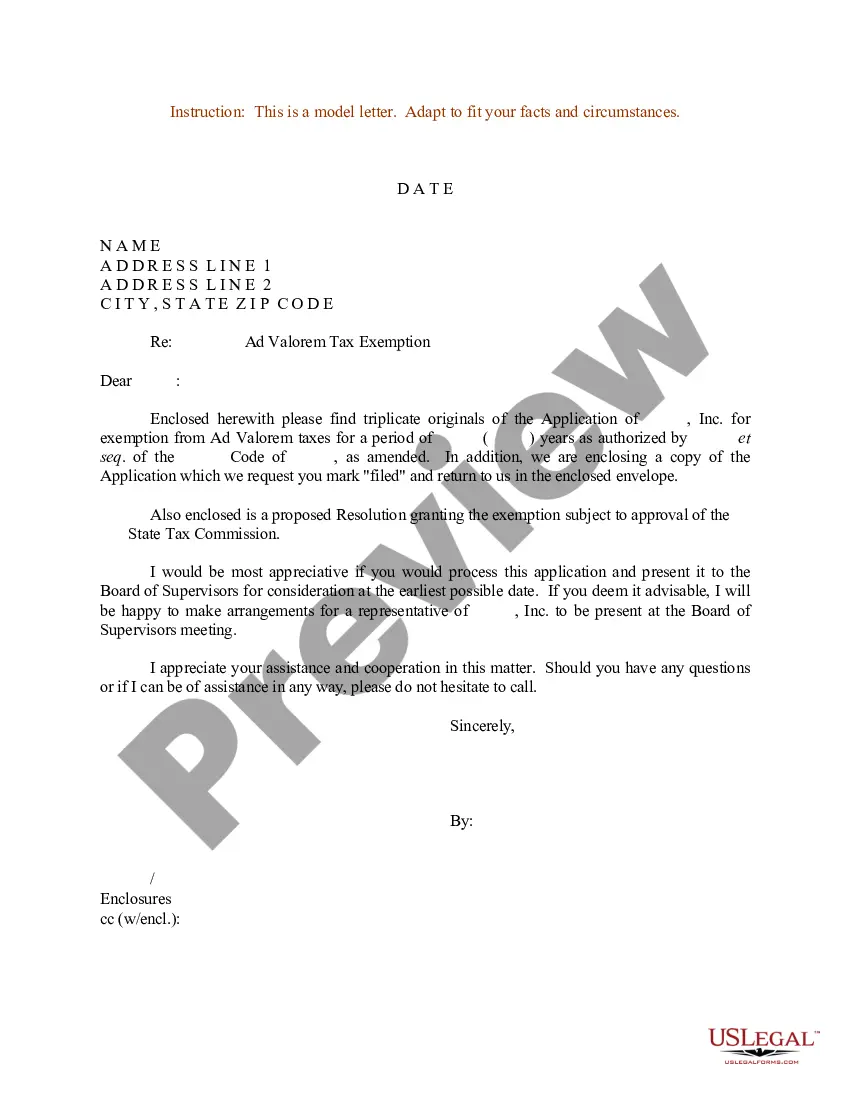
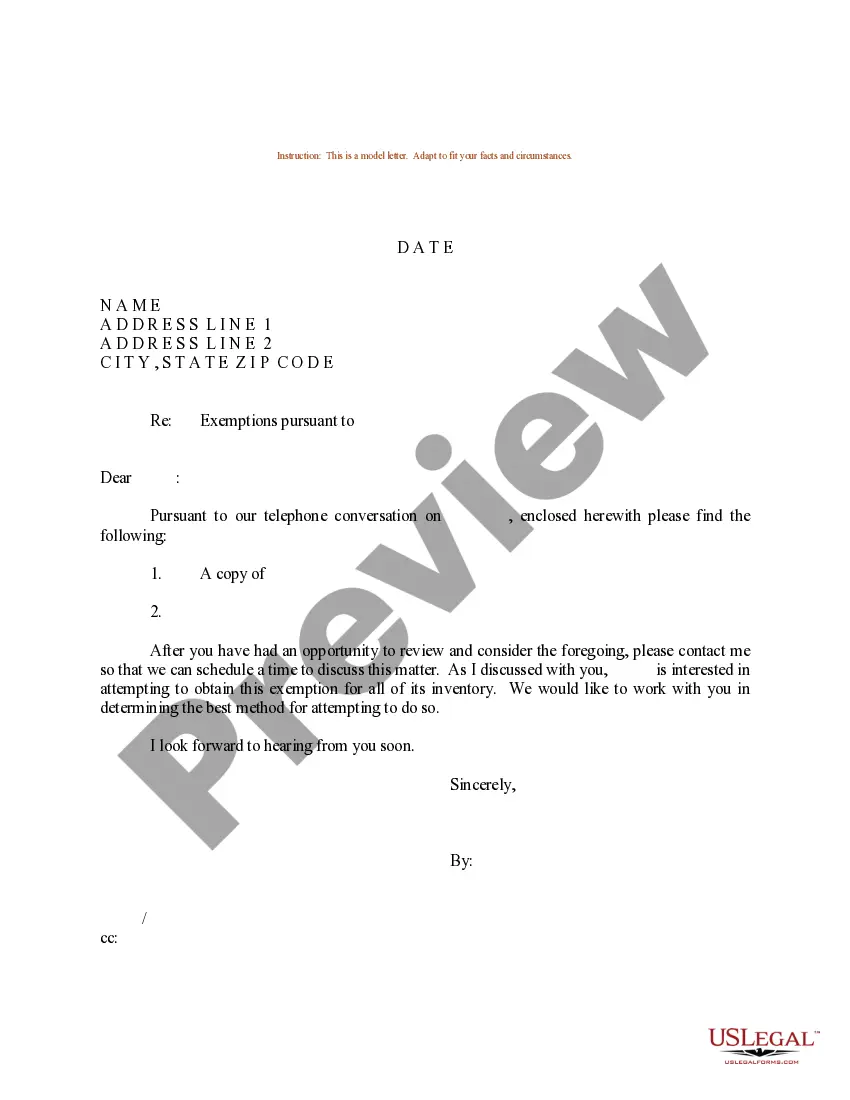
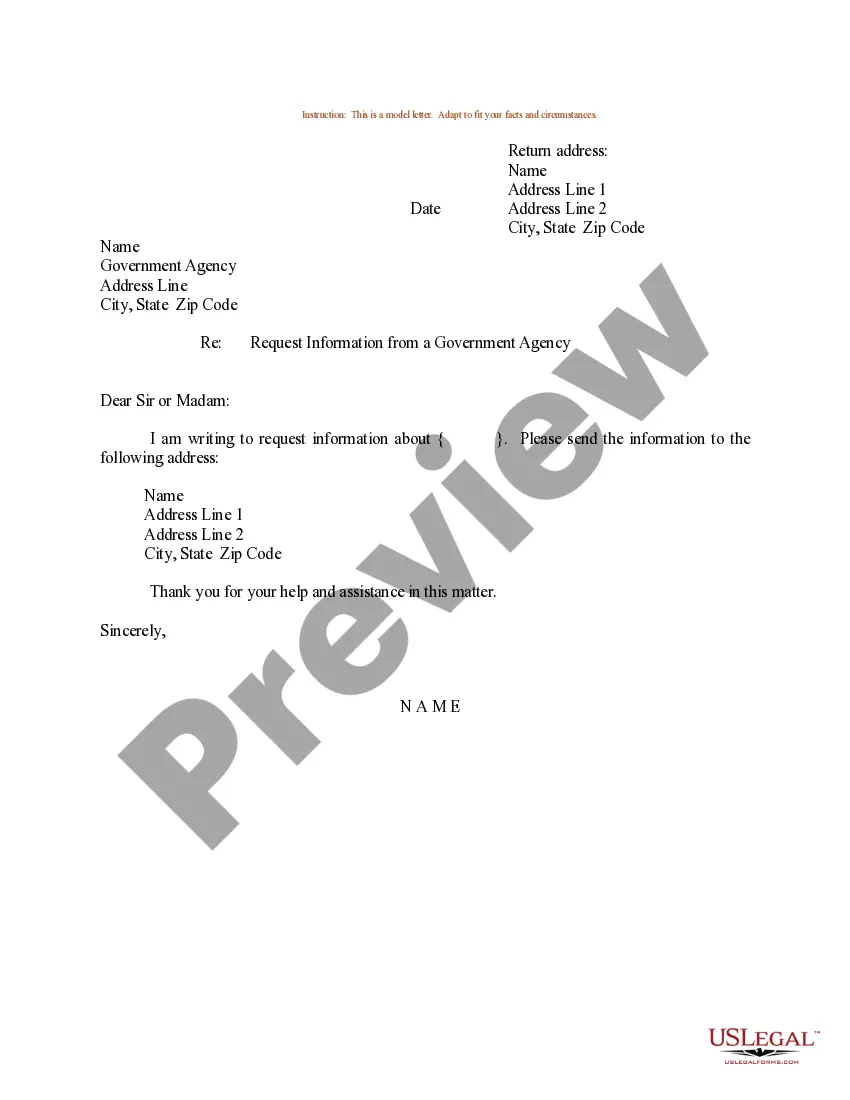
Sample Letter For Exemption In Wake
Description
Get your form ready online
Our built-in tools help you complete, sign, share, and store your documents in one place.
Make edits, fill in missing information, and update formatting in US Legal Forms—just like you would in MS Word.
Download a copy, print it, send it by email, or mail it via USPS—whatever works best for your next step.
Sign and collect signatures with our SignNow integration. Send to multiple recipients, set reminders, and more. Go Premium to unlock E-Sign.
If this form requires notarization, complete it online through a secure video call—no need to meet a notary in person or wait for an appointment.
We protect your documents and personal data by following strict security and privacy standards.

Make edits, fill in missing information, and update formatting in US Legal Forms—just like you would in MS Word.

Download a copy, print it, send it by email, or mail it via USPS—whatever works best for your next step.

Sign and collect signatures with our SignNow integration. Send to multiple recipients, set reminders, and more. Go Premium to unlock E-Sign.

If this form requires notarization, complete it online through a secure video call—no need to meet a notary in person or wait for an appointment.

We protect your documents and personal data by following strict security and privacy standards.
Looking for another form?
Form popularity
FAQ
Dear (Supervisor's Name), I am writing to formally request bereavement leave due to the passing of my (relation, eg, grandmother). She passed away on (date), and I would like to request leave starting from (start date) to (end date) to attend the funeral and be with my family during this difficult time.
Reasons include: Working commitments. Distance - live too far away and travel would be challenging. Illness or a medical condition making it difficult, uncomfortable, and perhaps impossible. Sadness and emotional difficulty. Children are too young to attend. Uncomfortable – may not have seen the person for some time.
It's too far away If you are unable to travel, or if it would be expensive and impractical to attend, then you are likely to be excused from attending. If attending would require international travel, then you might be excused from showing up in person. In this instance, you should send flowers in lieu of attending.
Be Direct and Honest: Clearly state your intention. You can say something like, ``I wanted to let you know that I need to attend a funeral on (date).'' Provide Details if Comfortable: If you feel comfortable, you can share the relationship you had with the deceased, but it's not mandatory.
Sincerely, Your Signature Your Printed Name Dear Recipient, I, Your Name, hereby grant you permission to arrange for the burial of Name of Deceased in our family plot. Please handle all necessary tasks with the funeral home, including transporting the body, preparing the grave, and selecting a casket.
Be Honest If You Can't Attend: If you cannot attend, you might say, ``I'm sorry, but I won't be able to make it. Please know that my thoughts are with you and your family.'' Overall, your response should convey empathy and a willingness to support the person who invited you, even if you didn't know the deceased.
Send a Personalized Letter or Card You might not be able to attend the funeral, but you still have options. One approach is sending a personalized letter or card. A heartfelt message shows your support for those grieving, even if distance separates you. Choose an appropriate bereavement card first.
Dear Teacher/Boss/Manager, I am writing to inform you that I was unable to attend class/work/meeting on date due to unforeseen circumstances. I regret to inform you that I had to attend a funeral of a close family member, which required me to be out of town.
Use phrases like ``I am very sorry I was unable to attend...'' or ``Please accept my sincere apologies for not being present at...'' Explain the reason, but don't make excuses. Briefly state why you were unable to attend, but avoid making it sound like you're making an excuse.
You might say, “No, I can't attend the meeting, but I am happy to review the minutes and give you my feedback.” Another response could be, “No, I won't be there, but I'll be glad to ask someone on my team to cover for me.”Saying “no, but… ” turns a potential negative into a positive and lets the meeting organizer know ...