Sample Bonus Template For Achieving Sales Target In North Carolina
Description
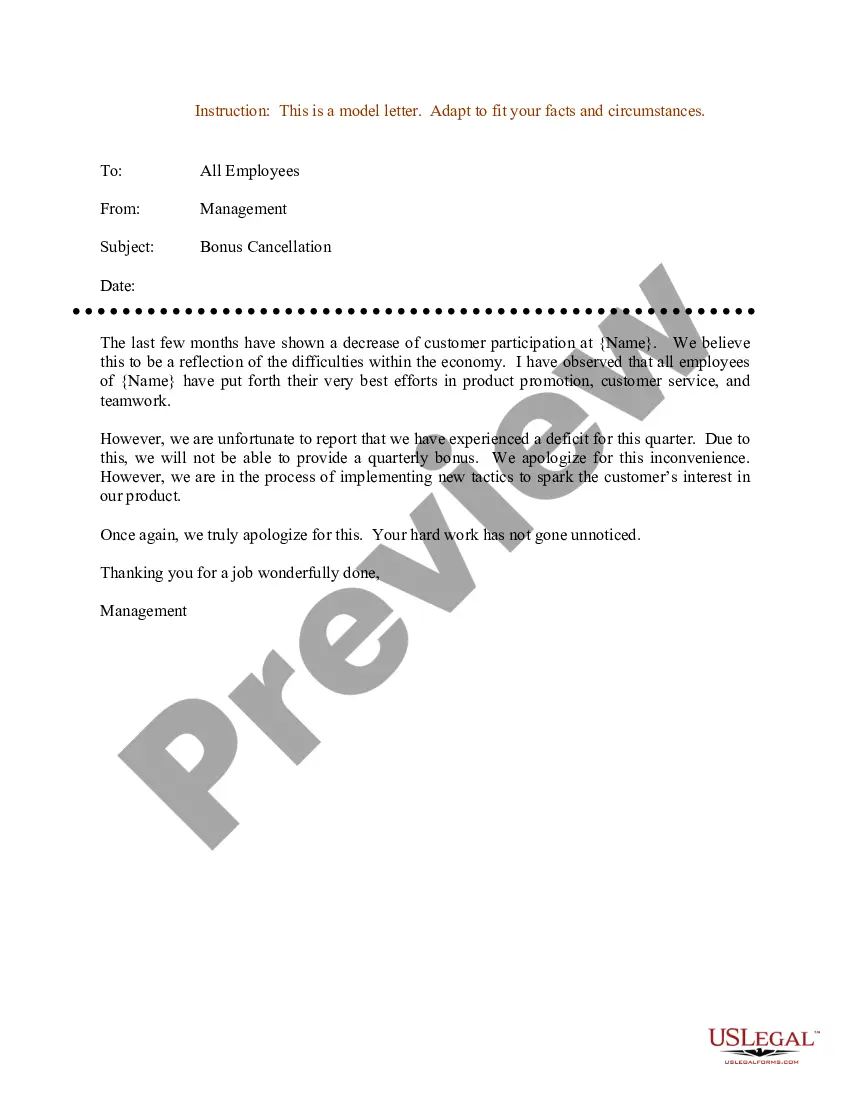
Get your form ready online
Our built-in tools help you complete, sign, share, and store your documents in one place.
Make edits, fill in missing information, and update formatting in US Legal Forms—just like you would in MS Word.
Download a copy, print it, send it by email, or mail it via USPS—whatever works best for your next step.
Sign and collect signatures with our SignNow integration. Send to multiple recipients, set reminders, and more. Go Premium to unlock E-Sign.
If this form requires notarization, complete it online through a secure video call—no need to meet a notary in person or wait for an appointment.
We protect your documents and personal data by following strict security and privacy standards.

Make edits, fill in missing information, and update formatting in US Legal Forms—just like you would in MS Word.

Download a copy, print it, send it by email, or mail it via USPS—whatever works best for your next step.

Sign and collect signatures with our SignNow integration. Send to multiple recipients, set reminders, and more. Go Premium to unlock E-Sign.

If this form requires notarization, complete it online through a secure video call—no need to meet a notary in person or wait for an appointment.

We protect your documents and personal data by following strict security and privacy standards.
Looking for another form?









Form popularity
FAQ
To start setting meaningful incentive goals, follow these best practices. Align goals to strategic priorities. Gather accurate individual historical data. Set a minimum qualifier. Avoid “double-dipping” ... Communicate. Keep an eye on your budget. Iterate and improve.
The target bonus is a percentage of the employee's annual base salary in effect as of the end of the Plan Year. If the Company or Department achieves certain business performance results, and the employee achieves certain individual goals, the employee will receive the target bonus.
Establish clear and measurable goals: The bonus should be tied to specific goals that are measurable and achievable. These goals should be aligned with the overall goals and objectives of the company.
Establish clear and measurable goals: The bonus should be tied to specific goals that are measurable and achievable. These goals should be aligned with the overall goals and objectives of the company.
Organizations may grant goal-based bonuses on a regular basis, such as bi-annually or annually, and use them to incentivize employees to perform well and hit their goals. Example: Employees may receive a goal-based bonus after completing a project or reaching their quota within a set timeline, such as a quarter.
A common structure is tiered bonuses. Here, employees can achieve different "levels" of bonuses based on their performance metrics. For instance, reaching 80% of a target might secure a smaller bonus, while achieving 120% may earn a significantly larger one.
I would say have a basic, then reward by time at company, reward by commission (this will include individual performance. Then a bonus if the company has done well. Do not change the format once you have decided.

