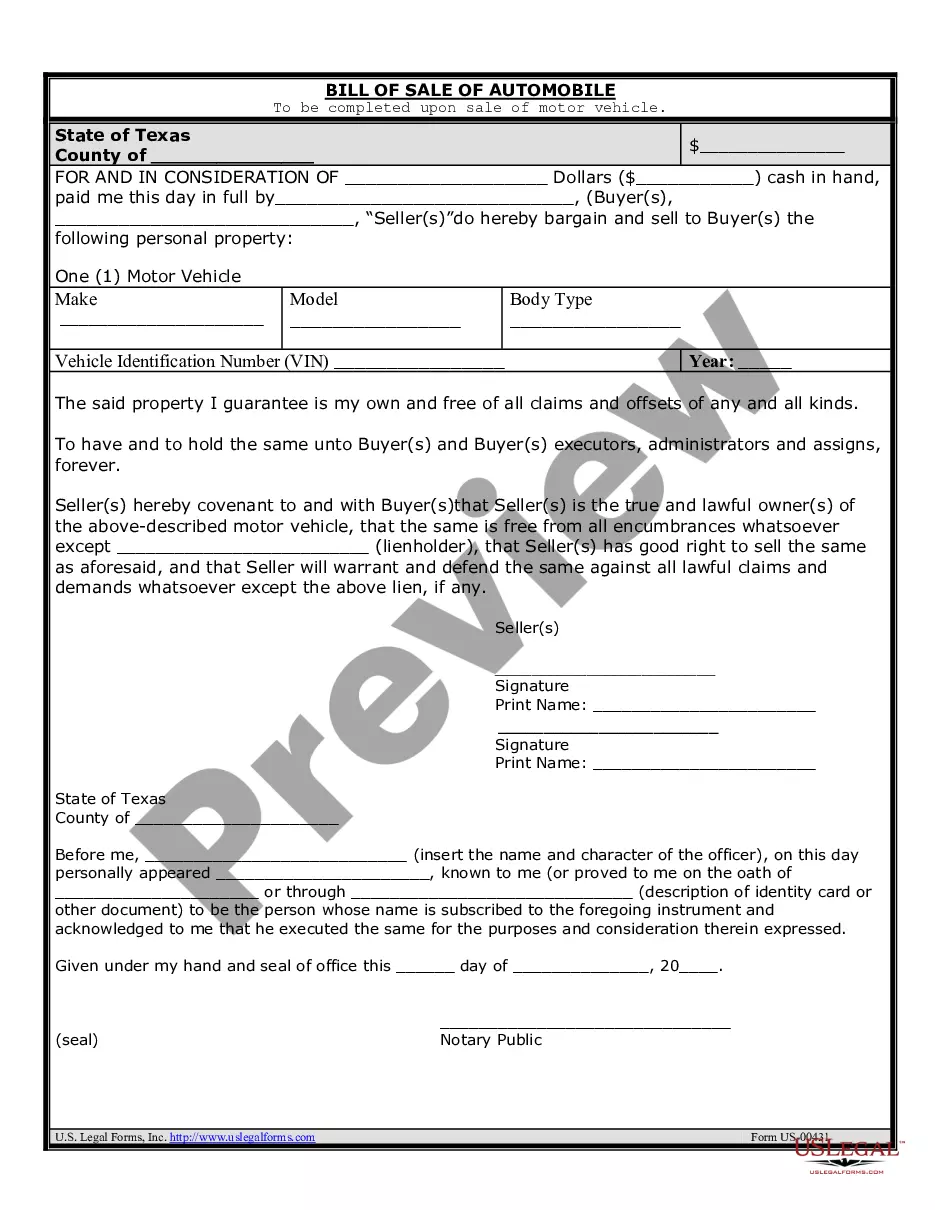
Discrimination Definition In Life Orientation In Collin
Description




Get your form ready online
Our built-in tools help you complete, sign, share, and store your documents in one place.
Make edits, fill in missing information, and update formatting in US Legal Forms—just like you would in MS Word.
Download a copy, print it, send it by email, or mail it via USPS—whatever works best for your next step.
Sign and collect signatures with our SignNow integration. Send to multiple recipients, set reminders, and more. Go Premium to unlock E-Sign.
If this form requires notarization, complete it online through a secure video call—no need to meet a notary in person or wait for an appointment.
We protect your documents and personal data by following strict security and privacy standards.

Make edits, fill in missing information, and update formatting in US Legal Forms—just like you would in MS Word.

Download a copy, print it, send it by email, or mail it via USPS—whatever works best for your next step.

Sign and collect signatures with our SignNow integration. Send to multiple recipients, set reminders, and more. Go Premium to unlock E-Sign.

If this form requires notarization, complete it online through a secure video call—no need to meet a notary in person or wait for an appointment.

We protect your documents and personal data by following strict security and privacy standards.
Looking for another form?








Form popularity
FAQ
Filing a Complaint The Texas Workforce Commission Civil Rights Division (TWCCRD) Employment Discrimination Inquiry Submission System (EDISS) is the method to submit your employment discrimination complaint. It provides an ample amount of space to describe how you have been discriminated against.
There are limits on the amount of compensatory and punitive damages a person can recover. These limits vary depending on the size of the employer: For employers with 15-100 employees, the limit is $50,000. For employers with 101-200 employees, the limit is $100,000.
Direct evidence is most helpful to a Texas workplace discrimination case. Examples of direct evidence may include: Written employment policies. Communications or witness testimony.
Evidence in a discrimination case in California typically includes: emails, text messages, recordings, disciplinary forms, termination documents, or a copy of your employment contract if one exists. If you're like most Californians, you spend an inordinate amount of time at work.
Discrimination is the unfair or prejudicial treatment of people and groups based on characteristics such as race, gender, age, or sexual orientation.
Summary score: Questions 1 – 10, recode responses of “a few times a year” or more frequently (2-5) as 1, responses of “less than once a year” or “never” as 0; then sum the recoded responses. If 1 or more, ask the follow up questions.
Situation-based coding item weighting structure, Everyday Discrimination Scale. In frequency-based coding,15–17,22–24,28 each response is given a value ing to the Likert scale ('never'=1 to 'almost everyday'=6). Responses are summed across items to produce a score ranging from 10 to 60.
The Everyday Discrimination Scale (EDS) has been used widely as a measure of subjective experiences of discrimination. The usefulness of this measure for assessments of perceived experiences of discrimination by American Indian and Alaska Native (AI/AN) peoples has not been explored.
Everyday Discrimination Scale You are treated with less courtesy than other people are. You are treated with less respect than other people are. You receive poorer service than other people at restaurants or stores. People act as if they think you are not smart. People act as if they are afraid of you.
Discrimination, which is often the result of prejudices people hold, makes people powerless, impedes them from becoming active citizens, restricts them from developing their skills and, in many situations, from accessing work, health services, education or accommodation.