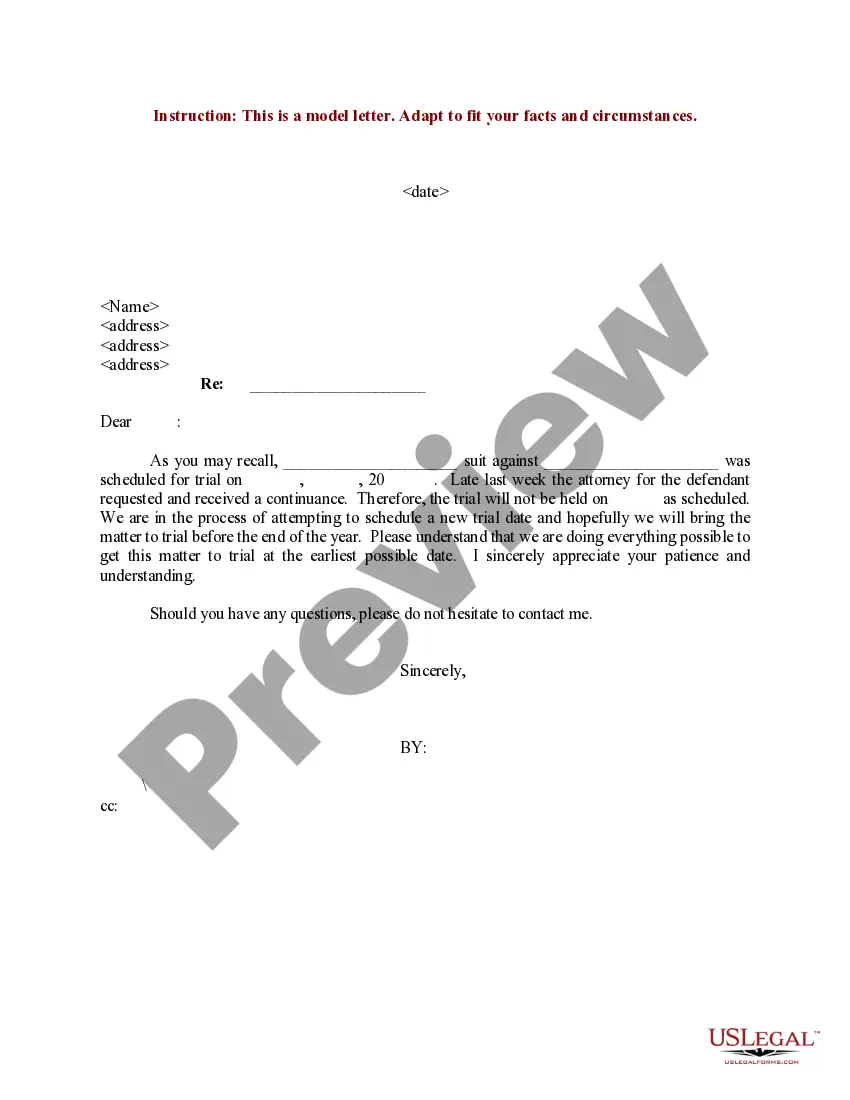
This is a multi-state form covering the subject matter of the title.
Difference Between Clinical Trial And Community Trial In Illinois
State:
Multi-State
Category:
Control #:
US-000291
Format:
Word;
Rich Text
99 downloads
Description
Free preview




Get your form ready online
Our built-in tools help you complete, sign, share, and store your documents in one place.
Built-in online Word editor
Make edits, fill in missing information, and update formatting in US Legal Forms—just like you would in MS Word.
Export easily
Download a copy, print it, send it by email, or mail it via USPS—whatever works best for your next step.
E-sign your document
Sign and collect signatures with our SignNow integration. Send to multiple recipients, set reminders, and more. Go Premium to unlock E-Sign.
Notarize online 24/7
If this form requires notarization, complete it online through a secure video call—no need to meet a notary in person or wait for an appointment.
Store your document securely
We protect your documents and personal data by following strict security and privacy standards.

Make edits, fill in missing information, and update formatting in US Legal Forms—just like you would in MS Word.

Download a copy, print it, send it by email, or mail it via USPS—whatever works best for your next step.

Sign and collect signatures with our SignNow integration. Send to multiple recipients, set reminders, and more. Go Premium to unlock E-Sign.

If this form requires notarization, complete it online through a secure video call—no need to meet a notary in person or wait for an appointment.

We protect your documents and personal data by following strict security and privacy standards.
Looking for another form?









Form popularity
FAQ
Whereas clinical testing is done using scientific processes that measure changes with precision, a consumer perception test asks testers to take a product home, use it for a specific amount of time — often four to eight weeks — and then self-report their findings.
A Senior Management Official (SMO) is the cleared employee of a legal entity who, based on the entity's governance documents, occupies a position in the entity with ultimate authority over the entity's operations and the authority to direct actions necessary to safeguard classified information throughout the entity.
There are two main types of trials or studies: interventional. observational.
While SMOs specialize in site operations, CROs oversee the entire trial process from start to finish.
Site management organizations (SMOs) differ from CROs in several ways, including that they: Are not explicitly regulated or defined by the Food and Drug Administration (FDA). Provide services specific to the clinical study sites.
Interventional studies can be divided broadly into two main types: (i) “controlled clinical trials” (or simply “clinical trials” or “trials”), in which individuals are assigned to one of two or more competing interventions, and (ii) “community trials” (or field trials), in which entire groups, e.g., villages, ...
Community trials address the efficacy of preventive interventions applied at the group level (e.g., a social marketing campaign trial). Field trials address preventive interventions applied to individuals (e.g., a vaccine trial).
An IRO is a type of SMO that is embedded within hospitals, physician practices, and other provider organizations and supplies the entire clinical trial infrastructure that the provider will need to successfully run a clinical trial program, excluding the principal investigator (PI).
Community trials are an extension of field trials. In community trials the study group is the entire community, rather than individuals. Conceptually, the difference is whether or not the intervention is implemented separately for each individual.