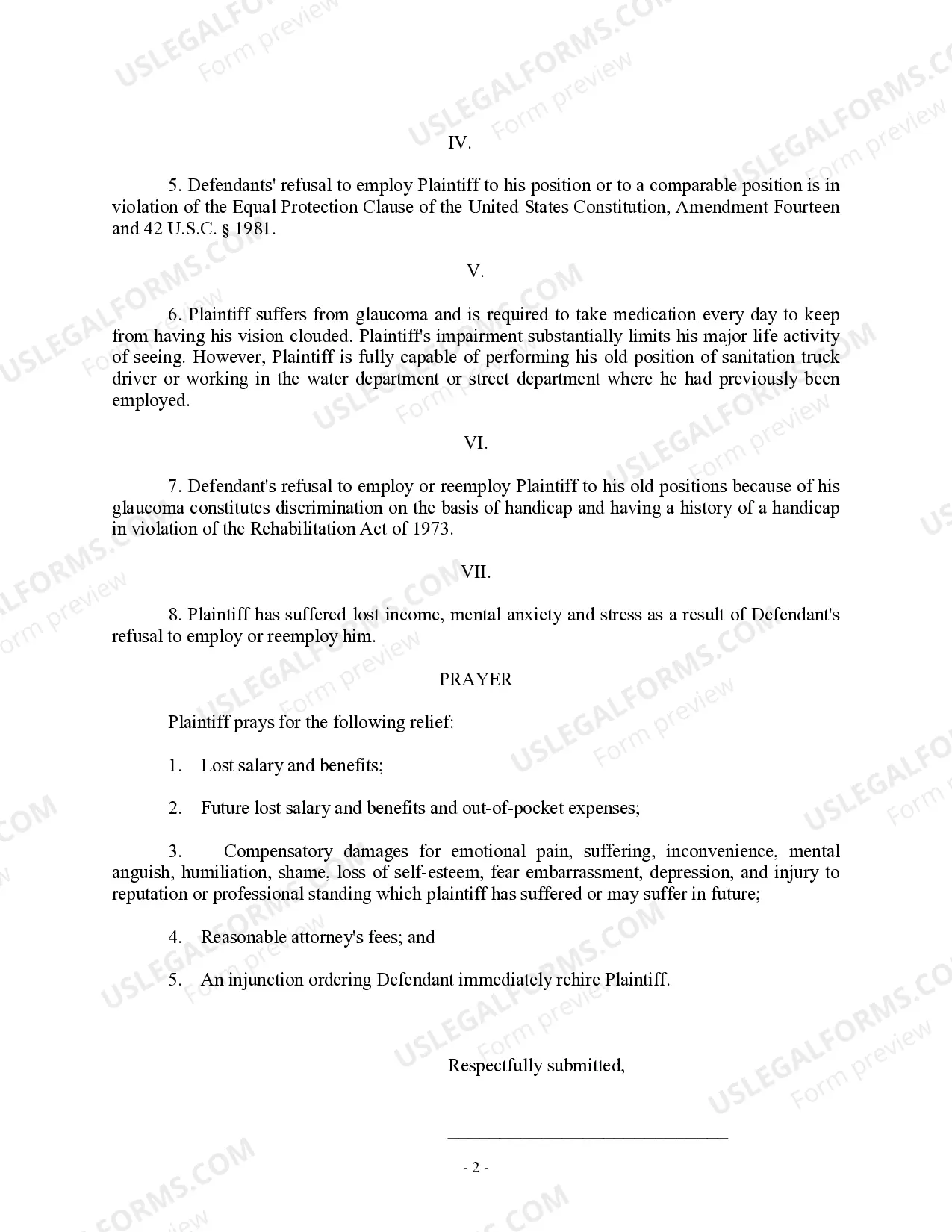
Plaintiff seeks to recover actual, compensatory, liquidated, and punitive damages for discrimination based upon discrimination concerning his disability. Plaintiff submits a request to the court for lost salary and benefits, future lost salary and benefits, and compensatory damages for emotional pain and suffering.
Discrimination For Woman In Wake
State:
Multi-State
Category:
County:
Wake
Control #:
US-000286
Format:
Word;
Rich Text
143 downloads
Description
Free preview





Get your form ready online
Our built-in tools help you complete, sign, share, and store your documents in one place.
Built-in online Word editor
Make edits, fill in missing information, and update formatting in US Legal Forms—just like you would in MS Word.
Export easily
Download a copy, print it, send it by email, or mail it via USPS—whatever works best for your next step.
E-sign your document
Sign and collect signatures with our SignNow integration. Send to multiple recipients, set reminders, and more. Go Premium to unlock E-Sign.
Notarize online 24/7
If this form requires notarization, complete it online through a secure video call—no need to meet a notary in person or wait for an appointment.
Store your document securely
We protect your documents and personal data by following strict security and privacy standards.

Make edits, fill in missing information, and update formatting in US Legal Forms—just like you would in MS Word.

Download a copy, print it, send it by email, or mail it via USPS—whatever works best for your next step.

Sign and collect signatures with our SignNow integration. Send to multiple recipients, set reminders, and more. Go Premium to unlock E-Sign.

If this form requires notarization, complete it online through a secure video call—no need to meet a notary in person or wait for an appointment.

We protect your documents and personal data by following strict security and privacy standards.
Looking for another form?

Form popularity
FAQ
If you've experienced unlawful discrimination, you can complain to the person or organisation who's discriminated against you. You can also make a discrimination claim in the civil courts. Read this page to find out what you should do before you take action about unlawful discrimination.
Epithets, slurs, jokes, negative stereotyping or threatening, intimidating or hostile acts that relate to a person's race, color, religion, gender, national origin, age or disability.
If you've experienced unlawful discrimination, you can complain to the person or organisation who's discriminated against you. You can also make a discrimination claim in the civil courts.
However, discrimination is a state of mind and, therefore, notoriously hard to prove. Sophisticated employers are well aware that discrimination is illegal. Thus, most cases are established through circumstantial evidence.
The chances of winning your discrimination case can vary dramatically depending on the particular circumstances you face. When a lot of evidence has accumulated against your employer, such as emails and history of discriminatory remarks in front of multiple witnesses, your chances of winning a lawsuit are higher.
It will not only benefit you, but your co-workers as well because it will likely make your workplace safer by creating a better environment for all. When you sue, you can also obtain a legal remedy for the discrimination you have faced. Employers often offer a significant sum in these cases.
With 95% of EEOC district court cases being successful, it is clear that legal recourse can be an effective tool for victims of discrimination.
How to Prove Discrimination in the Workplace You have been treated unjustly based on one of your protected characteristics. You are qualified, capable and honest and performed your job satisfactorily. Discrimination has negatively affected your job. Job decisions were not objective.
Evidence takes several forms. It includes your testimony, which is the very first evidence gathered by EEOC. It also includes written materials such as evaluations, notes by your employer, letters, memos, and the like. You will be asked to provide any documents you may have that relate to your case.