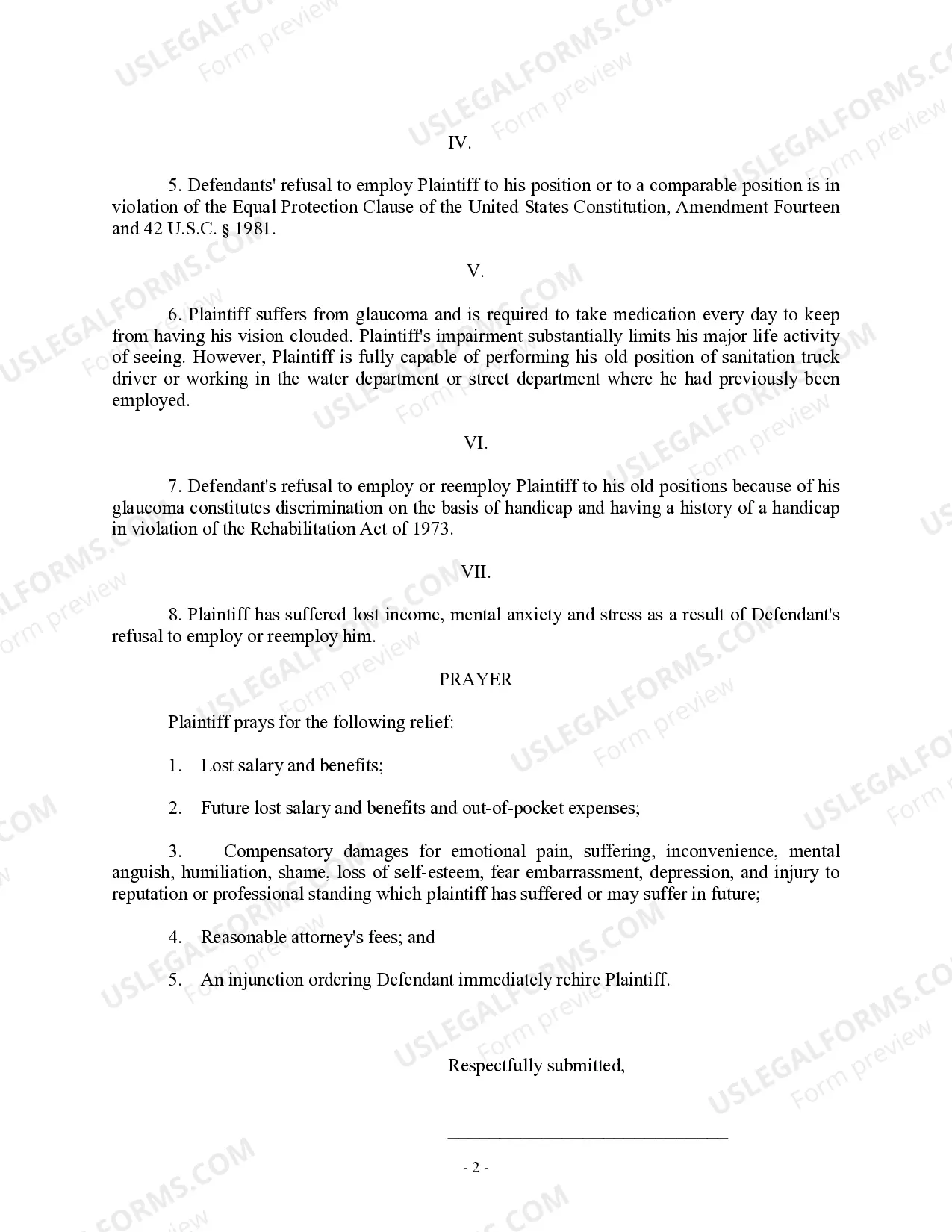
Plaintiff seeks to recover actual, compensatory, liquidated, and punitive damages for discrimination based upon discrimination concerning his disability. Plaintiff submits a request to the court for lost salary and benefits, future lost salary and benefits, and compensatory damages for emotional pain and suffering.
Discrimination With Gender In Philadelphia
State:
Multi-State
Category:
County:
Philadelphia
Control #:
US-000286
Format:
Word;
Rich Text
143 downloads
Description
Free preview





Get your form ready online
Our built-in tools help you complete, sign, share, and store your documents in one place.
Built-in online Word editor
Make edits, fill in missing information, and update formatting in US Legal Forms—just like you would in MS Word.
Export easily
Download a copy, print it, send it by email, or mail it via USPS—whatever works best for your next step.
E-sign your document
Sign and collect signatures with our SignNow integration. Send to multiple recipients, set reminders, and more. Go Premium to unlock E-Sign.
Notarize online 24/7
If this form requires notarization, complete it online through a secure video call—no need to meet a notary in person or wait for an appointment.
Store your document securely
We protect your documents and personal data by following strict security and privacy standards.

Make edits, fill in missing information, and update formatting in US Legal Forms—just like you would in MS Word.

Download a copy, print it, send it by email, or mail it via USPS—whatever works best for your next step.

Sign and collect signatures with our SignNow integration. Send to multiple recipients, set reminders, and more. Go Premium to unlock E-Sign.

If this form requires notarization, complete it online through a secure video call—no need to meet a notary in person or wait for an appointment.

We protect your documents and personal data by following strict security and privacy standards.
Looking for another form?

Form popularity
FAQ
(1) Except as provided in subsection (2), it shall be an unlawful discriminatory practice for an employer to procure, to seek a person's cooperation or consent to procure, or to use credit information regarding an employee or applicant in connection with hiring, discharge, tenure, promotion, discipline or consideration ...
The following would be considered illegal discrimination if there is evidence that the decision was made based on a protected characteristic: Sexual Harassment. Refusal to Provide Services. Unfair Lending Practices. Misrepresenting the Availability of Housing. Refusal to Allow “Reasonable Modifications” Refusing Rental.
The City of Philadelphia has a powerful law prohibiting discrimination in three areas of protection: (1) employment; (2) public accommodation; and (3) housing and real property. The ordinance applies to employers, businesses, housing providers and property owners of all sizes.
The Pennsylvania Human Relations Act (PHRA) covers discrimination in employment, housing, commercial property, education, and public accommodations. The PHRA has been amended many times since its adoption in 1955, originally as the Pennsylvania Fair Employment Practice Act.
Examples of gender discrimination include but are not limited to: Misgendering or mispronouning (purposefully using the wrong gender identity or pronouns to address someone) Having limited access to all-gender restrooms. Disfavoring someone based on gender.
Filing a Claim for Employment Discrimination Before you may file a lawsuit against your employer in court, you must first file a complaint of discrimination with either the EEOC or PHRC. You must file the complaint with either agency within 180 days of the adverse employment action.
When it comes to California discrimination lawsuits, the potential payout varies greatly depending on the company's size. Take small businesses with fewer than 100 employees - they're looking at a maximum payout of $50,000. But scale up to 101-200 employees, and that number jumps to $100,000.
To succeed and receive most damages available under the U.S. Equal Employment Opportunity Commission (EEOC), you must prove your claim is more likely true than not true. You stand a better chance of winning if you present multiple types of evidence reinforcing your claim.
Ing to the Equal Employment Opportunity Commission (EEOC), the average settlement for employment discrimination claims is about $40,000. However, depending on the facts and circumstances of the case, settlements or verdicts can climb to seven figures.
You generally have to file a complaint with the CRD or EEOC before you can file a lawsuit in civil court. You are first required to obtain a “right to sue” notice before your case can be taken to court. You can request an immediate right to sue notice, without having to go through a complete CRD or EEOC investigation.