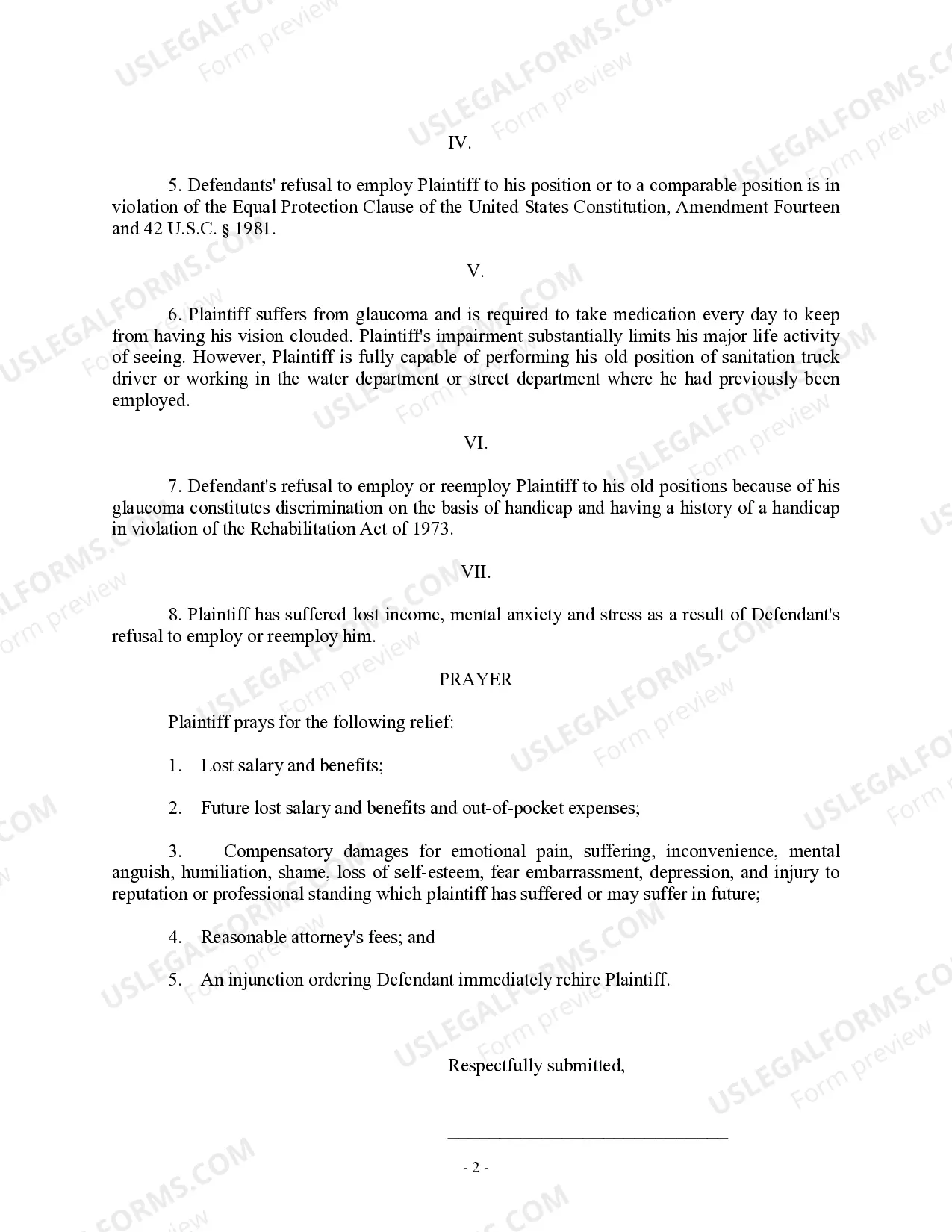
Plaintiff seeks to recover actual, compensatory, liquidated, and punitive damages for discrimination based upon discrimination concerning his disability. Plaintiff submits a request to the court for lost salary and benefits, future lost salary and benefits, and compensatory damages for emotional pain and suffering.
Discrimination With Ai In Philadelphia
State:
Multi-State
Category:
County:
Philadelphia
Control #:
US-000286
Format:
Word;
Rich Text
143 downloads
Description
Free preview





Get your form ready online
Our built-in tools help you complete, sign, share, and store your documents in one place.
Built-in online Word editor
Make edits, fill in missing information, and update formatting in US Legal Forms—just like you would in MS Word.
Export easily
Download a copy, print it, send it by email, or mail it via USPS—whatever works best for your next step.
E-sign your document
Sign and collect signatures with our SignNow integration. Send to multiple recipients, set reminders, and more. Go Premium to unlock E-Sign.
Notarize online 24/7
If this form requires notarization, complete it online through a secure video call—no need to meet a notary in person or wait for an appointment.
Store your document securely
We protect your documents and personal data by following strict security and privacy standards.

Make edits, fill in missing information, and update formatting in US Legal Forms—just like you would in MS Word.

Download a copy, print it, send it by email, or mail it via USPS—whatever works best for your next step.

Sign and collect signatures with our SignNow integration. Send to multiple recipients, set reminders, and more. Go Premium to unlock E-Sign.

If this form requires notarization, complete it online through a secure video call—no need to meet a notary in person or wait for an appointment.

We protect your documents and personal data by following strict security and privacy standards.
Looking for another form?









Form popularity
FAQ
AI systems often lack common sense reasoning, which humans take for granted. For example, an AI may struggle to understand that "the box won't fit in the suitcase" even though the box and suitcase dimensions are provided. Data Dependency: AI models require vast amounts of data for training.
An example is when a facial recognition system is less accurate in identifying people of color or when a language translation system associates certain languages with certain genders or stereotypes.
While the AI user may have initiated the process, accountability could extend to the user's manager or the employing company who allowed such a situation to occur. AI developers and vendors, too, might face scrutiny for any deficiencies in the system's design that allowed the error.
What are the three sources of bias in AI? Researchers have identified three types of bias in AI: algorithmic, data, and human.
From data quality issues to ethical concerns, AI presents a complex array of obstacles that require insightful strategies to overcome. The top five AI challenges that businesses will face are data-related, ethical concerns, regulatory and legal, bias and transparency.
Lack of transparency of AI tools: AI decisions are not always intelligible to humans. AI is not neutral: AI-based decisions are susceptible to inaccuracies, discriminatory outcomes, embedded or inserted bias.
Issues like liability, intellectual property rights, and regulatory compliance are some of the major AI challenges. The accountability question arises when an AI-based decision maker is involved and results in a faulty system or an accident causing potential harm to someone.
AI and human freedom and autonomy AI systems can be used to influence workers to work longer hours, for example by nudging rideshare drivers to drive longer. Additionally, the data used to train AI systems are sometimes collected without informed consent, raising concerns about privacy and data protection.
The City of Philadelphia has a powerful law prohibiting discrimination in three areas of protection: (1) employment; (2) public accommodation; and (3) housing and real property. The ordinance applies to employers, businesses, housing providers and property owners of all sizes.
We shall not discriminate and will not discriminate in employment, recruitment, Board membership, advertisements for employment, compensation, termination, upgrading, promotions, and other conditions of employment against any employee or job applicant on the basis of race, color, religion (creed), gender, gender ...