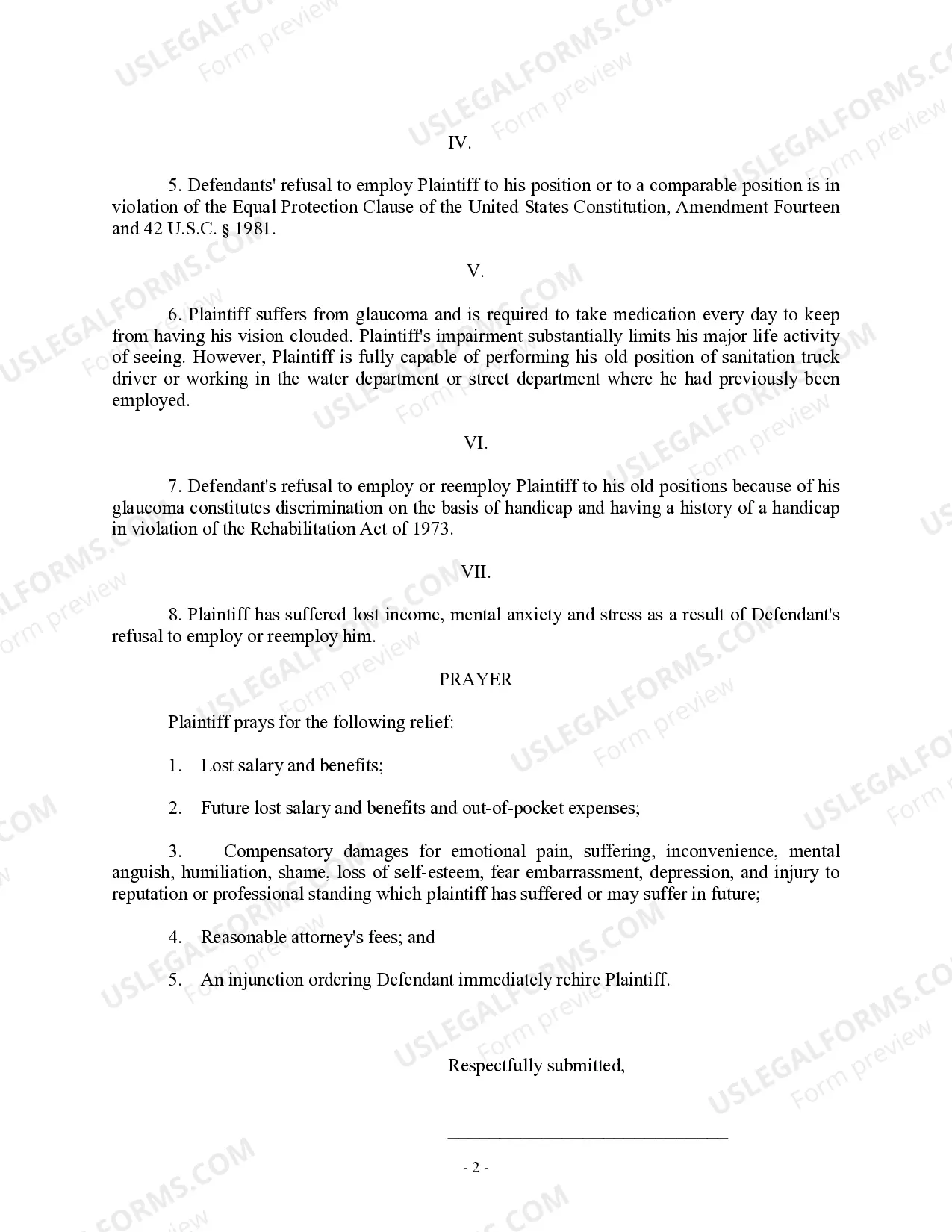
Plaintiff seeks to recover actual, compensatory, liquidated, and punitive damages for discrimination based upon discrimination concerning his disability. Plaintiff submits a request to the court for lost salary and benefits, future lost salary and benefits, and compensatory damages for emotional pain and suffering.
Discrimination With Mental Health In Oakland
State:
Multi-State
Category:
County:
Oakland
Control #:
US-000286
Format:
Word;
Rich Text
143 downloads
Description
Free preview





Get your form ready online
Our built-in tools help you complete, sign, share, and store your documents in one place.
Built-in online Word editor
Make edits, fill in missing information, and update formatting in US Legal Forms—just like you would in MS Word.
Export easily
Download a copy, print it, send it by email, or mail it via USPS—whatever works best for your next step.
E-sign your document
Sign and collect signatures with our SignNow integration. Send to multiple recipients, set reminders, and more. Go Premium to unlock E-Sign.
Notarize online 24/7
If this form requires notarization, complete it online through a secure video call—no need to meet a notary in person or wait for an appointment.
Store your document securely
We protect your documents and personal data by following strict security and privacy standards.

Make edits, fill in missing information, and update formatting in US Legal Forms—just like you would in MS Word.

Download a copy, print it, send it by email, or mail it via USPS—whatever works best for your next step.

Sign and collect signatures with our SignNow integration. Send to multiple recipients, set reminders, and more. Go Premium to unlock E-Sign.

If this form requires notarization, complete it online through a secure video call—no need to meet a notary in person or wait for an appointment.

We protect your documents and personal data by following strict security and privacy standards.
Looking for another form?




Form popularity
FAQ
However, discrimination is a state of mind and, therefore, notoriously hard to prove. Sophisticated employers are well aware that discrimination is illegal. Thus, most cases are established through circumstantial evidence.
Here are some ways you can deal with stigma: Get treatment. You may be reluctant to admit you need treatment. Don't let stigma create self-doubt and shame. Don't isolate yourself. Don't equate yourself with your illness. Join a support group. Get help at school. Speak out against stigma.
In general, a complaint of employment discrimination must be filed within three years from the date an alleged discriminatory act occurred. You must file a complaint with CRD even if you wish to file a case directly in court.
Any employee who feels that he/she has been unfairly discriminated against or that an employer has contravened the laws may lodge a grievance in writing with their employer. The matter may thereafter be referred to the CCMA if the issue cannot be resolved at the workplace.
Responding to unlawful discrimination speak to the person involved if it is safe to do so. speak to your manager or supervisor about what is happening. consider any policies that your workplace has about discrimination and dealing with a grievance. speak to Human Resources team, if your workplace has one.
Report discrimination to a local Fair Employment Practices Agency (FEPA). If the discrimination breaks both a state and federal law, the FEPA will also send your complaint to the EEOC. Use the EEOC's directory of field offices to find the FEPA near you.
If you have a mental health condition, you may be protected against discrimination and harassment at work related to your condition, you have workplace confidentiality rights, and you may have a legal right to get reasonable accommodations that can help you perform and keep your job.
Medical records, along with corroborating testimony, can prove you have or had a disability. However, in cases where discrimination is based on a perceived disability, substantiating employer statements or nonverbal conduct regarding your mental or physical abilities becomes crucial.
Discrimination may be obvious and direct, such as someone making a negative remark about your mental illness or your treatment. Or it may be unintentional or subtle, such as someone avoiding you because the person assumes you could be unstable, violent or dangerous due to your mental illness.
Evidence in a discrimination case in California typically includes: emails, text messages, recordings, disciplinary forms, termination documents, or a copy of your employment contract if one exists. If you're like most Californians, you spend an inordinate amount of time at work.