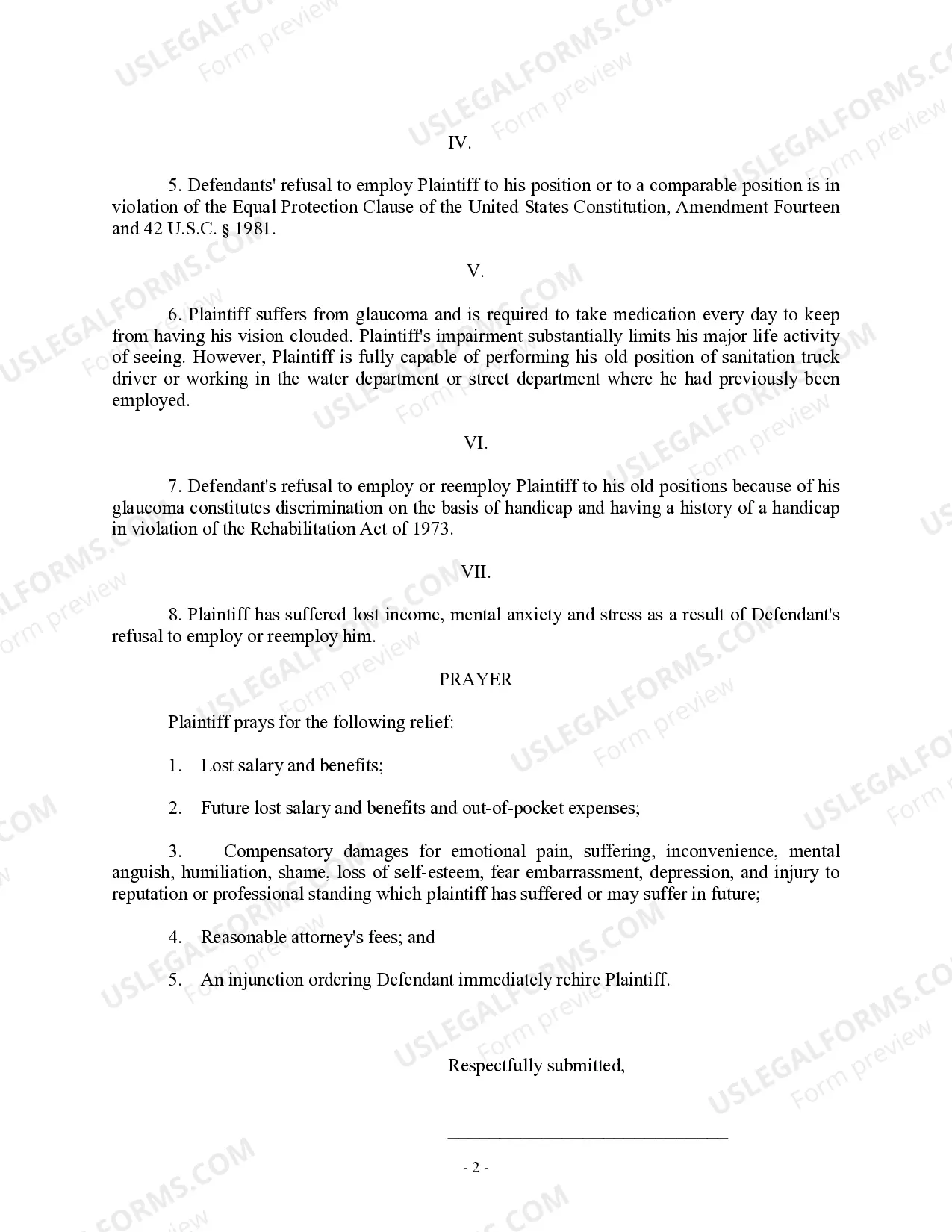
Plaintiff seeks to recover actual, compensatory, liquidated, and punitive damages for discrimination based upon discrimination concerning his disability. Plaintiff submits a request to the court for lost salary and benefits, future lost salary and benefits, and compensatory damages for emotional pain and suffering.
Discrimination With Ai In Nassau
State:
Multi-State
Category:
County:
Nassau
Control #:
US-000286
Format:
Word;
Rich Text
143 downloads
Description
Free preview





Get your form ready online
Our built-in tools help you complete, sign, share, and store your documents in one place.
Built-in online Word editor
Make edits, fill in missing information, and update formatting in US Legal Forms—just like you would in MS Word.
Export easily
Download a copy, print it, send it by email, or mail it via USPS—whatever works best for your next step.
E-sign your document
Sign and collect signatures with our SignNow integration. Send to multiple recipients, set reminders, and more. Go Premium to unlock E-Sign.
Notarize online 24/7
If this form requires notarization, complete it online through a secure video call—no need to meet a notary in person or wait for an appointment.
Store your document securely
We protect your documents and personal data by following strict security and privacy standards.

Make edits, fill in missing information, and update formatting in US Legal Forms—just like you would in MS Word.

Download a copy, print it, send it by email, or mail it via USPS—whatever works best for your next step.

Sign and collect signatures with our SignNow integration. Send to multiple recipients, set reminders, and more. Go Premium to unlock E-Sign.

If this form requires notarization, complete it online through a secure video call—no need to meet a notary in person or wait for an appointment.

We protect your documents and personal data by following strict security and privacy standards.
Looking for another form?









Form popularity
FAQ
Include the following in your complaint letter: Your name, address and telephone number. The name, address, and telephone number of your attorney or authorized representative, if you are represented. The basis of your complaint. The date(s) that the incident(s) you are reporting as discrimination occurred.
Consulting with your attorney regarding the details of your particular situation and the value your claim may have is, therefore, always an important step to take prior to filing any lawsuit. The average settlement for employment discrimination claims is about $40,000, ing to the EEOC.
Explain as clearly as possible what happened, why you believe it happened, and how you were discriminated against. Please include how other persons were treated differently from you, if applicable. If you were denied a benefit or service, please provide a copy of the denial letter.
We shall not discriminate and will not discriminate in employment, recruitment, Board membership, advertisements for employment, compensation, termination, upgrading, promotions, and other conditions of employment against any employee or job applicant on the basis of race, color, religion (creed), gender, gender ...
After the complaint is filed, it will be reviewed and preliminary information will be gathered to determine whether the Labor Commissioner has jurisdiction over the issues raised. If it is determined that the Labor Commissioner has jurisdiction, the complaint will be accepted for investigation.
A job discrimination complaint may be filed by mail or in person at the nearest EEOC office. You can find the closest EEOC office by calling the EEOC at 1-800-669-4000, or by going to the EEOC's Field Office List and Jurisdiction Map and selecting the office closest to you.
The Law prohibits employers and employment agencies from using an automated employment decision tool (AEDT) in New York City unless they ensure a bias audit was done and provide required notices. The Law was enacted in 2021. It took effect on January 1, 2023. Enforcement begins on July 5, 2023.
What are the three sources of bias in AI? Researchers have identified three types of bias in AI: algorithmic, data, and human.
NYC 'Loophole' The law requires employers to conduct an annual bias audit on automated technology tools they use in making hiring and promotion decisions, publish the results on their company websites, and provide notice to job candidates about the automated decision tools they're using.
An example is when a facial recognition system is less accurate in identifying people of color or when a language translation system associates certain languages with certain genders or stereotypes.