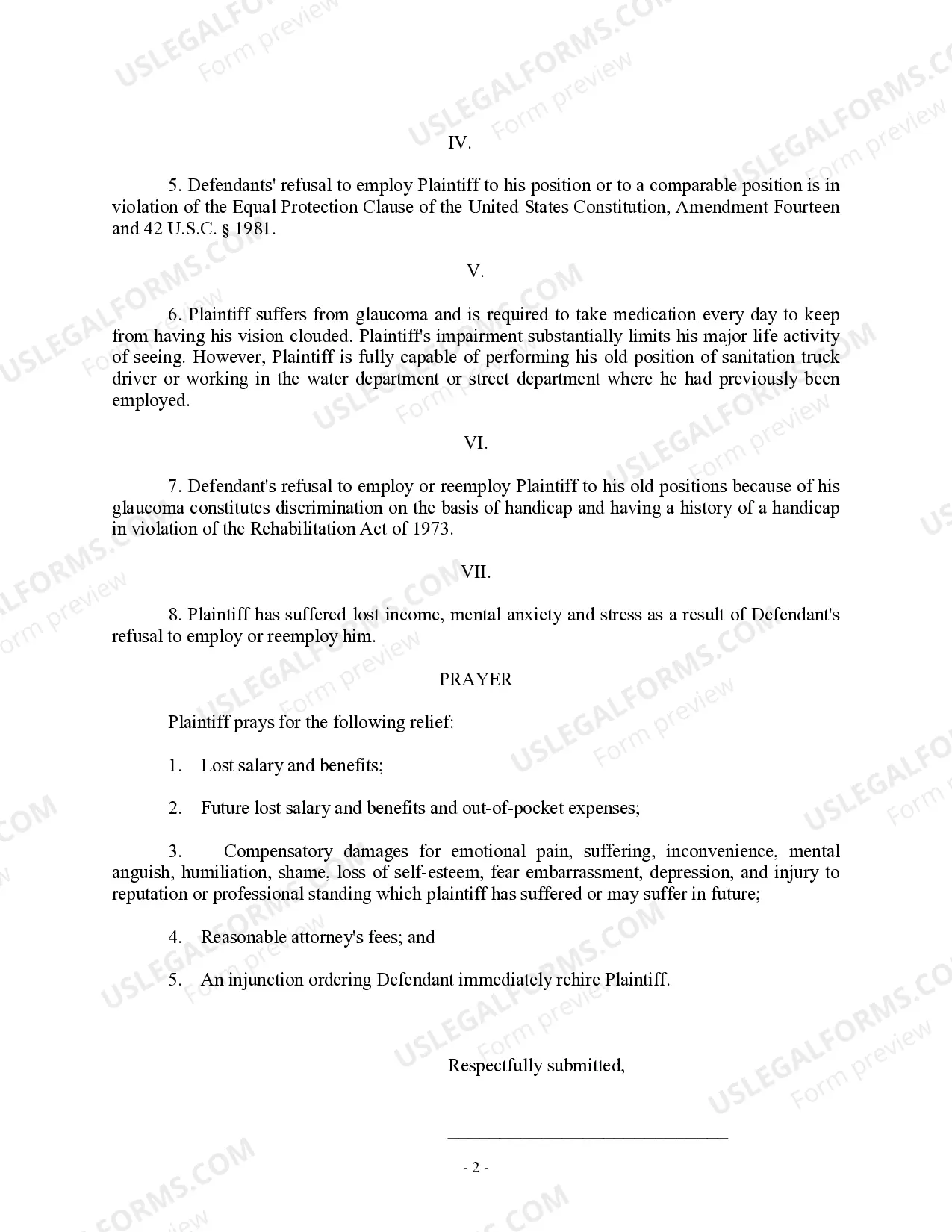
Plaintiff seeks to recover actual, compensatory, liquidated, and punitive damages for discrimination based upon discrimination concerning his disability. Plaintiff submits a request to the court for lost salary and benefits, future lost salary and benefits, and compensatory damages for emotional pain and suffering.
Discrimination For Woman In Montgomery
State:
Multi-State
Category:
County:
Montgomery
Control #:
US-000286
Format:
Word;
Rich Text
143 downloads
Description
Free preview





Get your form ready online
Our built-in tools help you complete, sign, share, and store your documents in one place.
Built-in online Word editor
Make edits, fill in missing information, and update formatting in US Legal Forms—just like you would in MS Word.
Export easily
Download a copy, print it, send it by email, or mail it via USPS—whatever works best for your next step.
E-sign your document
Sign and collect signatures with our SignNow integration. Send to multiple recipients, set reminders, and more. Go Premium to unlock E-Sign.
Notarize online 24/7
If this form requires notarization, complete it online through a secure video call—no need to meet a notary in person or wait for an appointment.
Store your document securely
We protect your documents and personal data by following strict security and privacy standards.

Make edits, fill in missing information, and update formatting in US Legal Forms—just like you would in MS Word.

Download a copy, print it, send it by email, or mail it via USPS—whatever works best for your next step.

Sign and collect signatures with our SignNow integration. Send to multiple recipients, set reminders, and more. Go Premium to unlock E-Sign.

If this form requires notarization, complete it online through a secure video call—no need to meet a notary in person or wait for an appointment.

We protect your documents and personal data by following strict security and privacy standards.
Looking for another form?







Form popularity
FAQ
"The Montgomery Bus Boycott was a civil rights protest during which African Americans refused to ride city buses in Montgomery, Alabama, to protest segregated seating. The boycott took place from December 5, 1955, to December 20, 1956, and is regarded as the first large-scale U.S. demonstration against segregation.
Sparked by the arrest of Rosa Parks on 1 December 1955, the Montgomery bus boycott was a 13-month mass protest that ended with the U.S. Supreme Court ruling that segregation on public buses is unconstitutional.
Jim Crow bus laws in Montgomery at the time of Parks' arrest established a section for whites at the front of the bus, and a section for blacks in the back. The law required that when the white section filled, black passengers in the “colored section” give up their seats and move further back.
"The Montgomery Bus Boycott was a civil rights protest during which African Americans refused to ride city buses in Montgomery, Alabama, to protest segregated seating. The boycott took place from December 5, 1955, to December 20, 1956, and is regarded as the first large-scale U.S. demonstration against segregation.
Under the system of segregation used on Montgomery buses, the ten front seats were reserved for white people at all times. The ten back seats were supposed to be reserved for black people at all times. The middle section of the bus consisted of sixteen unreserved seats for white and black people on a segregated basis.
On 5 June 1956, the federal district court ruled in Browder v. Gayle that bus segregation was unconstitutional, and in November 1956 the U.S. Supreme Court affirmed Browder v. Gayle and struck down laws requiring segregated seating on public buses.
Board of Education for Montgomery African Americans helped motivate them to continue the boycott. The company reluctantly desegregated its buses only after November 13, 1956, when the Supreme Court ruled Alabama's bus segregation laws unconstitutional.
The event that triggered the boycott took place in Montgomery on December 1, 1955, after seamstress Rosa Parks refused to give her seat to a white passenger on a city bus. Local laws dictated that African American passengers sat at the back of the bus while whites sat in front.
Epithets, slurs, jokes, negative stereotyping or threatening, intimidating or hostile acts that relate to a person's race, color, religion, gender, national origin, age or disability.
A written complaint to OSPI must include the following information: A description the conduct or incident—use facts (what, who and when) An explanation of why you believe unlawful discrimination has taken place. Your name and contact information, including a mailing address.