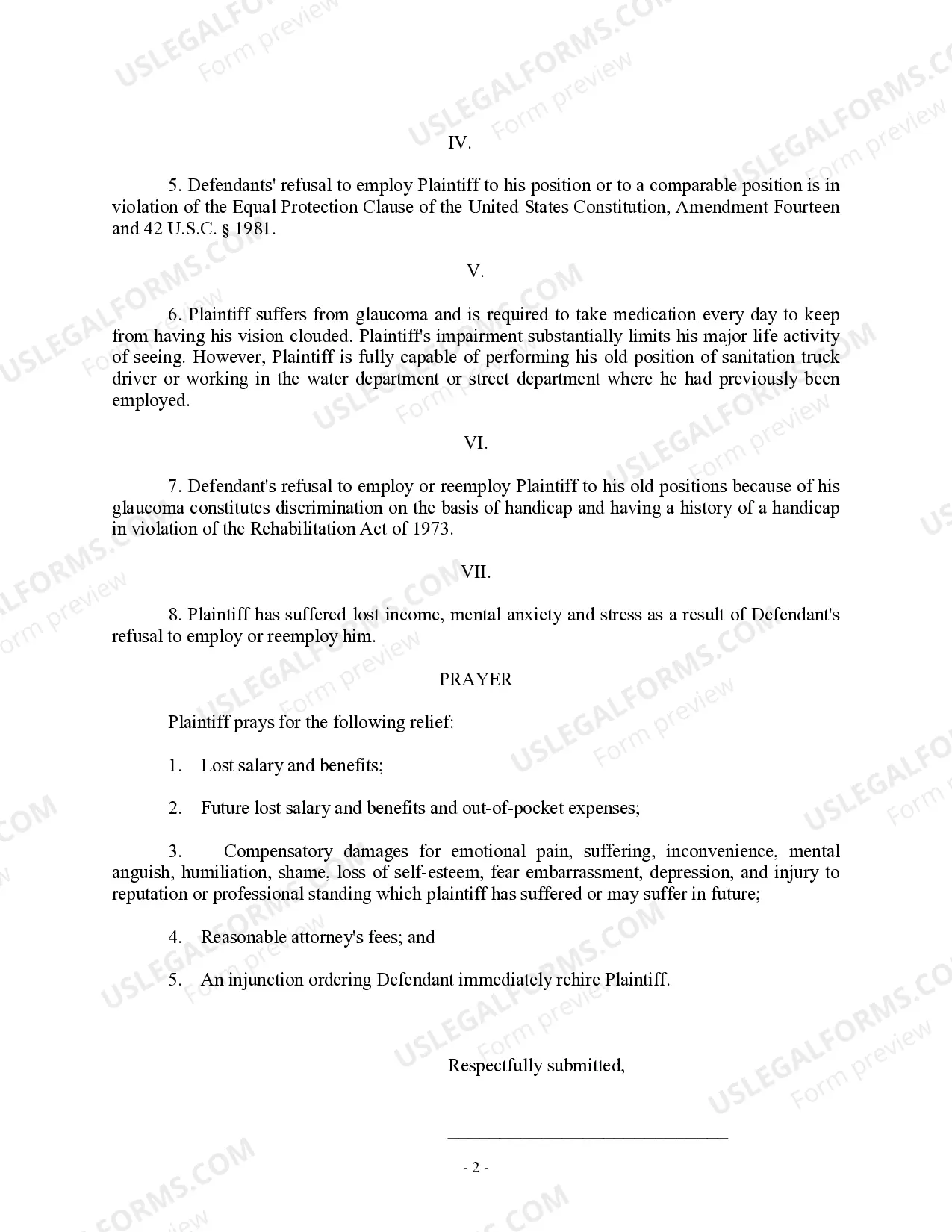
Plaintiff seeks to recover actual, compensatory, liquidated, and punitive damages for discrimination based upon discrimination concerning his disability. Plaintiff submits a request to the court for lost salary and benefits, future lost salary and benefits, and compensatory damages for emotional pain and suffering.
Discrimination Without Prejudice Example In Massachusetts
State:
Multi-State
Category:
Control #:
US-000286
Format:
Word;
Rich Text
143 downloads
Description
Free preview





Get your form ready online
Our built-in tools help you complete, sign, share, and store your documents in one place.
Built-in online Word editor
Make edits, fill in missing information, and update formatting in US Legal Forms—just like you would in MS Word.
Export easily
Download a copy, print it, send it by email, or mail it via USPS—whatever works best for your next step.
E-sign your document
Sign and collect signatures with our SignNow integration. Send to multiple recipients, set reminders, and more. Go Premium to unlock E-Sign.
Notarize online 24/7
If this form requires notarization, complete it online through a secure video call—no need to meet a notary in person or wait for an appointment.
Store your document securely
We protect your documents and personal data by following strict security and privacy standards.

Make edits, fill in missing information, and update formatting in US Legal Forms—just like you would in MS Word.

Download a copy, print it, send it by email, or mail it via USPS—whatever works best for your next step.

Sign and collect signatures with our SignNow integration. Send to multiple recipients, set reminders, and more. Go Premium to unlock E-Sign.

If this form requires notarization, complete it online through a secure video call—no need to meet a notary in person or wait for an appointment.

We protect your documents and personal data by following strict security and privacy standards.
Looking for another form?









Form popularity
FAQ
The easiest way to prove unlawful discrimination is through the use of direct evidence. Direct evidence is the kind that, if believed, requires a conclusion that unlawful discrimination motivated the employer's decision. Direct evidence requires no inference or presumption.
For example: Respect diversity by providing person centred care. Treat the individuals you support as unique rather than treating all individuals in the same way.
The following would be considered illegal discrimination if there is evidence that the decision was made based on a protected characteristic: Sexual Harassment. Refusal to Provide Services. Unfair Lending Practices. Misrepresenting the Availability of Housing. Refusal to Allow “Reasonable Modifications” Refusing Rental.
Massachusetts law prohibits discrimination on the basis of a person's membership in a protected class, such as: Race (including natural & protective hairstyles) Color. Disability.
Examples of Employment Discrimination Failure to hire. Harassment. Quid pro quo: Conditioning employment or promotion on sexual favors. Hostile Work Environment: Continuous actions and comments based on protected characteristics that create an uncomfortable and hostile workplace.
When it comes to California discrimination lawsuits, the potential payout varies greatly depending on the company's size. Take small businesses with fewer than 100 employees - they're looking at a maximum payout of $50,000. But scale up to 101-200 employees, and that number jumps to $100,000.
To build a strong case, you must demonstrate that you suffered an adverse employment action as a result of the discrimination. Adverse actions can include being passed over for a promotion, denial of a lateral transfer, receiving unfavorable performance evaluations, demotion, or termination.
I've seen firsthand how these cases can vary widely in California. The average settlement for a disability discrimination case can range from around $25,000 to $500,000. Less complex cases often settle for about $100,000 or less, while more involved cases can exceed $1,000,000. But these are just ballpark figures.