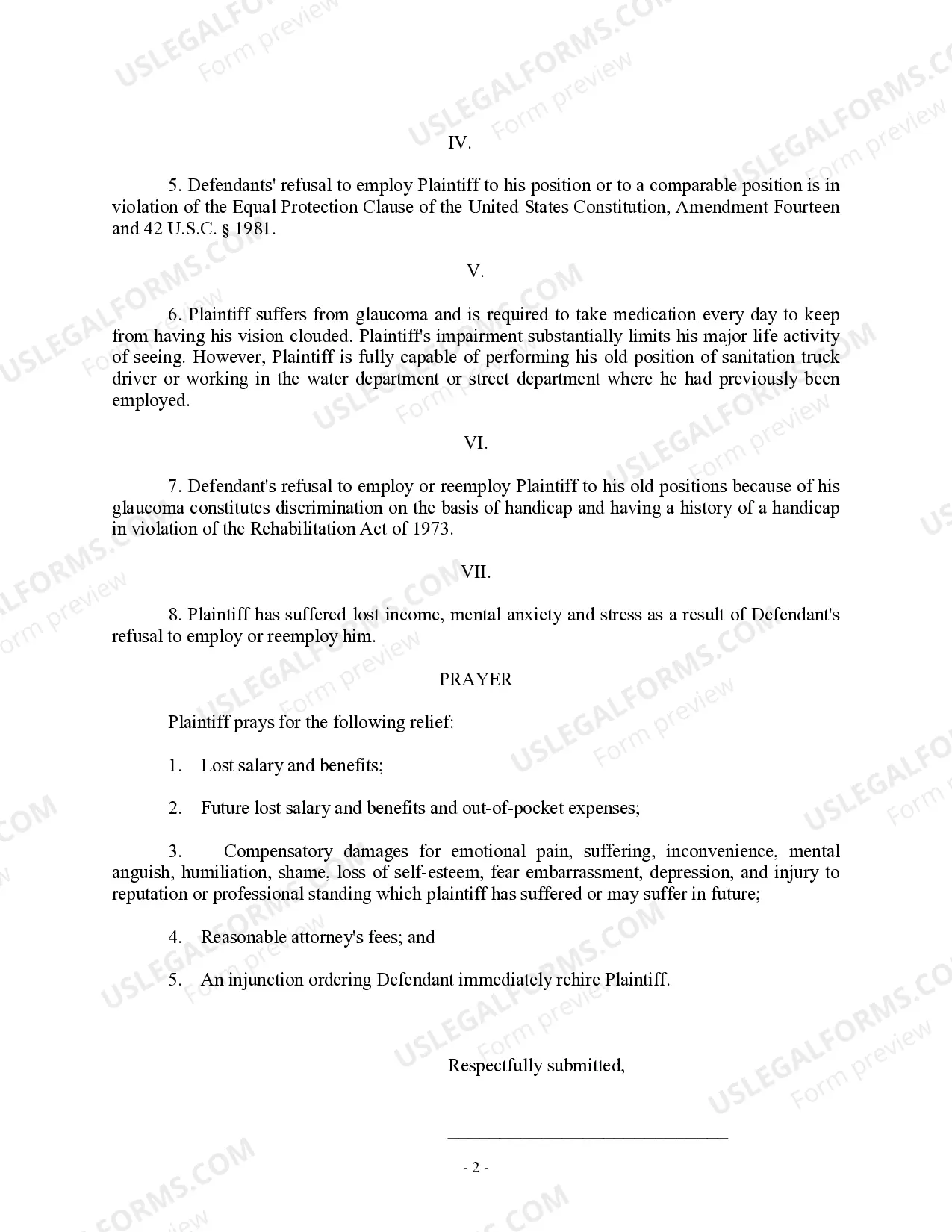
Plaintiff seeks to recover actual, compensatory, liquidated, and punitive damages for discrimination based upon discrimination concerning his disability. Plaintiff submits a request to the court for lost salary and benefits, future lost salary and benefits, and compensatory damages for emotional pain and suffering.
Discrimination For Woman In Fulton
State:
Multi-State
Category:
County:
Fulton
Control #:
US-000286
Format:
Word;
Rich Text
143 downloads
Description
Free preview





Get your form ready online
Our built-in tools help you complete, sign, share, and store your documents in one place.
Built-in online Word editor
Make edits, fill in missing information, and update formatting in US Legal Forms—just like you would in MS Word.
Export easily
Download a copy, print it, send it by email, or mail it via USPS—whatever works best for your next step.
E-sign your document
Sign and collect signatures with our SignNow integration. Send to multiple recipients, set reminders, and more. Go Premium to unlock E-Sign.
Notarize online 24/7
If this form requires notarization, complete it online through a secure video call—no need to meet a notary in person or wait for an appointment.
Store your document securely
We protect your documents and personal data by following strict security and privacy standards.

Make edits, fill in missing information, and update formatting in US Legal Forms—just like you would in MS Word.

Download a copy, print it, send it by email, or mail it via USPS—whatever works best for your next step.

Sign and collect signatures with our SignNow integration. Send to multiple recipients, set reminders, and more. Go Premium to unlock E-Sign.

If this form requires notarization, complete it online through a secure video call—no need to meet a notary in person or wait for an appointment.

We protect your documents and personal data by following strict security and privacy standards.
Looking for another form?







Form popularity
FAQ
You generally have to file a complaint with the CRD or EEOC before you can file a lawsuit in civil court. You are first required to obtain a “right to sue” notice before your case can be taken to court. You can request an immediate right to sue notice, without having to go through a complete CRD or EEOC investigation.
To succeed and receive most damages available under the U.S. Equal Employment Opportunity Commission (EEOC), you must prove your claim is more likely true than not true. You stand a better chance of winning if you present multiple types of evidence reinforcing your claim.
Ing to the Equal Employment Opportunity Commission (EEOC), the average settlement for employment discrimination claims is about $40,000. However, depending on the facts and circumstances of the case, settlements or verdicts can climb to seven figures.
If you've experienced unlawful discrimination, you can complain to the person or organisation who's discriminated against you. You can also make a discrimination claim in the civil courts. Read this page to find out what you should do before you take action about unlawful discrimination.
However, discrimination is a state of mind and, therefore, notoriously hard to prove. Sophisticated employers are well aware that discrimination is illegal. Thus, most cases are established through circumstantial evidence.
Responding to unlawful discrimination speak to the person involved if it is safe to do so. speak to your manager or supervisor about what is happening. consider any policies that your workplace has about discrimination and dealing with a grievance. speak to Human Resources team, if your workplace has one.
Any employee who feels that he/she has been unfairly discriminated against or that an employer has contravened the laws may lodge a grievance in writing with their employer. The matter may thereafter be referred to the CCMA if the issue cannot be resolved at the workplace.
Report discrimination to a local Fair Employment Practices Agency (FEPA). If the discrimination breaks both a state and federal law, the FEPA will also send your complaint to the EEOC. Use the EEOC's directory of field offices to find the FEPA near you.
Explain as clearly as possible what happened, why you believe it happened, and how you were discriminated against. Please include how other persons were treated differently from you, if applicable. If you were denied a benefit or service, please provide a copy of the denial letter.