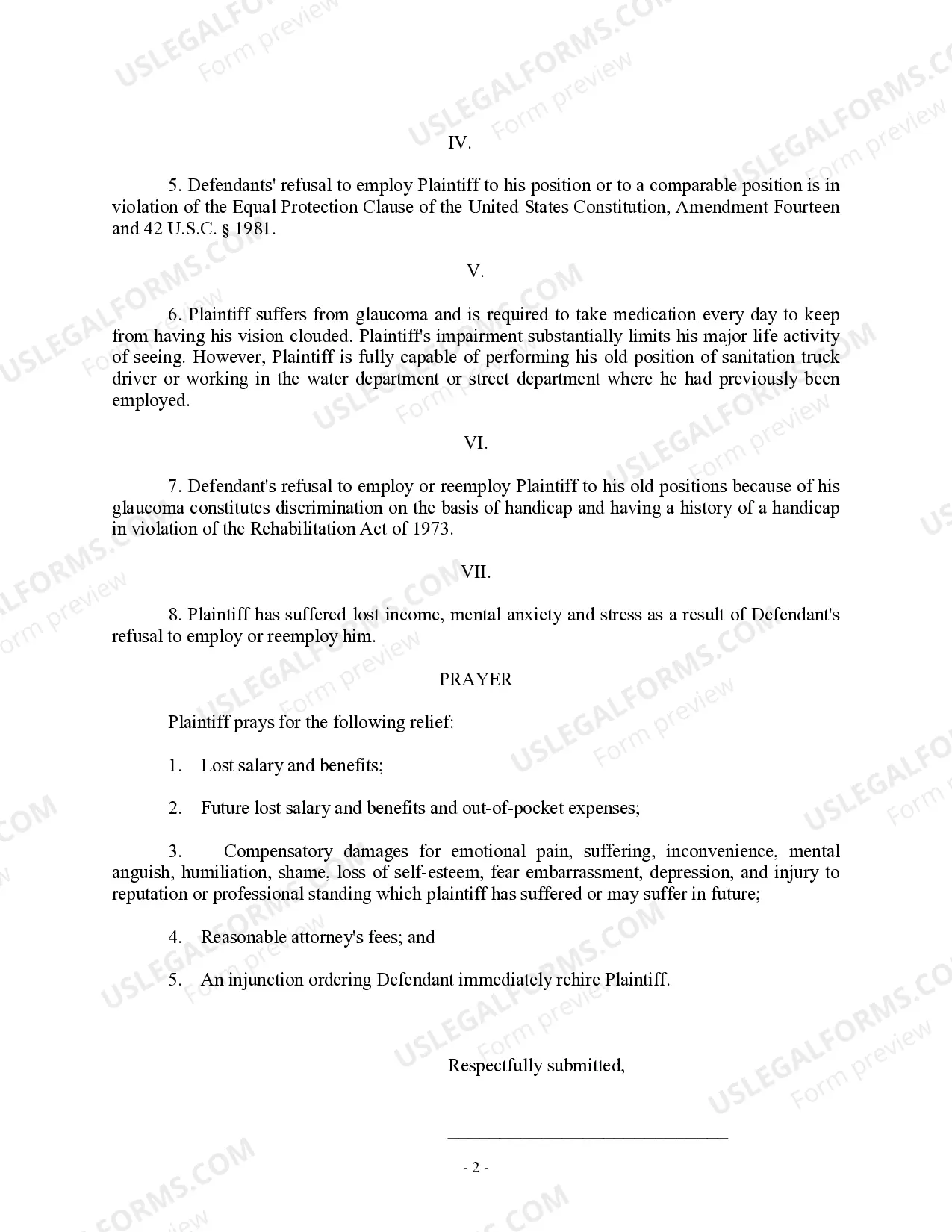
Plaintiff seeks to recover actual, compensatory, liquidated, and punitive damages for discrimination based upon discrimination concerning his disability. Plaintiff submits a request to the court for lost salary and benefits, future lost salary and benefits, and compensatory damages for emotional pain and suffering.
Discrimination Without Prejudice Example In Chicago
State:
Multi-State
Category:
City:
Chicago
Control #:
US-000286
Format:
Word;
Rich Text
143 downloads
Description
Free preview





Get your form ready online
Our built-in tools help you complete, sign, share, and store your documents in one place.
Built-in online Word editor
Make edits, fill in missing information, and update formatting in US Legal Forms—just like you would in MS Word.
Export easily
Download a copy, print it, send it by email, or mail it via USPS—whatever works best for your next step.
E-sign your document
Sign and collect signatures with our SignNow integration. Send to multiple recipients, set reminders, and more. Go Premium to unlock E-Sign.
Notarize online 24/7
If this form requires notarization, complete it online through a secure video call—no need to meet a notary in person or wait for an appointment.
Store your document securely
We protect your documents and personal data by following strict security and privacy standards.

Make edits, fill in missing information, and update formatting in US Legal Forms—just like you would in MS Word.

Download a copy, print it, send it by email, or mail it via USPS—whatever works best for your next step.

Sign and collect signatures with our SignNow integration. Send to multiple recipients, set reminders, and more. Go Premium to unlock E-Sign.

If this form requires notarization, complete it online through a secure video call—no need to meet a notary in person or wait for an appointment.

We protect your documents and personal data by following strict security and privacy standards.
Looking for another form?









Form popularity
FAQ
For example, in a disability or race discrimination case, some courts have said that the 4 elements are that (1) the plaintiff belongs to a protected group, (2) he is qualified for the job (3) the plaintiff was discriminated against, and (4) the plaintiff was replaced bv a nonminority.
The focal point of the test for unfairness is the "impact of the discrimination on the complainant and others in his or her situation." If it is found that the discrimination was not unfair, then section 8(2) will not have been violated.
Call the Chicago Commission on Human Relations at (312) 744-4111, or stop by our offices at 740 N. Sedgwick, 4th floor for information about filing a complaint. You may also visit our website at .chicago/humanrelations, our Facebook page or email us at cchr@cityofchicago.
A written complaint to OSPI must include the following information: A description the conduct or incident—use facts (what, who and when) An explanation of why you believe unlawful discrimination has taken place. Your name and contact information, including a mailing address.
Examples of Employment Discrimination Failure to hire. Harassment. Quid pro quo: Conditioning employment or promotion on sexual favors. Hostile Work Environment: Continuous actions and comments based on protected characteristics that create an uncomfortable and hostile workplace.
Wronged employees have three ways of proving their employers intended to discriminate: circumstantial evidence, direct evidence, and pattern and practice. Circumstantial evidence is evidence that proves a fact by inference, as opposed to direct evidence which directly proves a fact.
You might notice that members of one racial group receive more rewards for the same work or less punishment for the same misconduct. This is illegal, disparate treatment. You prove this discrimination by showing that similarly situated employees of different races are not receiving the same treatment at work.
The Chicago Human Rights Ordinance prohibits discrimination in employment, public accommodations, credit transactions, and bonding, as well as retaliation. The Chicago Fair Housing Ordinance prohibits housing discrimination.
Ing to various legal industry analyses, plaintiffs in employment discrimination lawsuits might win at trial in approximately 1 out of 4 cases. However, this rate can fluctuate based on jurisdiction and the nature of the case.
Many cases of intentional discrimination are not proven by a single type of evidence. Rather, many different kinds of evidence-direct and circumstantial, statistical and anecdotal-are relevant to the showing of intent and should be assessed on a cumulative basis.