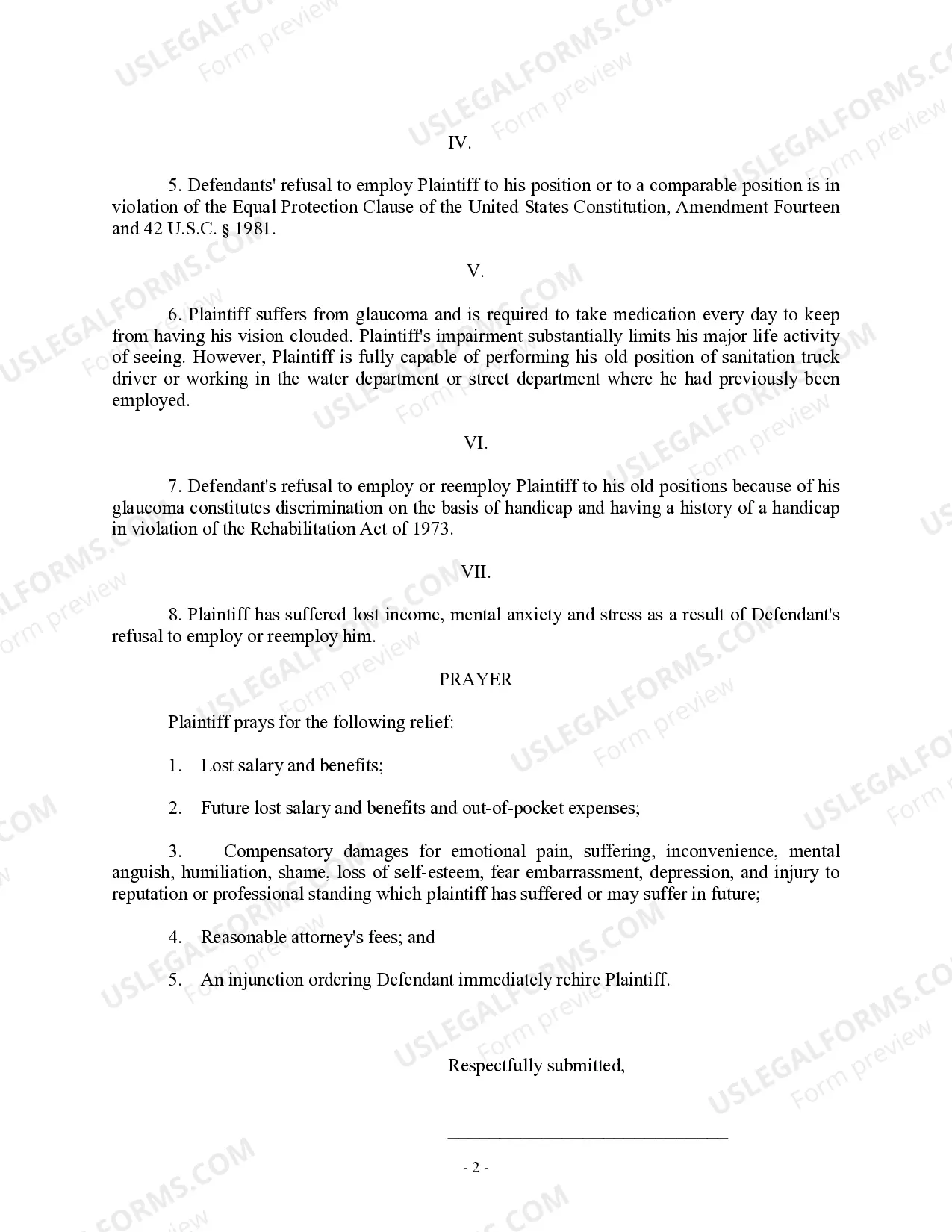
Plaintiff seeks to recover actual, compensatory, liquidated, and punitive damages for discrimination based upon discrimination concerning his disability. Plaintiff submits a request to the court for lost salary and benefits, future lost salary and benefits, and compensatory damages for emotional pain and suffering.
With Discriminatory Power In California
State:
Multi-State
Category:
Control #:
US-000286
Format:
Word;
Rich Text
143 downloads
Description
Free preview





Get your form ready online
Our built-in tools help you complete, sign, share, and store your documents in one place.
Built-in online Word editor
Make edits, fill in missing information, and update formatting in US Legal Forms—just like you would in MS Word.
Export easily
Download a copy, print it, send it by email, or mail it via USPS—whatever works best for your next step.
E-sign your document
Sign and collect signatures with our SignNow integration. Send to multiple recipients, set reminders, and more. Go Premium to unlock E-Sign.
Notarize online 24/7
If this form requires notarization, complete it online through a secure video call—no need to meet a notary in person or wait for an appointment.
Store your document securely
We protect your documents and personal data by following strict security and privacy standards.

Make edits, fill in missing information, and update formatting in US Legal Forms—just like you would in MS Word.

Download a copy, print it, send it by email, or mail it via USPS—whatever works best for your next step.

Sign and collect signatures with our SignNow integration. Send to multiple recipients, set reminders, and more. Go Premium to unlock E-Sign.

If this form requires notarization, complete it online through a secure video call—no need to meet a notary in person or wait for an appointment.

We protect your documents and personal data by following strict security and privacy standards.
Looking for another form?








Form popularity
FAQ
Labor Code section 232 prohibits an employer from discharging or retaliating against an employee for disclosing his or her wages.
230. (a) An employer shall not discharge or in any manner discriminate against an employee for taking time off to serve as required by law on an inquest jury or trial jury, if the employee, prior to taking the time off, gives reasonable notice to the employer that the employee is required to serve.
No employer may do any of the following: (a) Require, as a condition of employment, that an employee refrain from disclosing the amount of his or her wages. (b) Require an employee to sign a waiver or other document that purports to deny the employee the right to disclose the amount of his or her wages.
In general, a complaint of employment discrimination must be filed within three years from the date an alleged discriminatory act occurred. You must file a complaint with CRD even if you wish to file a case directly in court.
Create an account on the Cal Civil Rights System for yourself. All you need is a valid email address and a phone number. Once you have an account, call 800-884-1684. Our staff will associate your account with the complaint.
However, discrimination is a state of mind and, therefore, notoriously hard to prove. Sophisticated employers are well aware that discrimination is illegal. Thus, most cases are established through circumstantial evidence.
Average Disability Discrimination Settlements in California The average settlement for a disability discrimination case can range from around $25,000 to $500,000. Less complex cases often settle for about $100,000 or less, while more involved cases can exceed $1,000,000.
To prove discrimination in the workplace, wrongful termination or workplace retaliation in California, you may need to present evidence that: You have been treated unjustly based on one of your protected characteristics. You are qualified, capable and honest and performed your job satisfactorily.
The following definitions are from the University of California – Anti-Discrimination Policy. Discrimination is defined as an Unfavorable Action taken because of an individual's actual or perceived Protected Category.
Evidence in a discrimination case in California typically includes: emails, text messages, recordings, disciplinary forms, termination documents, or a copy of your employment contract if one exists. If you're like most Californians, you spend an inordinate amount of time at work.