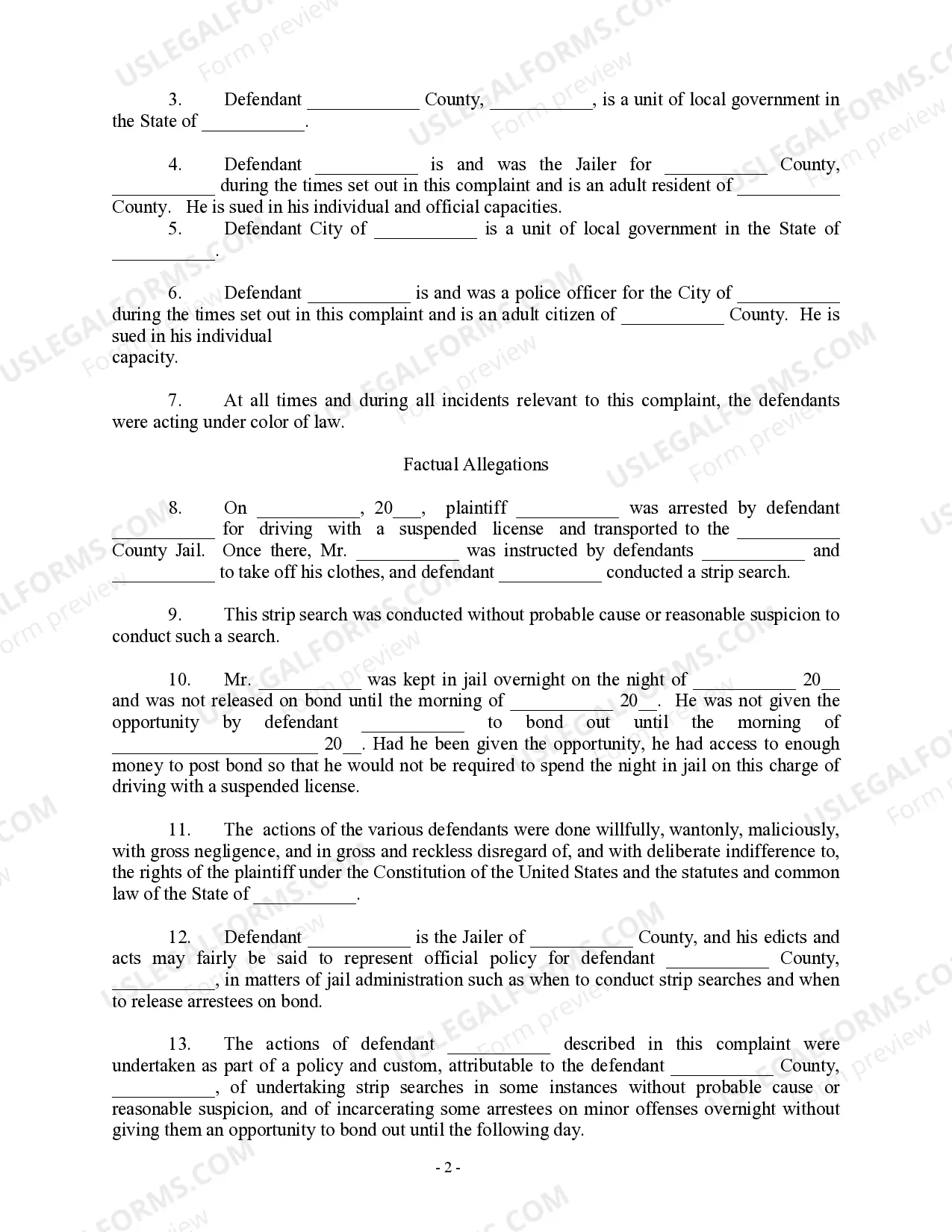
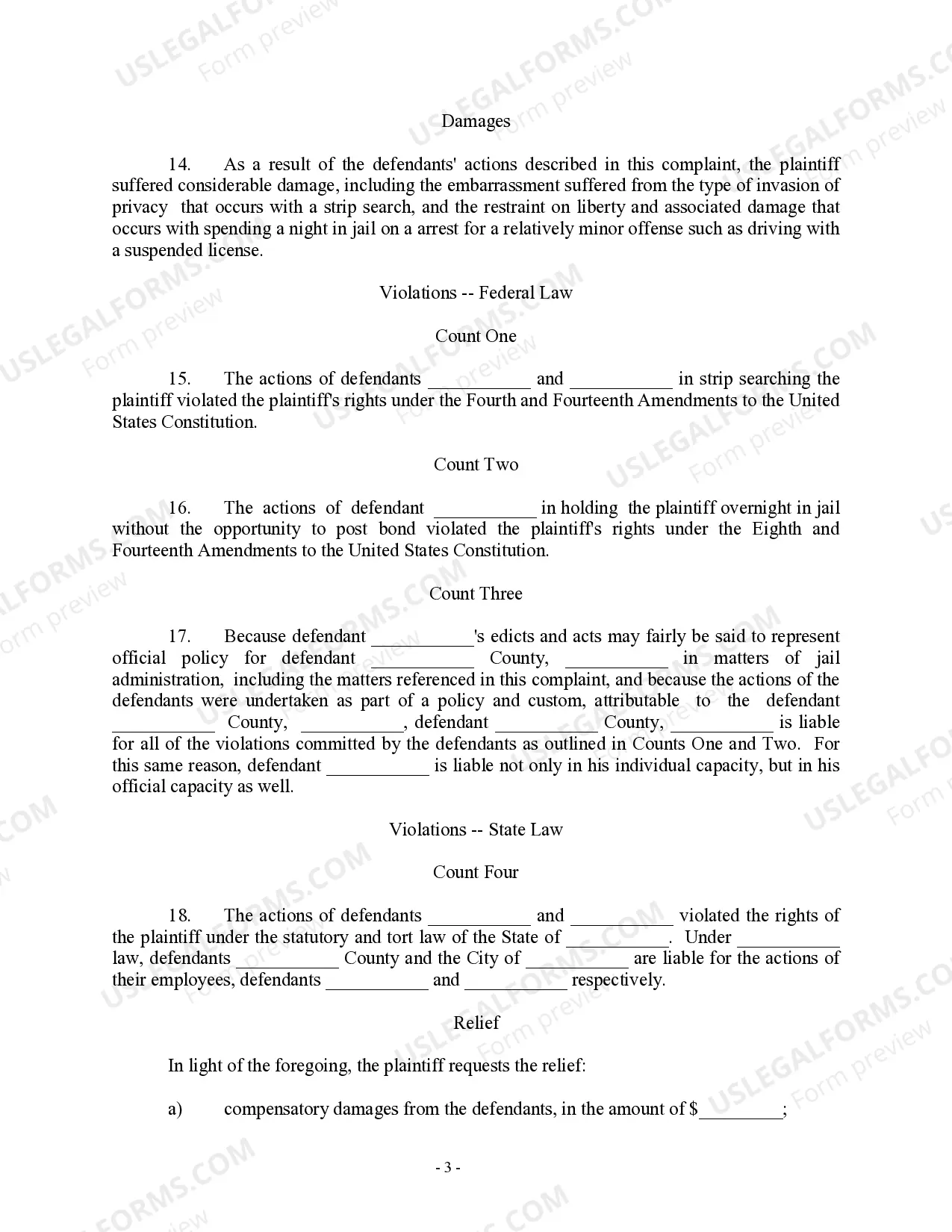
This form is a Complaint. This action was filed by the plaintiff due to a strip search which was conducted upon his/her person after an arrest. The plaintiff requests that he/she be awarded compensatory damages and punitive damages for the alleged violation of his/her constitutional rights.
Body Search For In Minnesota
State:
Multi-State
Category:
Control #:
US-000282
Format:
Word;
Rich Text
81 downloads
Description
Free preview




Get your form ready online
Our built-in tools help you complete, sign, share, and store your documents in one place.
Built-in online Word editor
Make edits, fill in missing information, and update formatting in US Legal Forms—just like you would in MS Word.
Export easily
Download a copy, print it, send it by email, or mail it via USPS—whatever works best for your next step.
E-sign your document
Sign and collect signatures with our SignNow integration. Send to multiple recipients, set reminders, and more. Go Premium to unlock E-Sign.
Notarize online 24/7
If this form requires notarization, complete it online through a secure video call—no need to meet a notary in person or wait for an appointment.
Store your document securely
We protect your documents and personal data by following strict security and privacy standards.

Make edits, fill in missing information, and update formatting in US Legal Forms—just like you would in MS Word.

Download a copy, print it, send it by email, or mail it via USPS—whatever works best for your next step.

Sign and collect signatures with our SignNow integration. Send to multiple recipients, set reminders, and more. Go Premium to unlock E-Sign.

If this form requires notarization, complete it online through a secure video call—no need to meet a notary in person or wait for an appointment.

We protect your documents and personal data by following strict security and privacy standards.
Looking for another form?








Form popularity
FAQ
The four states that currently allow conjugal visits are California, Connecticut, New York, and Washington.
Programs which allow an opportunity for a conjugal visit exist in five States: Mississippi, New York, California, South Carolina, and Minnesota.
In California, you do not have to be married for a conjugal visit. You can spend time with any immediate family member, including include spouses, registered domestic partners, siblings, children, or parents. In New York, visitors can be children, spouses, parents, grandparents, or foster parents/legal guardians.
Records of law enforcement arrest reports are public, as are investigatory records that do not deal with an active investigation or compromise another investigation, or reveal the identity of a protected person.
Conjugal visits are unfortunately very rare in the US, probably because most people think that prisoners should be kept as miserable as possible, as if their sentence wasn't enough in itself.
A law enforcement agency may not provide, directly or through a third party, to a peace officer any course that includes training on the detection or use of excited delirium. This section does not prohibit peace officer training in responding to and the proper care of a person in crisis.
626.05 DEFINITIONS. A "search warrant" is an order in writing, in the name of the state, signed by a court other than a court exercising probate jurisdiction, directed to a peace officer, commanding the peace officer to make a search as authorized by law and hold any item seized, subject to the order of a court.
336.2-725 STATUTE OF LIMITATIONS IN CONTRACTS FOR SALE. (1) An action for breach of any contract for sale must be commenced within four years after the cause of action has accrued. By the original agreement the parties may reduce the period of limitation to not less than one year but may not extend it.
A search warrant cannot be issued but upon probable cause, supported by affidavit, naming or describing the person, and particularly describing the property or thing to be seized, and particularly describing the place to be searched.
Nightcap - A night capped warrant is a warrant signed by a judge authorizing the arrest of an individual at any time, day or night.