Patent Infringement In The Philippines In Texas
Description

Get your form ready online
Our built-in tools help you complete, sign, share, and store your documents in one place.
Make edits, fill in missing information, and update formatting in US Legal Forms—just like you would in MS Word.
Download a copy, print it, send it by email, or mail it via USPS—whatever works best for your next step.
Sign and collect signatures with our SignNow integration. Send to multiple recipients, set reminders, and more. Go Premium to unlock E-Sign.
If this form requires notarization, complete it online through a secure video call—no need to meet a notary in person or wait for an appointment.
We protect your documents and personal data by following strict security and privacy standards.

Make edits, fill in missing information, and update formatting in US Legal Forms—just like you would in MS Word.

Download a copy, print it, send it by email, or mail it via USPS—whatever works best for your next step.

Sign and collect signatures with our SignNow integration. Send to multiple recipients, set reminders, and more. Go Premium to unlock E-Sign.

If this form requires notarization, complete it online through a secure video call—no need to meet a notary in person or wait for an appointment.

We protect your documents and personal data by following strict security and privacy standards.
Looking for another form?




Form popularity
FAQ
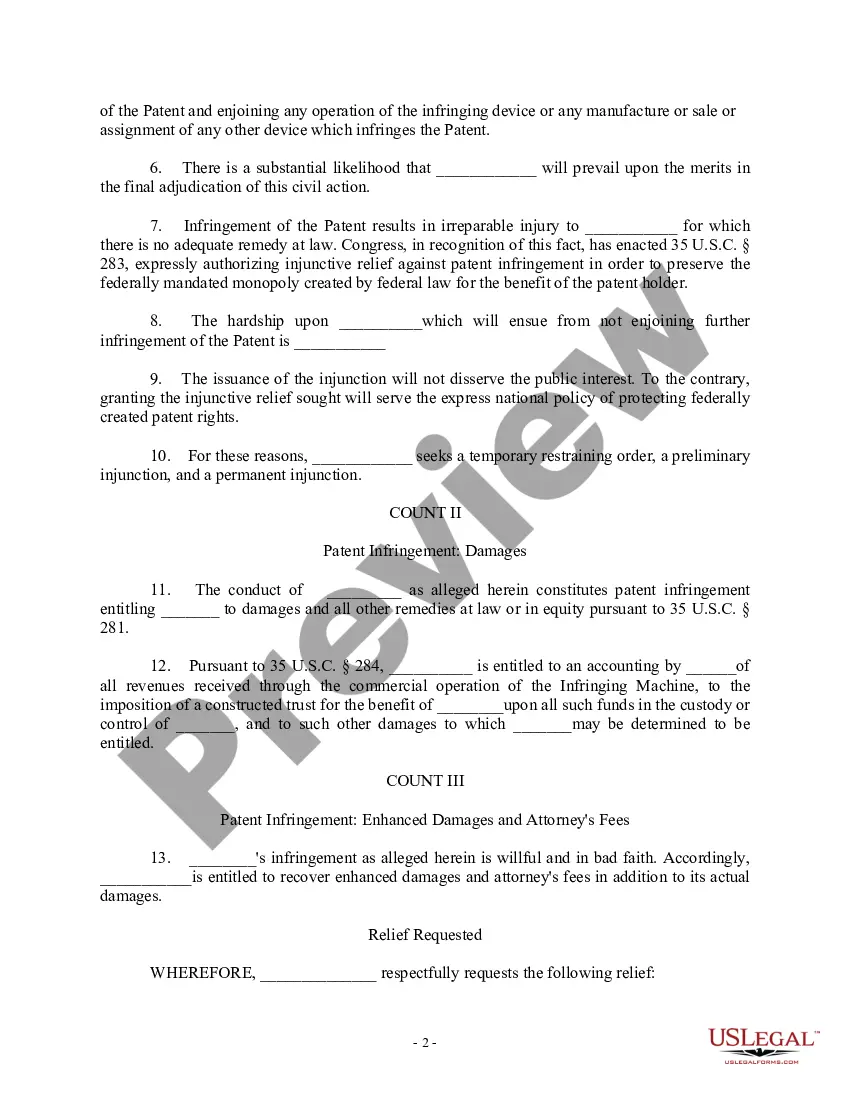
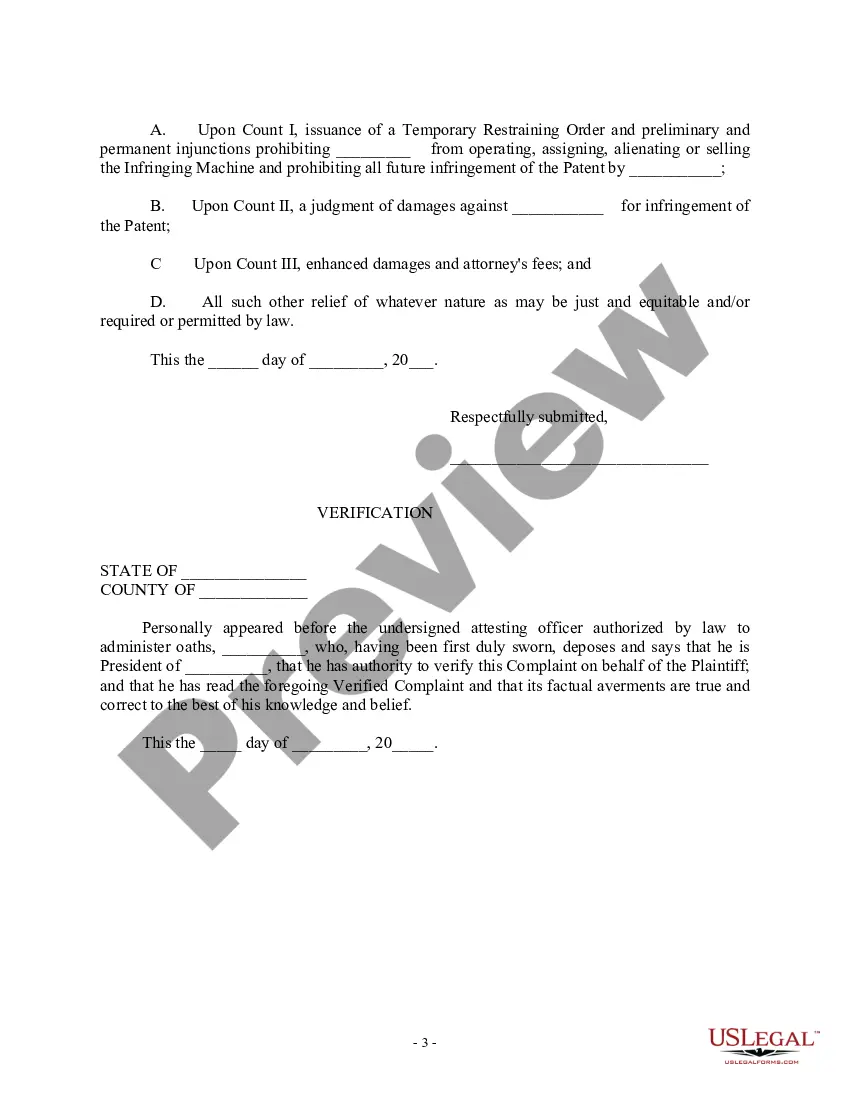
A patent infringement action would typically name as a defendant every alleged patent infringer. This may be a particularly easy process if there is only one specific individual who has infringed on your patent. It can become much more complicated, however, when there are multiple individuals and businesses involved.
An alleged infringer can assert a number of common defenses in response to a patent infringement claim, including: ∎ A defense of non-infringement (see Non-infringement). ∎ Invalidity defenses based on prior art (see Prior Art Invalidity).
There is no statutory cap on the damages for a patent infringement lawsuit. Whatever amount of harm you can prove the defendant caused, that's the amount you're entitled to.
Cir. 1985) (“The patentee bears the burden of proving infringement by a preponderance of the evidence.”).
Getting Started in Litigation Your attorney will file a formal complaint in federal court, explaining how the defendant has infringed on your patent. Together with your attorney, you will need to compile evidence of your ownership of the patent and the infringement.
The usual form of protection is to apply for a patent with the Bureau of Patents of the Philippine Intellectual Property Office (IPO).
Patent cases use a "preponderance of the evidence" standard of proof, unless the validity of a patent is in question, in which case the standard is "clear and convincing evidence." The comment examines the meaning of the standards in their application to United States patent practice.
If a decision is reversed by the Supreme Court, the case file is referred to the Court of First Instance or the Regional Court of Appeal (whichever decision is reversed). Available remedies for patent infringement include monetary damages, preliminary and permanent injunctions.
Patents are enforced against an infringer either through a civil action before the Regional Trial Court (“RTC”) or an administrative action before the Bureau of Legal Affairs (“BLA”) of the Intellectual Property Office of the Philippines (“IPOPHL”).
A civil action for patent infringement may be field to recover damages sustained by the patent owner. If the damages sustained cannot be ascertained with reasonable certainty, the court may award by way of damages a sum equivalent to reasonable royalty.