Patent Infringement In Us In Philadelphia
Description

Get your form ready online
Our built-in tools help you complete, sign, share, and store your documents in one place.
Make edits, fill in missing information, and update formatting in US Legal Forms—just like you would in MS Word.
Download a copy, print it, send it by email, or mail it via USPS—whatever works best for your next step.
Sign and collect signatures with our SignNow integration. Send to multiple recipients, set reminders, and more. Go Premium to unlock E-Sign.
If this form requires notarization, complete it online through a secure video call—no need to meet a notary in person or wait for an appointment.
We protect your documents and personal data by following strict security and privacy standards.

Make edits, fill in missing information, and update formatting in US Legal Forms—just like you would in MS Word.

Download a copy, print it, send it by email, or mail it via USPS—whatever works best for your next step.

Sign and collect signatures with our SignNow integration. Send to multiple recipients, set reminders, and more. Go Premium to unlock E-Sign.

If this form requires notarization, complete it online through a secure video call—no need to meet a notary in person or wait for an appointment.

We protect your documents and personal data by following strict security and privacy standards.
Looking for another form?



Form popularity
FAQ
By statute, all cases “arising under” patent law must be heard exclusively by the federal courts (not state courts) and, on appeal, by the Federal Circuit (not the twelve regional circuits).
The first tip for protecting your rights is to register the work with the U.S. Copyright Office. If you do not register your work, you cannot bring a copyright lawsuit under federal law. However, you can pursue a claim in state court to stop the infringer from using your copyrighted work and to seek actual damages.
There are three steps involved: Discovering the details of the accused activity; Studying the claims of the patent; and. Comparing the accused activity to the patent claims.
The venue statute specifically applicable to patent infringement lawsuits requires plaintiffs to file: (1) in the judicial district where the defendant “resides,” or (2) “where the defendant has committed acts of infringement and has a regular and established place of business.” Since 1990, the Federal Circuit –the ...
If the State has waived its sovereign immunity to patent infringement, yes. Alternatively, a state may have provided by state statute an alternative remedy for its infringement of a patent. If so, the patentee may sue to obtain that alternative remedy.
Polaroid took Kodak to court in 1976, accusing it of infringing on 12 patents relating to instant photography. The pioneering instant camera and film company, now defunct, sought $12 billion in damages, a staggering sum even by today's standards.
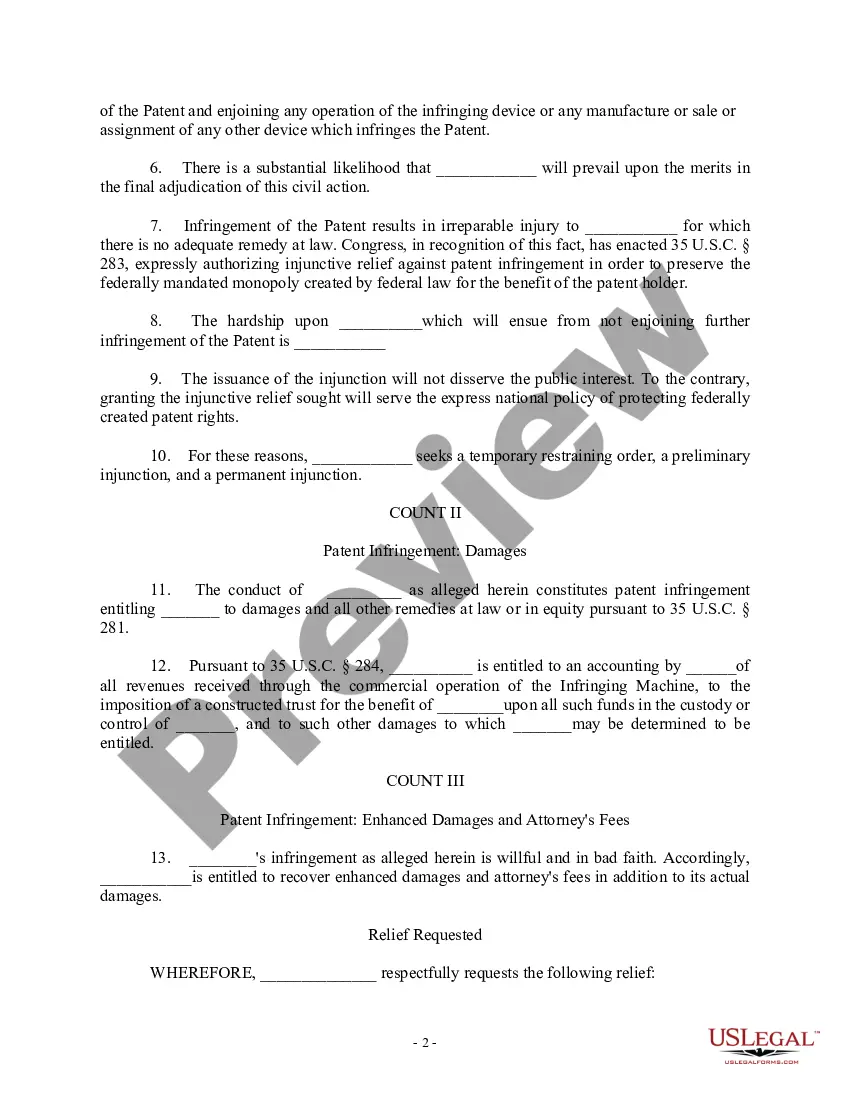
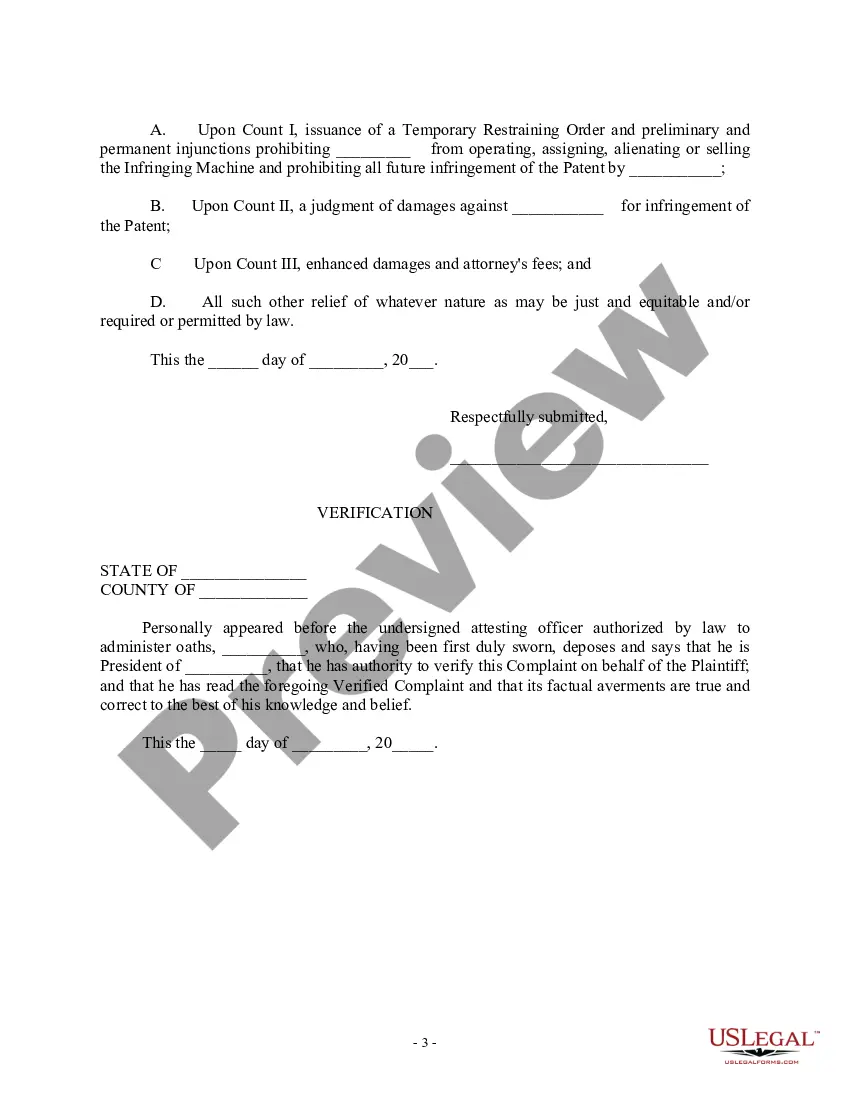
Patent infringement is not a crime. Instead, patent rights are enforced through civil litigation. Next, the court will look at whether a particular device literally infringes the claim. The elements of each of the patent's claims will be compared with the invention that is claimed to be infringing.
By statute, all cases “arising under” patent law must be heard exclusively by the federal courts (not state courts) and, on appeal, by the Federal Circuit (not the twelve regional circuits).
Patent infringement is the unlawful use, selling, or copying of a patented invention. United States patent law protects such inventions. A patent is a type of intellectual property that the inventor could seek protection by filing a patent application.
A patent holder must sue the unauthorized party in federal district court. The patent holder can sue in any federal court where the infringed product is found. Patent lawsuits are time-consuming. Depending on where you live, these suits can take years to get to trial.