Patent Infringement In Pharmaceutical Industry In Clark
Description

Get your form ready online
Our built-in tools help you complete, sign, share, and store your documents in one place.
Make edits, fill in missing information, and update formatting in US Legal Forms—just like you would in MS Word.
Download a copy, print it, send it by email, or mail it via USPS—whatever works best for your next step.
Sign and collect signatures with our SignNow integration. Send to multiple recipients, set reminders, and more. Go Premium to unlock E-Sign.
If this form requires notarization, complete it online through a secure video call—no need to meet a notary in person or wait for an appointment.
We protect your documents and personal data by following strict security and privacy standards.

Make edits, fill in missing information, and update formatting in US Legal Forms—just like you would in MS Word.

Download a copy, print it, send it by email, or mail it via USPS—whatever works best for your next step.

Sign and collect signatures with our SignNow integration. Send to multiple recipients, set reminders, and more. Go Premium to unlock E-Sign.

If this form requires notarization, complete it online through a secure video call—no need to meet a notary in person or wait for an appointment.

We protect your documents and personal data by following strict security and privacy standards.
Looking for another form?






Form popularity
FAQ
If the accused manufactured, sold, attempted to sell, or imported the invention without permission, a direct infringement occurs. If the accused actively induces a third party to manufacture, sell, attempt to sell, or import the invention without permission, indirect infringement (contributory infringement) occurs.
There is no statutory cap on the damages for a patent infringement lawsuit. Whatever amount of harm you can prove the defendant caused, that's the amount you're entitled to.
In other words, patent protection means that the invention cannot be commercially made, used, distributed, imported or sold by others without the patent owner's consent.
A patent holder has the right to exclude others from making, using, and selling the patented invention for a defined period. Therefore, patented drugs are temporarily safe from the competition of generics, often resulting in substantial revenues.
There are three types of patents: utility, design and plant. Utility and plant patent applications can be provisional and nonprovisional. Provisional applications may not be filed for design inventions.
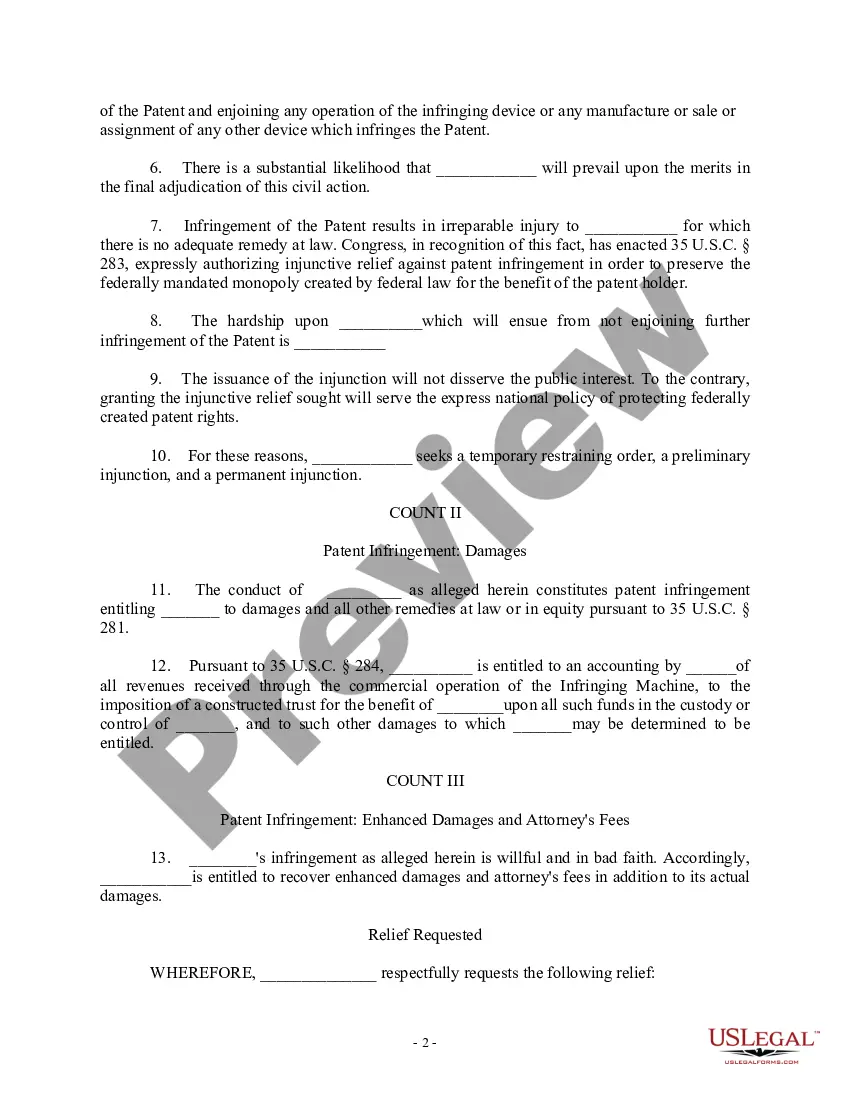
A patent holder must sue the unauthorized party in federal district court. The patent holder can sue in any federal court where the infringed product is found. Patent lawsuits are time-consuming. Depending on where you live, these suits can take years to get to trial.
Pharmaceutical patents are the backbone of the modern pharmaceutical industry. They allow drug developers to possess exclusive rights in their inventions for a limited period of time. That exclusivity drives innovation and is critically important to a pharmaceutical company's return on investment.
The technical nature of patent litigation means that experiments are often an essential (and sometimes the only) way to prove key aspects of infringement (or, more unusually, invalidity), particularly in life sciences-related cases.
Getting Started in Litigation Your attorney will file a formal complaint in federal court, explaining how the defendant has infringed on your patent. Together with your attorney, you will need to compile evidence of your ownership of the patent and the infringement.