Subrogation Recovery By State In Clark
Description





Get your form ready online
Our built-in tools help you complete, sign, share, and store your documents in one place.
Make edits, fill in missing information, and update formatting in US Legal Forms—just like you would in MS Word.
Download a copy, print it, send it by email, or mail it via USPS—whatever works best for your next step.
Sign and collect signatures with our SignNow integration. Send to multiple recipients, set reminders, and more. Go Premium to unlock E-Sign.
If this form requires notarization, complete it online through a secure video call—no need to meet a notary in person or wait for an appointment.
We protect your documents and personal data by following strict security and privacy standards.

Make edits, fill in missing information, and update formatting in US Legal Forms—just like you would in MS Word.

Download a copy, print it, send it by email, or mail it via USPS—whatever works best for your next step.

Sign and collect signatures with our SignNow integration. Send to multiple recipients, set reminders, and more. Go Premium to unlock E-Sign.

If this form requires notarization, complete it online through a secure video call—no need to meet a notary in person or wait for an appointment.

We protect your documents and personal data by following strict security and privacy standards.
Looking for another form?







Form popularity
FAQ
Yes, you do need to respond to subrogation letters and if you don't, your insurance will likely drop you. Basically, your insurance company is trying to see if someone else was responsible for your injury, for example, maybe you were injured in a car accident, a work injury, or something of the like.
Receiving a subrogation letter can seem problematic, but it does not have to be. Instead, reach out to your car accident attorney immediately to provide a copy of the letter and any information about the claims you made. If you received compensation from the insurance company, do not ignore this letter.
It is fair and reasonable to provide the customer with a waiver, if the customer's insurer waives subrogation against you as well, but I would not agree to it if it were only in the customer's favour. It is shifting customer risk from it and its insurer to you.
If you are injured in an accident in Nevada, subrogation laws prevent you from getting a double financial recovery from 1) your insurance company and 2) the at-fault party. Therefore if your insurance company pays for all of your damages, you cannot then sue the negligent party that injured you for those same damages.
Insurance companies don't have forever to make a subrogation claim. While the statutory limitations period can vary depending on the type of subrogation claim made—and in which jurisdiction it is made—the standard statute of limitations ranges from one to six years.
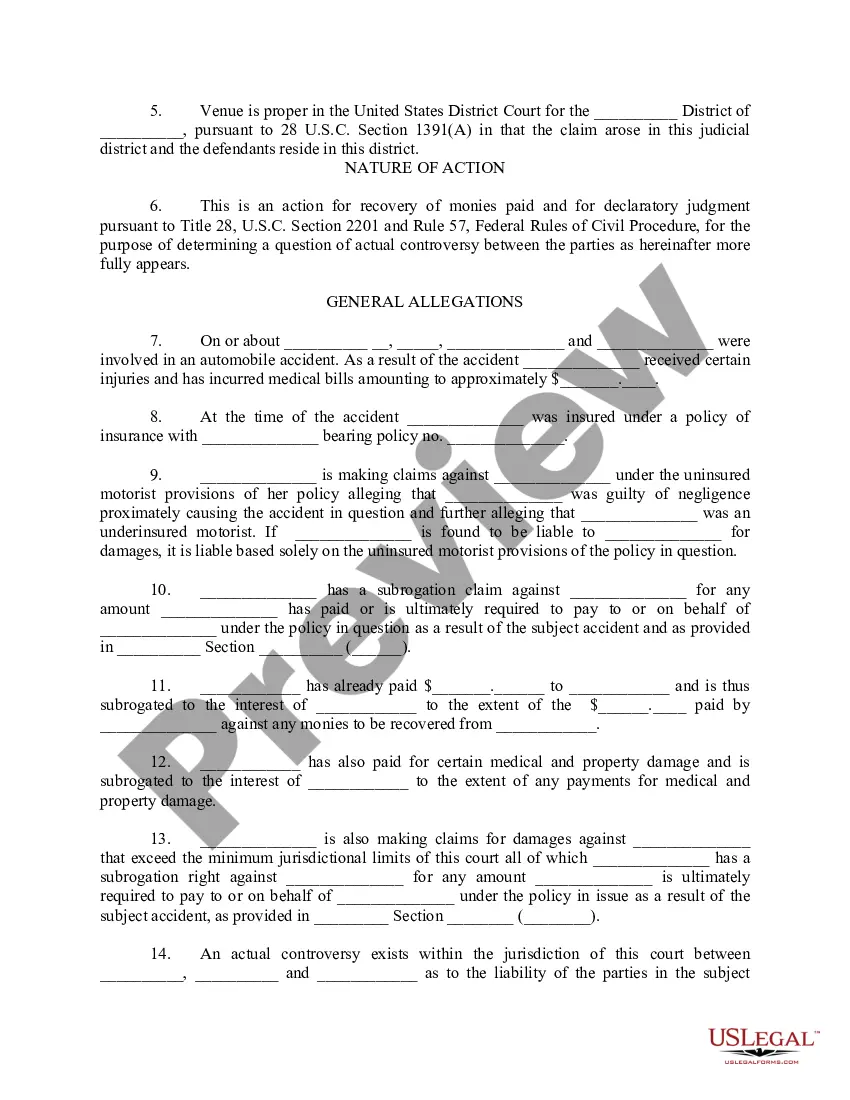
When you file a claim, your insurer can try to recover costs from the person responsible for your injury or property damage. This is known as subrogation. For example: Your insurance company pays your doctor for your treatment following an auto accident that someone else caused.
Those states are: Arizona. Connecticut. Kansas. Missouri. New Jersey. New York. North Carolina. Virginia.
Statute of limitations Insurance companies generally have two (2) years from the date of your injury to seek subrogation.
When factoring comparative negligence and improper referrals, the recovery rate should be somewhere in the range of 85-90%. This requires adjusters properly identifying subrogation, assessing comparative negligence and pursuing only what they are entitled to.
