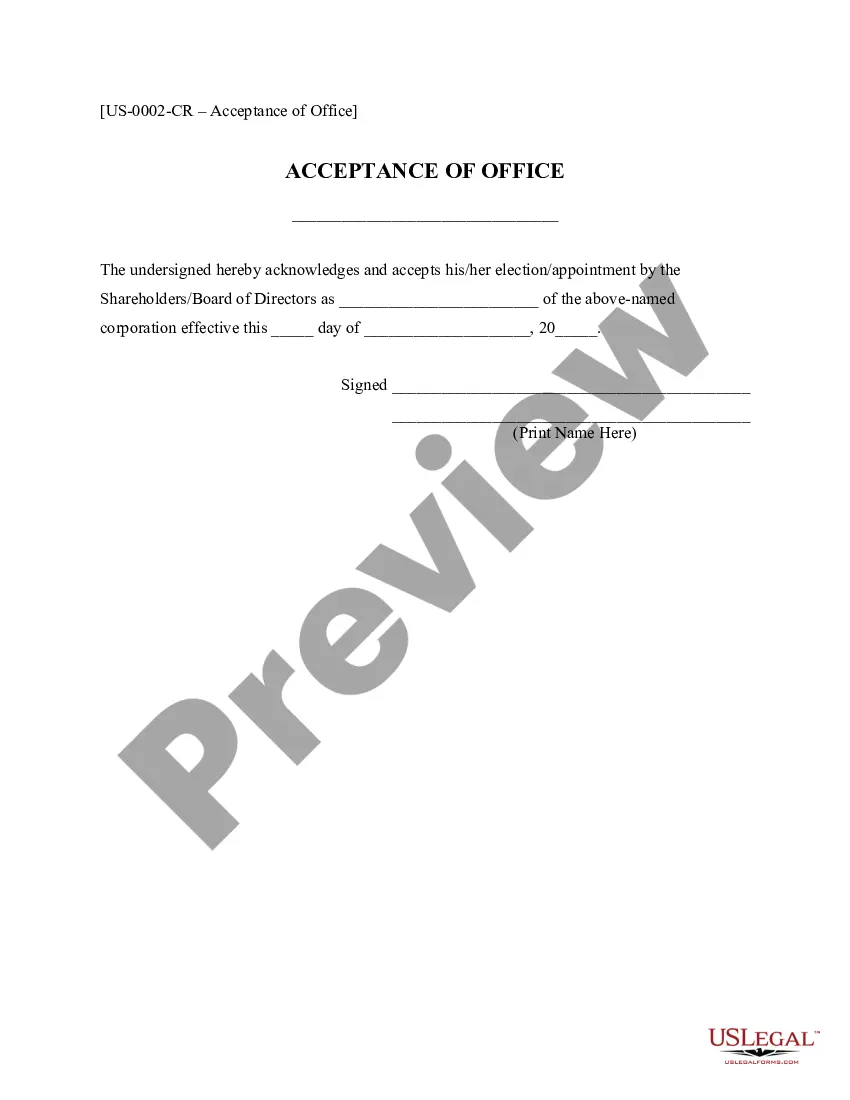
Acceptance On Appointment In Minnesota
Description

Get your form ready online
Our built-in tools help you complete, sign, share, and store your documents in one place.
Make edits, fill in missing information, and update formatting in US Legal Forms—just like you would in MS Word.
Download a copy, print it, send it by email, or mail it via USPS—whatever works best for your next step.
Sign and collect signatures with our SignNow integration. Send to multiple recipients, set reminders, and more. Go Premium to unlock E-Sign.
If this form requires notarization, complete it online through a secure video call—no need to meet a notary in person or wait for an appointment.
We protect your documents and personal data by following strict security and privacy standards.

Make edits, fill in missing information, and update formatting in US Legal Forms—just like you would in MS Word.

Download a copy, print it, send it by email, or mail it via USPS—whatever works best for your next step.

Sign and collect signatures with our SignNow integration. Send to multiple recipients, set reminders, and more. Go Premium to unlock E-Sign.

If this form requires notarization, complete it online through a secure video call—no need to meet a notary in person or wait for an appointment.

We protect your documents and personal data by following strict security and privacy standards.
Looking for another form?






Form popularity
FAQ
Minnesota law does not set a specific timeline for settling an estate, but it generally should be done as "expeditiously and efficiently as is compatible with the best interests of the estate." Delays can result in additional expenses and even legal repercussions for the executor.
11.01Signature Every pleading, written motion, and other similar document shall be signed by at least one attorney of record in the attorney's individual name, or, if the party is self-represented, shall be signed by the party.
Minnesota law does not set a specific timeline for settling an estate, but it generally should be done as "expeditiously and efficiently as is compatible with the best interests of the estate." Delays can result in additional expenses and even legal repercussions for the executor.
Rule 804 includes those exceptions to the hearsay rule that are conditioned upon a showing that the declarant is unavailable. As with the exceptions in Rule 803 the requirements of relevancy (Article 4) and firsthand knowledge (Rule 602) must be satisfied.
In general, executors and administrators have one year from the date of their appointment to distribute the estate to beneficiaries. That said, many estates are complex and cannot be settled within a one-year timeframe.
Rule 125. Filing with the clerk of the appellate courts may be accomplished by one of the following means: (1) By use of the appellate courts' electronic filing system if required by an order of the Minnesota Supreme Court. C. By hand delivery to the clerk of the appellate courts or use of a commercial courier service.
If your personal property exceeds $75,000 or you own real estate in your name alone, your estate must be probated.
The informal probate process is initiated by filing an application with the probate court. In some counties, you must file the application in person. If the probate registrar determines the application is complete, the registrar will issue a statement of probate and appoint a personal representative.
Apply or Petition for appointment as Personal Representative. Although a Personal Representative (PR) may be nominated in a Will, he or she does not actually become the Personal Representative until they are appointed by the court as part of a process known as Probate.
If you die without a will, Minnesota's inheritance laws will control how your estate will be divided. Your property will go to your spouse or closest relatives. If you have a spouse and children, the property will go to them by a set formula.

