Trim Carpentry Price List For Cleaning Services
Description

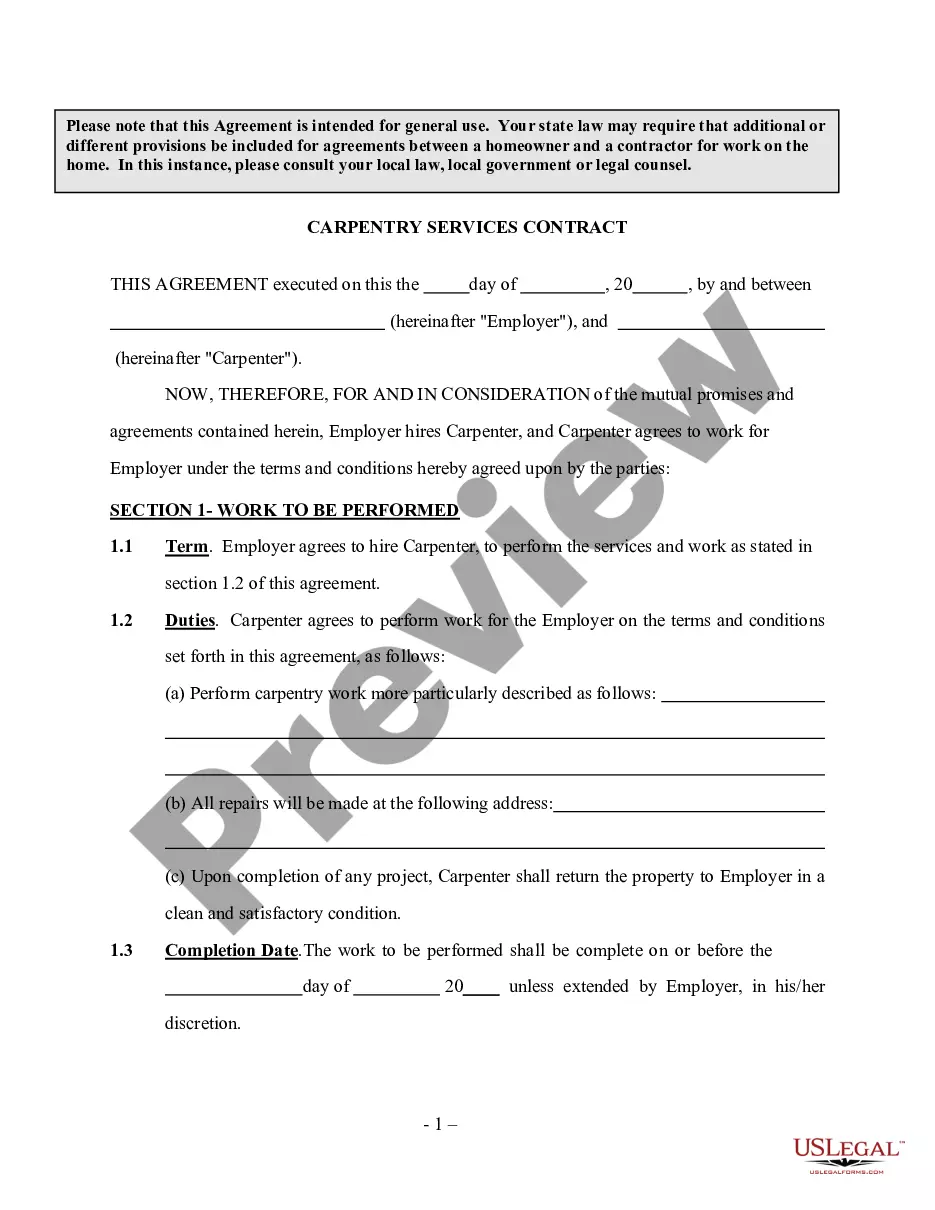
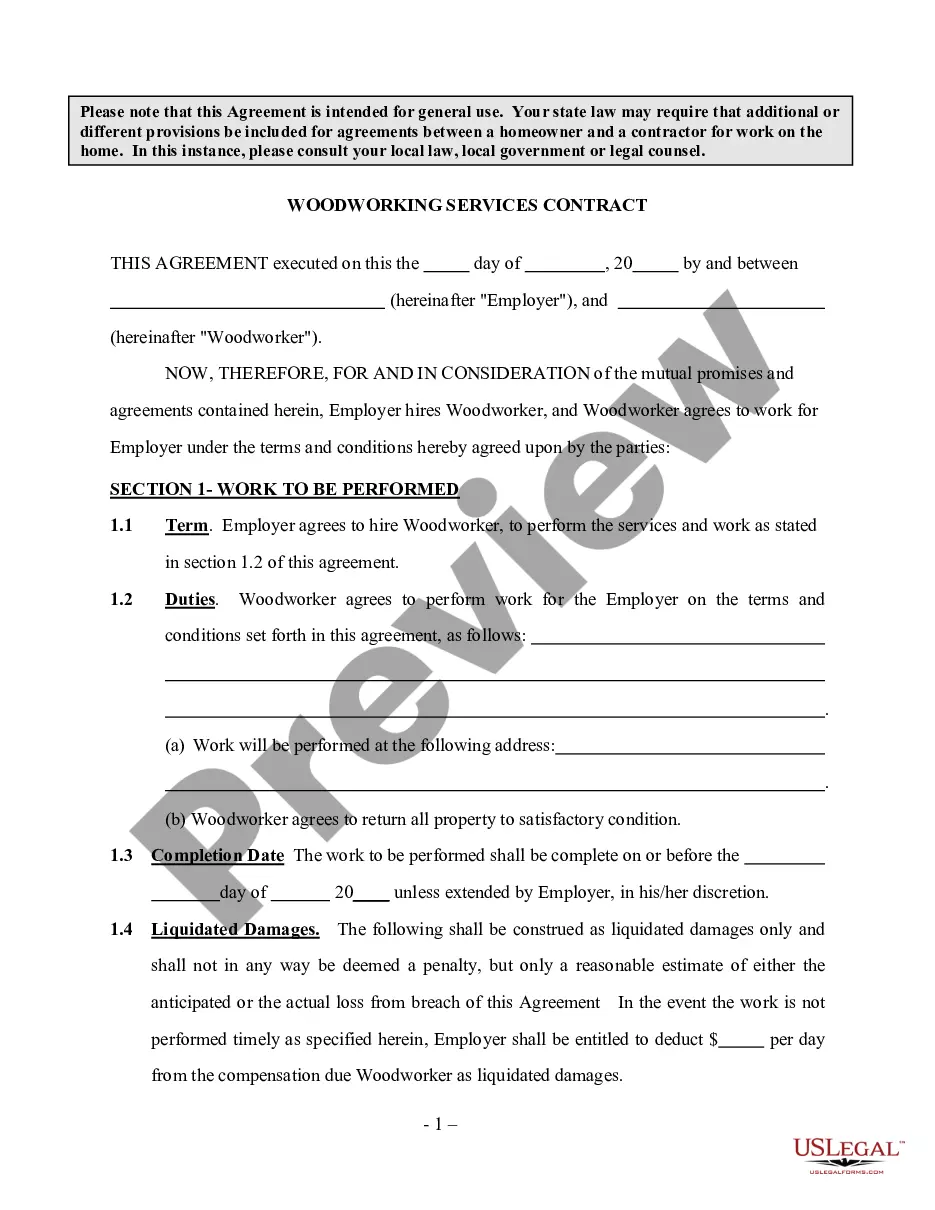
Get your form ready online
Our built-in tools help you complete, sign, share, and store your documents in one place.
Make edits, fill in missing information, and update formatting in US Legal Forms—just like you would in MS Word.
Download a copy, print it, send it by email, or mail it via USPS—whatever works best for your next step.
Sign and collect signatures with our SignNow integration. Send to multiple recipients, set reminders, and more. Go Premium to unlock E-Sign.
If this form requires notarization, complete it online through a secure video call—no need to meet a notary in person or wait for an appointment.
We protect your documents and personal data by following strict security and privacy standards.

Make edits, fill in missing information, and update formatting in US Legal Forms—just like you would in MS Word.

Download a copy, print it, send it by email, or mail it via USPS—whatever works best for your next step.

Sign and collect signatures with our SignNow integration. Send to multiple recipients, set reminders, and more. Go Premium to unlock E-Sign.

If this form requires notarization, complete it online through a secure video call—no need to meet a notary in person or wait for an appointment.

We protect your documents and personal data by following strict security and privacy standards.
Looking for another form?










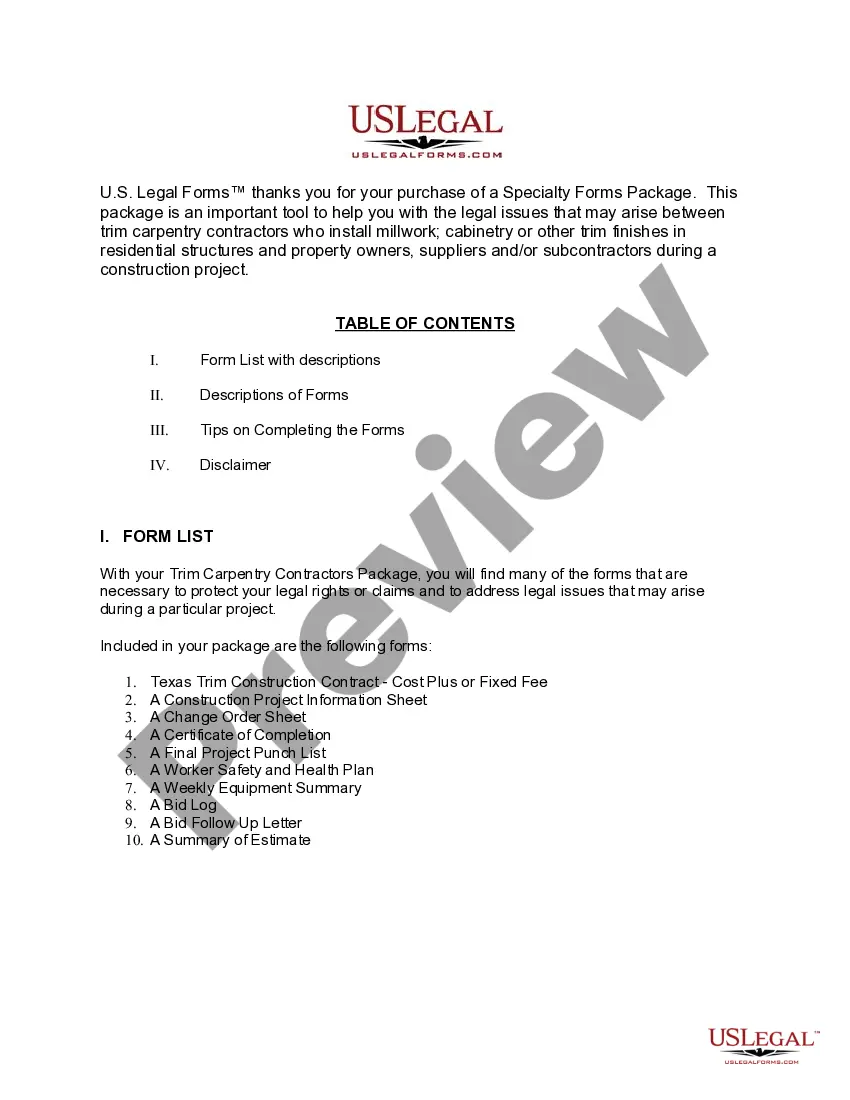
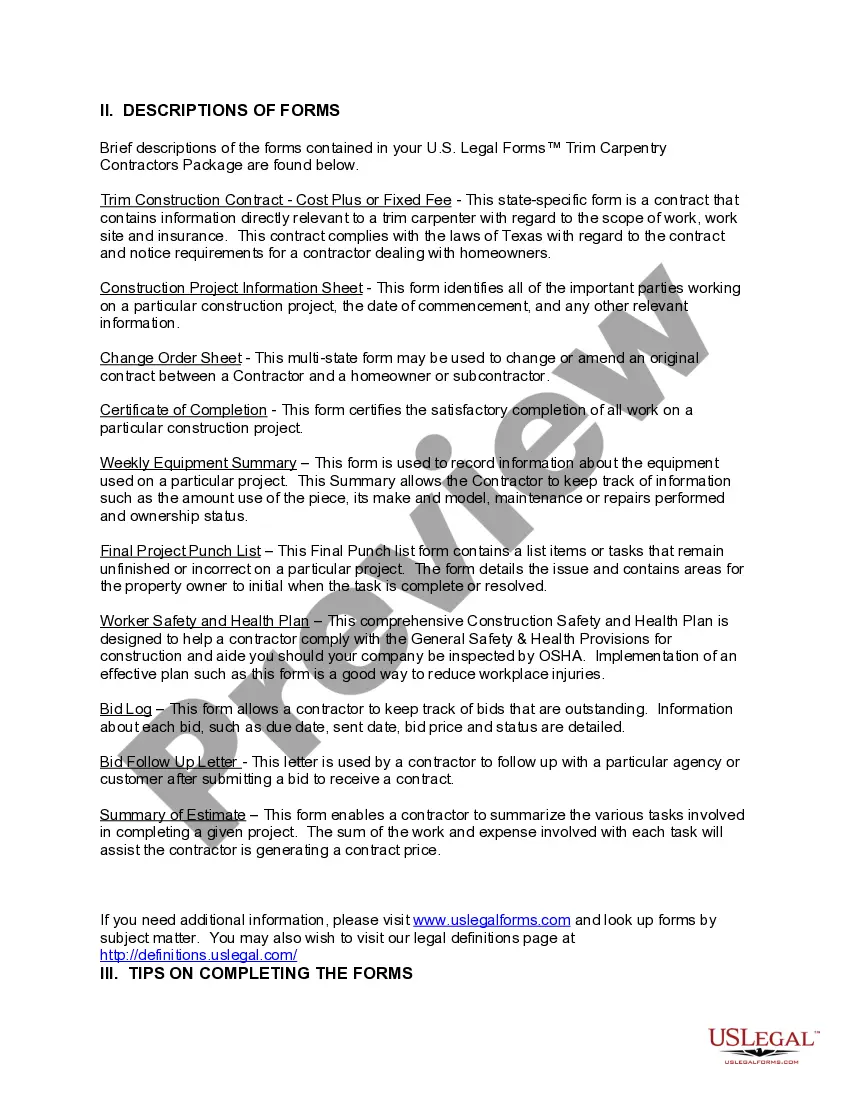
How to fill out Texas Trim Carpentry Contractor Package?
Managing legal documents and protocols can be an exhausting enhancement to your daily routine.
Trim Carpentry Rate Sheet For Cleaning Services and similar documents usually necessitate you to search for them and comprehend how to fill them out correctly.
Thus, whether you are addressing financial, legal, or personal affairs, utilizing a comprehensive and functional online repository of documents on hand will greatly benefit you.
US Legal Forms is the premier online platform for legal templates, offering over 85,000 state-specific documents and a variety of tools to help you complete your paperwork effortlessly.
Is this your first experience with US Legal Forms? Sign up and establish a free account in a few moments, and you will gain access to the document repository and Trim Carpentry Rate Sheet For Cleaning Services. After that, follow the steps outlined below to complete your document: Be sure you have identified the correct document by utilizing the Review feature and examining the document description. Click Buy Now when you are ready, and choose the monthly subscription option that meets your requirements. Click Download, then complete, sign, and print the document. US Legal Forms has 25 years of experience assisting users with their legal documents. Locate the document you need today and streamline any process without difficulty.
- Browse the collection of relevant documents accessible to you with a single click.
- US Legal Forms provides state- and county-specific documents available for download at any time.
- Protect your document management processes by using a reliable service that enables you to create any form within minutes without additional or hidden charges.
- Simply Log In to your account, find Trim Carpentry Rate Sheet For Cleaning Services and download it instantly from the My documents section.
- You can also retrieve previously saved documents.
Form popularity
FAQ
While both trim carpenters and finish carpenters work on the final stages of construction, their focus varies slightly. Trim carpenters mainly handle details like moldings and trim, enhancing visual appeal. On the other hand, finish carpenters often deal with more structural elements, including cabinets and furniture installation. Knowing these distinctions can guide you in selecting the right professional for your project, and consulting a trim carpentry price list for cleaning services can help you plan your expenses accordingly.
A trim carpenter specializes in finishing touches that enhance the overall look of a space. They install moldings, baseboards, and window casings, among other elements. Essentially, they focus on the aesthetics of a project, ensuring that everything flows seamlessly together. Understanding their role can help you appreciate the value they add to projects, which is often reflected in a trim carpentry price list for cleaning services.
The price of carpentry services varies based on the complexity of the project and the materials used. Generally, you can expect to see a trim carpentry price list for cleaning services that outlines rates per hour or per project. For more accurate estimates, it's wise to consult local contractors or check online platforms. This will help you budget effectively for your carpentry needs.
Calculating for trim involves measuring the lengths of the areas where the trim will be installed. First, determine the dimensions of each wall or surface that requires the trim. Then, add these lengths together for the total footage needed. To make the most of our Trim carpentry price list for cleaning services, use precise measurements to estimate the required materials and your overall budget effectively.
A contractor who provides services in more than one special skill area must be licensed. Specialty contractors who provide only one special skill are not required to have a state license (except residential roofers).
$128 initial application fee/renewal fee. $120 license fee. $50 examination application. $8 board fee.
Contact the Construction Codes and Licensing Division at 651-284-5034 or dli.license@state.mn.us.
New Construction Warranty Law in Minnesota This law requires builders to provide a written warranty covering certain defects in materials and workmanship for one year after the building's sale. The warranty also covers major construction defects for ten years after the sale.
Companies that expect to file gross revenue receipts of over $15,000 for the calendar year need to be licensed. Companies that do not expect to bring in $15,000 in revenue must file an affidavit with the state. Contractors that work in one field, such as masonry, do not need to get a license.
You don't need a license if: You're an employee of a licensed contractor or a subcontractor who doesn't work directly with the homeowner. Your work is limited to buildings with more than four units. You're working on a property you own and don't plan to sell.